Yibin man returns home to start a business developing specialty ecological farming, boosting fellow villagers' incomes
On January 4, a rare warm winter sun shone as, looking down from the watershed of Fenshui Village in Nanguang Town, Cuiping District, Yibin, stretches of boundless, lush green bamboo and trees made people feel especially relaxed and cheerful. Up close, flocks of free-range silkie chickens, native chickens, black phoenix chickens, partridge chickens and pheasants under the woods were full of life. Wang Gang, head of the Jiangdigou Planting and Breeding Professional Cooperative, was feeding the chickens ranging under the forest with corn. "Chicken manure fertilizes the grass, the green grass fattens the native chickens, and Fenshui Village is rich in mountain forest resources, so we live off the mountain and also nurture it..." Wang Gang said, calling the chickens to eat while cheerfully explaining his green circular economy.
Returning home to start a business
Learning techniques and exploring the market
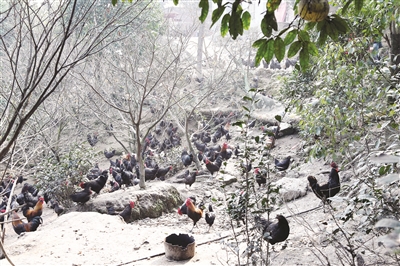
In 2011, after more than ten years of working away from home as a migrant worker in Beijing, Wang Gang, having spotted the opportunity in ecological farming, resolutely gave up a well-paid job and returned to his hometown of Nanguang Town, preparing to use the area's rich under-forest resources to develop a farming business. Through more than half a year of field visits to various places and training courses, Wang Gang mastered chicken-raising techniques and invested 200,000 yuan in raising native chickens, pheasants and other breeds under the forest. Today the chicken farm has begun to take shape, with an annual output of nearly 2,000 native chickens, pheasants and other birds. Driven by him, Fenshui Village now has 4 large-scale farming households and has established three planting and breeding professional cooperatives. Wang Gang provides villagers with chicks and guidance on farming techniques, and at present more than half the households in the village keep more or fewer free-range native chickens.
Targeted poverty alleviation
Strengthening Party building to promote economic development
Wang Xinghui, secretary of the Party branch of Fenshui Village, told reporters that because Fenshui Village is fairly close to the urban area, the Yichang Road runs through the village. Many villagers work short-term jobs elsewhere, and last year, affected by the overall economic environment, their income from working fell, so the village considered supporting villagers' income growth through industrial development. By strengthening Party building to drive economic development, and using the "Party branch + professional cooperative" model to lead the whole village to prosperity together, the branch seeks preferential policies and the professional cooperative integrates farming and breeding households. Last year, the village's targeted poverty alleviation work, relying on developing planting and breeding, lifted 23 poor households out of poverty, and the village's per capita annual income reached more than 12,000 yuan. This year, efforts in targeted poverty alleviation will be increased to lift all poor households out of poverty.
Centering on the core of Nanguang Town's happy and beautiful new village construction - helping farmers increase income and escape poverty - the village has formulated a development plan of "one line, two areas" in light of local conditions. Along the Yichang tourist highway, farmhouses focusing on leisure, entertainment and fishing will be developed, while on the mountain, crop-and-livestock circular farming focusing on growing vegetables and fruits and raising native chickens, cattle, sheep and pigs will be developed, increasing villagers' income through the real economy and agricultural development in a more stable and sustainable way.
Giving play to advantages
Purely natural, safer to eat
Two-thirds of Fenshui Village is mountain forest. Relying on abundant forest land resources to develop under-forest economy, and using the advantages of under-forest land and shade to engage in planting and breeding, is a major feature of the village's ecological agriculture. Fenshui Village lies near the Yangtze River, and the whole village has a forest coverage rate of 70%, with fresh air, a beautiful environment and no industrial pollution. The native chickens raised under the forest are kept completely free-range in a purely natural way from hatching to market; the chickens usually forage among the trees and are fed mainly corn and wheat bran, with no additives at all - purely ecological farming. Thanks to the village's excellent natural environment, the chickens raised under the forest are very active and eat a lot, and are extremely unlikely to suffer disease outbreaks during growth; no antibiotics are used, and after cooking the meat is tender and delicious. However, they take more than 5 months longer to reach market weight than confined chickens, and their egg-laying rate is only 40%.
Wang Gang believes that native chickens and native eggs raised this way have higher nutritional value and are truly pollution-free green food. As people pay more and more attention to healthy eating, native chickens and native eggs are increasingly welcomed by consumers; native chickens sell for 18 yuan per jin, and pheasants for 35-40 yuan per jin. At present, sales rely only on tourists coming to buy after hearing about the farm and on repeat customers. Next, Wang Gang will consider expanding into e-commerce, hoping that more city residents can taste truly authentic native chickens, pheasants and eggs right at their doorsteps.
At present, nearly 20,000 native chickens and pheasants in the village, along with ecologically raised pigs, cattle and sheep, have reached market age, and Fenshui Village's beautiful natural scenery and various green vegetables and fruits await city residents to come and experience picking them.