Liu Xiaoying, the "leading goose" of poverty alleviation: to get rich, the first thing is to break the mindset of waiting, depending and asking
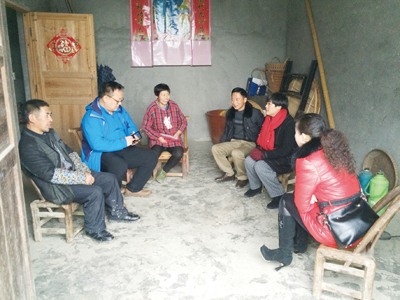
Liu Xiaoying (second from right) visits a farmer's home.
On January 8, Huazhishan Village, Tunbao Township, Enshi City, Hubei.
After the car rounded several "S" bends along the steep, muddy mountain road, the large tea plantation of Liu Xiaoying's Huazhishan Organic Tea Professional Cooperative finally appeared before our eyes. Below the mountain, the Qingjiang River winds like a ribbon; in the distance, the mountains are shrouded in mist and clouds, presenting a scene of tranquil pastoral beauty.
Seeing Liu Xiaoying, Liu Yuanzhen, a poor household in the Mianziwan group, and her husband came out of the house to greet her. Almost everyone in the village knows Liu Xiaoying well; on the way up the mountain, people kept greeting her along the road.
Liu Yuanzhen has a disabled hand, and her husband contracted pneumoconiosis while working away from home, so neither of them has much capacity for labor. When they used to rely on growing corn and potatoes, the family could barely secure enough food and clothing, and they also fell into a pile of debt, until they joined Liu Xiaoying's tea cooperative three years ago.
"We grow two mu of tea, and the cooperative provides fertilizer free of charge every year. Our annual income is about four to five thousand yuan," Liu Yuanzhen said. "The main problem is that we lack labor strength and cannot work hard. Also, tea has a growth cycle, so our income is still not much at present."
"When you really cannot manage it all, we will find a solution together," Liu Xiaoying comforted Liu Yuanzhen. Hearing that her daughter was still working away from home, she also invited the child to come and work at the cooperative.
In Huazhishan Village, many families have had experiences similar to Liu Yuanzhen's. Before 2009, all 280 households in Huazhishan Village lived on steep slopes at an altitude of 450 m to 1,100 m. They lived in earth-walled tile-roofed houses built in the 1970s, grew traditional crops such as corn and potatoes, and there was no road leading down the mountain. Although the area has beautiful natural scenery and is only a dozen or so kilometers from the main urban area of Enshi City, the village's per capita net income was less than 2,000 yuan, and 80% of farming households were in poverty. Walking into the village, it felt as if time had returned to the 1980s. At the time, local authorities also did a great deal of work to help villagers escape poverty, but because infrastructure construction lagged behind and there was a lack of leadership from a leading enterprise, the results were never ideal. The township government once organized villagers to develop 800 mu of tea, but villagers had to walk more than 10 km to sell tea, and the price was not high, so they were not very motivated, and the tea survival rate was less than 30%. All of this finally began to change after Liu Xiaoying arrived.
In 2009, with the assistance of the Huazhishan Village Committee, Liu Xiaoying invested more than 2 million yuan to establish the Huazhishan Ecological Tea Processing Company and the Organic Tea Professional Cooperative. Adopting the model of "company + cooperative + base + farming households," the cooperative recruited farmers to join, encouraging everyone to change the traditional planting structure and develop high-quality tea.
In order to break the villagers' mindset of waiting, depending and asking, Liu Xiaoying, together with village committee cadres, went door to door doing ideological work. By reasoning things out and calculating the detailed accounts, they finally persuaded 52 villagers to be the first batch to join the cooperative. Liu Xiaoying promised to provide everyone with free technical support and all-round services, signed protective-price purchase contracts with them, and also implemented share dividends for members and a second round of profit returns, which immediately stirred everyone's enthusiasm. In order to improve members' tea-growing techniques and the scientific and technological content of tea garden management, the cooperative specifically hired experts from elsewhere to provide members with professional technical guidance, and also formed its own professional technical team. In order to ensure efficient and safe tea cultivation, help members reduce input and increase efficiency, the cooperative also unified the procurement and distribution of fertilizers and pesticides, formulated technical standards for their application, and advanced more than 1 million yuan in procurement funds every year.
Over several years, the cooperative grew from nothing and from small to large. The number of members increased from the initial 52 to more than 500, and the tea garden area expanded from the original more than 300 mu to more than 2,000 mu now. In the whole village, 95% of farming households have planted tea, and both output and income per mu have increased substantially. Since 2009, through tea cultivation, the cooperative has brought members a cumulative income increase of 23 million yuan. The living environment and quality of life of most members have undergone qualitative changes. In the whole village, 240 households have moved into small brick-concrete buildings with ethnic characteristics, and mountain spring tap water reaches every household. In 2015, the per capita net income of Huazhishan Village was expected to exceed 8,000 yuan, with nearly 60 large households earning 50,000 yuan, and the cooperative was also awarded honors such as "National-Level Demonstration Cooperative" and "All-China Women's Federation Women's Science and Technology Demonstration Base."
"In recent years, we have also allocated more than 500,000 yuan to assist disadvantaged households among our members, supported 160 generally poor member households, and for especially poor member households, there are even more assistance policies every year," Liu Xiaoying said. Having experienced poverty in childhood herself, she knows how difficult life is for poor rural households. In recent years, while the cooperative has continued to develop and grow, it has always regarded poverty alleviation as a responsibility and obligation. "When helping, we consider the different circumstances of each household. For those with little land and poor labor capacity, we arrange for them to help others pick tea, or rent out their land. For those with especially poor conditions, the company rents the land and gives it to specialized households to cultivate."
Liu Xiaoying said that in recent years, more than 100 poor households in Huazhishan have escaped poverty through the cooperative, and for the remaining poor households, the cooperative will, as always, serve as the main force in targeted poverty alleviation. At present, for the tea-growing households among the village's 56 targeted poverty alleviation recipients, the cooperative has implemented paired assistance by cooperative management personnel, with responsibility assigned to specific people, and has formulated a targeted, operational and effective targeted poverty alleviation plan, including providing 400,000 tea seedlings free of charge, carrying out free unified pruning, providing organic fertilizer free of charge, and implementing premium-price purchases, so as to effectively solve the practical difficulties poor households face in investing in tea garden management.
"We will strive, through two to three years, to make the targeted poverty alleviation recipients not only escape poverty but also become prosperous, and fundamentally change their current situation. We will make Huazhishan Village a moderately prosperous new rural village with flourishing industry, thriving rural tourism, a beautiful environment and prosperous villagers."