Planting navel oranges on 300 mu, with an annual income of 400,000 yuan
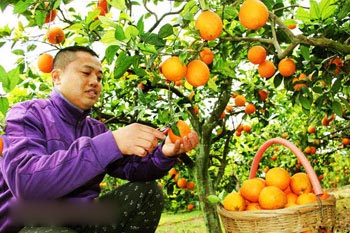
Pang Sheng said, "Xifeng navel orange" made his entrepreneurial dream come true
Gazing at the abundant golden fruit covering the branches all over the mountain; watching truck after truck loaded with navel oranges drive away from the orchard; counting the wads of cash tucked into his pocket, Pang Sheng was filled with surging emotions and endless reflections. Having had a first taste of success, he felt even more confident about building his own "sweet" career on the abandoned rural land.
This former armed police "soldier boy," deeply attached to his native land, gave up a highly profitable medicinal herb business, returned to his hometown to contract 300 mu of abandoned land, and became a genuine "farmer" living alongside the soil. "Digging gold from the soil" nearly cost him his entire 700,000 yuan investment, and his entrepreneurial journey was full of twists and turns. Last year, the "Xifeng navel orange" made his entrepreneurial dream come true.
After retiring from the military, he went to the coastal areas to work. His first fortune came from the medicinal herb business
Pang Sheng, 36 years old this year, is a villager of Rongping Village, Fenghe Township, Xichong County. At the age of 19, he left his parents and became an armed police soldier. He retired in the winter of 2004 and went to the coastal areas to work.
He had served as an armed police soldier, worked as a security guard, worked as an electrician, and also engaged in the medicinal herb business. Through 7 years of effort, he returned to his hometown with more than 700,000 yuan in cash and a passion for his native land, to build his own career.
"When I was working as a security guard, a boss thought highly of me and taught me the medicinal herb business." Pang Sheng said that in 2004 he went alone to Guangzhou, and relying on the skills he had developed in the military and his own honesty, he won the boss's trust and, in less than a year, accumulated the first fortune of his life.
Pang Sheng clearly remembers that when he first started the medicinal herb business, sometimes he had to travel to many places in a single day. Selecting, transporting, shelving, and selling often left him so exhausted that his legs and feet felt weak, and he would fall asleep the moment he got home. At first he dealt in finished medicinal herbs, then gradually moved into semi-finished products or raw material processing. In order to save costs, earn more money, and ensure quality, Pang Sheng always did his utmost in whatever he could handle himself, even personally slicing, air-drying, and oven-drying the medicinal herbs.
Returning home to start a business in agriculture, partnering with others to contract 300 mu of wasteland
"Very few people farm the land, and many fields are overgrown with weeds, so I decided to come back and farm." Pang Sheng said that when he returned home for the Spring Festival in 2011, he felt very uneasy seeing more and more rural land lying abandoned. Without obtaining his family's consent, he partnered with others to contract 300 mu of abandoned land in the village and started growing crops.
"At first I didn't know what was best to plant." Pang Sheng said that he had not farmed for many years and did not know what to plant to make money. Drawing on his experience in the medicinal herb business, he mainly planted Chinese medicinal herbs such as Polygonatum, honeysuckle, and Forsythia on different plots, and also planted conventional crops such as radishes. "I started diversified operations, using the output value of radishes to pay expenses, while the output value of medicinal herbs was pure profit." He said the initial investment in land rent, purchasing agricultural supplies, and labor was nearly 300,000 yuan. Plans cannot keep up with changes. Just as Pang Sheng was dreaming of success, cruel reality dealt him a "heavy blow to the head" and tore his dream to shreds.
Pang Sheng and the orchard
Medicinal herbs withered and crops were stolen. Planting Xifeng navel oranges brought hope
Recalling the early days of his business, Pang Sheng could no longer hide his inner pain, tears welling up in his eyes. He said in a choking voice, "I never expected that the Forsythia would fail to bear fruit, that almost all the honeysuckle seedlings would wither and die, and that the radishes, which looked ready to sell, would be stolen until hardly any were left by the time they ripened."
Pang Sheng, deeply attached to his native land, had originally wanted to accomplish something on the land. Now there was big trouble. His family, who had not supported him in the first place, strongly demanded that he give up, and even his partners asked to withdraw their capital. One blow after another made this taciturn man shut himself in a room for a full month. Afterward, he still did not give up and busied himself alone in the 300 mu of farmland, weeding, loosening the soil, and fertilizing...
"Seeing how hard he worked and how he persevered, I had no choice but to support him." Pang Sheng's wife, Ma Lingli, said that at first she did not support Pang Sheng's farming, so she worked away from home alone. When she heard that Pang Sheng's business had failed, she called many times, but Pang Sheng did not answer. Worried that something had happened to him, Ma Lingli made a special trip back to see him. In the farmland she saw that Pang Sheng was dark and thin, with calluses on both hands, and the couple held each other and wept bitterly in the empty valley.
With his family's support, Pang Sheng worked even harder. During these 5 years, he invested nearly 700,000 yuan in total. The earlier projects involving medicinal herbs and conventional crops failed one after another, and only the Xifeng navel orange brought him hope.
A bumper harvest of 300 mu of Xifeng navel oranges, earning 400,000 yuan through online and offline sales
Rows upon rows of neat navel orange trees were lush and green, with golden navel oranges hanging abundantly and enticingly beneath the leaves. About ten workers were busy under the trees picking fruit, sorting, and packing... Recently, a reporter came to Pang Sheng's Xifeng navel orange base and saw a scene of bumper harvest. By planting Xifeng navel oranges, Pang Sheng turned a weed-covered barren hill into a "treasure bowl" for increasing income.
"It was navel oranges that restored my confidence in farming." Pang Sheng recalled that at the beginning, planting navel oranges was not as easy as he had imagined. He had never specifically studied knowledge in this area, so he could only learn from experienced local growers about weeding, fertilizing, pruning, and applying pesticides to prevent disease. During the day he worked in the orchard, and at night in his spare time he studied fruit-growing techniques.
"Last year, 5,000 trees bore fruit, with an output of 150,000 jin, and finally there was profit." Pang Sheng said happily that this year they could all bear fruit, and some navel oranges had also entered the full-production period, with output increasing year by year.
Through 5 years of exploration, he developed understory economy in the 300 mu of navel orange trees according to the plots, interplanting Chinese medicinal herbs such as Pinellia and Polygonatum under the navel orange trees. "These Chinese medicinal herbs can reduce pests and diseases in navel oranges, save costs such as manual weeding and pesticide application, and increase the land's output value." Pang Sheng said that he had already trial-planted this intercropping, and the effect was very obvious. Interplanting Pinellia per mu would increase income by 5,000 yuan, and interplanting Polygonatum per mu would increase income by 10,000 yuan. This not only improved the quality of the navel oranges but also reduced cost expenditures, thereby increasing land utilization.
In addition, as the 300 mu of Xifeng navel oranges successively bore fruit, Pang Sheng was already actively thinking of ways to sell them. Besides individual customers or wholesalers coming to the orchard for on-site picking, he also used e-commerce platforms to carry out direct online sales. "I really didn't expect selling fruit online to be so popular." Pang Sheng said that more than half of his navel oranges had already been sold, and last year's output value would exceed 400,000 yuan. Pang Sheng introduced that through the application of e-commerce platforms and by adopting an interactive online-plus-offline model, online sales were expected to exceed 300,000 yuan.