Sanda Champion Returns Home to Farm Loaches, Becomes "Loach King" and Leads Farmers to Prosperity
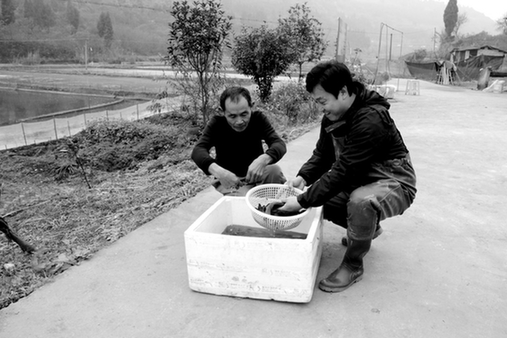
Zhou Chaohua (right) is identifying the sex of loaches with a worker
"Teacher Zhou has brought us a new path to prosperity again!" In early January 2016, after hearing the news that the village's loach farming cooperative had been submitted to the district agriculture committee for approval, the villagers of Tingzi Village, Taihe Town, Hechuan District, Chongqing, were beaming with joy and spreading the word to one another.
The reporter learned that the "Teacher Zhou" mentioned by the villagers is the general manager of Hechuan District Shenghua Aquaculture Co., Ltd. "The loaches have almost all been sold now. We've been clearing the ponds these days, and we'll release new fry in the spring." When the reporter met Zhou Chaohua, he was in the courtyard with workers identifying the sex of loaches.
Sanda Champion Returns Home to Farm Loaches
Born in 1973, Zhou Chaohua is a native of Yubei District, Chongqing, and was once an athlete on the Hunan Hengyang Sanda team. In 1993, he won the championship in the 56 kg category at the Hunan Provincial Wushu Championship. In the second half of 1994, because a hand injury prevented him from competing further, he went to the Hunan Qidong Wushu Academy to work as a coach. During his teaching years, he fell in love with Guo Li (a native of Taihe Town in our district), who was also a coach. In 2004, the two resigned and returned to Yubei to marry and start a business. After returning to Chongqing, Zhou Chaohua sold clothing and ran a small food business. Although business went fairly smoothly, he was always thinking about giving his family a better life.
Believing that loach farming had good prospects, Zhou Chaohua specially studied loach farming techniques. After completing his training, he went to Dianjiang, Changshou and other districts and counties to conduct surveys, but found no site suitable for loach farming, so the matter was once shelved.
At the end of 2010, when Zhou Chaohua and his wife visited relatives in Taihe Town, they discovered that Taihe Town had abundant water resources, flat terrain and convenient transportation, making it very suitable for loach farming. So he went to the Taihe Town Agricultural Service Center for consultation, and ultimately chose the site in Tingzi Village, Taihe Town. After some preparations, Zhou Chaohua began his journey into loach farming.
Setbacks Do Not Stop Him; He Raises Funds and Starts Over
In early 2011, Zhou Chaohua invested more than 400,000 yuan in introducing breeding stock, buying feed and contracting loach ponds. Under Zhou Chaohua's careful management, the loach farming was very successful. As the 5,000 kg of farmed loaches were about to go on the market, Zhou Chaohua and his family were overjoyed. In September of that year, Hechuan suffered a flood, and more than 4,000 kg of the loaches that were originally planned to be sold around National Day were washed away by the floodwaters, resulting in a direct loss of more than 300,000 yuan.
Years of savings were washed away. Looking at the mess of the loach ponds after the flood, Zhou Chaohua wanted to cry but had no tears. But he was not defeated by the difficulties. Before long, Zhou Chaohua borrowed money everywhere and began repairing the field embankments and buying fry.
In 2012, he and his partner He Yousheng invested more than 600,000 yuan, contracted another 25 mu of ponds in Group 10 of Tingzi Village, and established Hechuan District Shenghua Aquaculture Co., Ltd., expanding the farming scale. Before National Day that year, the 10,000 kg of loaches they farmed finally went on the market.
Zhou Chaohua's loach farming uses ecological farming and self-breeding and self-raising techniques. "The self-breeding and self-raising technique for loaches is something we developed through exploration. At present, very few farmers in Hechuan and surrounding areas have mastered this technique," Zhou Chaohua said.
At present, some farmers' loach breeding techniques are not mature, and the phenomenon of "inch-fry death" often occurs (that is, loaches die in large numbers before they grow to three cm). Most loach farmers in Sichuan and Chongqing mainly buy fry to raise, and very few breed and raise their own, while purchasing fry requires relatively high farming costs. To reduce farming costs, self-breeding and self-raising must be achieved.
Zhou Chaohua successively visited Sichuan, Jiangsu, Hubei and other provinces to learn from others, and consulted relevant materials, successfully achieving self-breeding and self-raising of loaches. "The new type of incubation barrel we developed can hatch 4.5 million loaches at a time." According to Zhou Chaohua, in addition to self-breeding and self-raising, the farming base also adopts an imitation-ecological farming model, implementing soil-based farming and using photosynthetic bacteria to regulate the microecological balance of the water body, extend the water-changing cycle, reduce the incidence of loach diseases, and thereby lower farming costs.
In 2014, He Yousheng withdrew his shares to pursue other development. Zhou Chaohua became general manager of Shenghua Aquaculture Co., Ltd. and expanded the farming base to 50 mu. Today, his farming base raises green loach, large-scale loach (Paramisgurnus dabryanus), ricefield eel and others, gradually building a loach industry chain from fry breeding, adult loach farming, and sales of fry and adult loaches. In March 2015, he also introduced the Taiwan eel loach, which has a shorter growth cycle, a low feed coefficient and a high feed conversion rate.
Expand the Industry and Help Farmers Get Rich
The loaches farmed by Zhou Chaohua are sold to aquatic product wholesale markets in Hechuan and Chongqing, and often demand exceeds supply. In 2014, the output value of the farming base reached more than 2 million yuan, and in 2015, although prices declined slightly, the output value still reached more than 1.5 million yuan.
At the same time, Zhou Chaohua adopted a company-plus-farmers farming model, purchasing finished products from farmers at protective prices and selling them centrally on the market, driving more than 20 neighboring villagers to develop and prosper together.
Mo Lirong, a villager from Tingzi Village, is one of the beneficiaries. Mo Lirong, who had worked as a carpenter elsewhere for many years, had always wanted to return to his hometown to develop an industry, but suffered from a lack of professional skills. In March 2013, Mo Lirong came to the farming base hoping to learn loach farming techniques. After free training, Mo Lirong, who had mastered the farming techniques, contracted 10 mu of land in the village to farm loaches. Over more than 2 years, the returns were quite good, and in 2014 he also bought a Changan vehicle to facilitate the transport of goods.
Zhou Chaohua's farming base is well known, and nearby villagers and people from other places constantly come to observe and learn. He not only teaches farming techniques free of charge, but also personally goes to the villagers' ponds to provide guidance when there are major problems. He even extends a helping hand to peers in urgent need, helping others tide over difficulties.
Late one night in May 2014, when it was raining heavily, Zhou Chaohua, who had just fallen asleep, was awakened by a knock on the door. It turned out to be a farmer from Tongnan hoping he would immediately rush to Tongnan to help solve the "inch-fry death" problem. Zhou Chaohua set off immediately and arrived at the farmer's home. After 3 days of treatment, the problem was finally solved, saving the farmer a considerable amount of economic loss.
Seeing that the loach farming industry in the village was developing well, Zhou Chaohua then thought of establishing a loach farming cooperative to make the loach industry in Tingzi Village bigger and stronger. At present, the relevant matters have been submitted to the district agriculture committee for approval. "After the cooperative is established, it will provide full services including standardized construction of loach ponds, supply of fry, supply of feed, farming techniques and sales." Zhou Chaohua introduced that as long as one does "regulate a pond of water well and protect a single intestine well," loach farming is very simple. He welcomes people who are willing to farm loaches to visit and learn at his farming base.