Osmanthus-scented rice priced at 3 times that of ordinary rice
Original headline: Octogenarian cultivates osmanthus-scented rice, worth 3 times that of ordinary rice
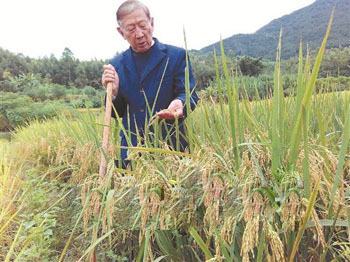
Pan Chengzu often goes to the fields to observe the rice's growth
Have you ever eaten rice with an osmanthus fragrance? Pan Chengzu of Lushan Village, Lefeng Town, Nan'an City, although having only an elementary school education, taught himself and cultivated the high-quality late rice "Meiwan No. 1," which passed technical appraisal and extension by the Nan'an County Science and Technology Commission and the Agriculture Bureau in November 1991. In the autumn of 2011, he successfully cultivated the conventional high-quality late rice "Xiyanghong No. 1," which was confirmed as a "Grade 2 edible indica rice variety" after testing by the Rice Quality Testing Center of the Ministry of Agriculture. His steps did not stop there; in 2013 he cultivated natural osmanthus-scented rice, whose grain quality was affirmed by the Rice Quality Testing Center of the Ministry of Agriculture, with all indicators meeting Grade 1 and Grade 2 standards. Yesterday, reporters visited Mr. Pan to hear the story behind his rice cultivation.
Inspired by bee pollination, he cultivated osmanthus-scented rice
The successful cultivation of "Meiwan No. 1" spurred Pan Chengzu's enthusiasm for breeding. Around 2008, many people in the village kept bees and collected lychee honey. One day in late September of the same year, he found in the fields that a group of bees kept shuttling between the rice paddies and the village's osmanthus trees, collecting both late rice pollen and osmanthus pollen. Based on the principles of crossbreeding, he reasoned: "Through bee pollination, late rice might cross with osmanthus, so could it become a naturally osmanthus-scented rice?"
Pan Chengzu, who had long devoted himself to studying various fragrant rice varieties such as Thai jasmine rice, Heilongjiang Daohuaxiang rice, and Liaoning popcorn-scented rice, began to take a strong interest in cultivating osmanthus-scented rice. "There are one or two dozen osmanthus trees in the village that are decades old, and the season when osmanthus blooms happens to be when late rice blooms," he said. In the autumn of 2009, he deliberately chose the rice "Xiyanghong No. 3," which had been cultivated for more than 20 years, as seed, planted it in the breeding field, and through bee and osmanthus pollination, continuously observed and screened in the field. When the rice was fully headed, he pulled up each rice plant with its roots and soil and brought them home, selecting several hybrid rice plants with a faint osmanthus fragrance to sow again the following year. After 5 years of careful cultivation and screening, he finally cultivated the natural osmanthus-scented rice "Xiyangxiang No. 1" in the autumn of 2013.
Worth 3 times that of ordinary rice, yield per mu expected to rise further
Pan Chengzu said that "Xiyangxiang No. 1" has a plant height of 1 m, a panicle length of 23 cm, 150,000 effective panicles per mu, 150 total grains per panicle, a seed-setting rate of 92.9%, and a 1000-grain weight of 26 g, which is 7 g heavier than the 19 g of other varieties, and the yield per mu can reach 450 kg-500 kg. Osmanthus-scented rice has strong heritability, wide adaptability, is easy to plant, and can resist rice blast and other diseases; its growth period is 138 days, 1 month less than the 168 days of other ordinary varieties.
"Although the yield is not very outstanding, its economic value is 3 times that of ordinary rice varieties." Pan Chengzu said that currently 1 jin of hybrid rice on the market is worth about 3 yuan, while 1 jin of "Xiyangxiang No. 1" is worth 10 yuan to 12 yuan. By this reckoning, 1 mu of hybrid rice with an average yield of 500 kg per mu has a total value of 2,000 yuan, while 1 mu of Xiyangxiang can be worth more than 6,000 yuan, increasing income by more than 4,000 yuan.
Pan Chengzu said that last year he also selected some promising seedlings of Xiyangxiang No. 2 and Xiyangxiang No. 3 that can reach a yield of more than 650 kg per mu, but they currently still fall short on resistance to neck blast; if tested for another 2 years, it may be possible to cultivate Xiyangxiang special rice with a yield of 650 kg per mu.
Multiple indicators reach Grade 1, possibly the first fragrant rice variety in the South
In the inspection report issued in February 2015 by the Rice and Rice Products Quality Supervision, Inspection and Testing Center of the Ministry of Agriculture as provided by Pan Chengzu, the reporter saw that multiple indicators of "Xiyangxiang No. 1," including brown rice rate, milled rice rate, transparency, and gel consistency, reached Grade 1, meeting the quality requirements for ordinary edible long-grain indica rice varieties. He said that after two years of planting observation, the indicators of "Xiyangxiang No. 1," including plant height, panicle length, tillering ability, number of grains per panicle, seed-setting rate, 1000-grain weight, plant uniformity, resistance to the three major rice diseases (rice blast, bacterial leaf blight, and bacterial leaf streak), yield, grain quality, and taste, have all stabilized.
He said that according to his understanding, "Xiyangxiang No. 1" is very likely the third fragrant rice variety in the country; the first is Daohuaxiang from Heilongjiang Province, and the second is japonica rice 1052 from Liaoning Province, also called popcorn fragrance. "Xiyangxiang No. 1" may be the first fragrant rice variety in southern China. During the cultivation process, the Nan'an Municipal Party Committee and Municipal Government, the Municipal Agricultural Office, and the Municipal Science and Technology Bureau allocated funds for support, listing it as a special scientific research project of the Nan'an Municipal Science and Technology Bureau for key support.
Local farmers in Lushan Village who have planted and eaten "Xiyangxiang No. 1" praised the variety with a folk rhyme: "Fragrant at the field edge, fragrant at the threshing floor, even more fragrant when cooked in the pot; after eating it the whole body feels relaxed, and one season's income is much greater (Minnan dialect: much, much more)."
Lei Yanming, head of the Agricultural Technology Station of Lefeng Town, said that "Xiyangxiang No. 1" counts as fragrant rice because its taste has the quality of fragrant rice, but at present the state can only test whether the grain quality is good or bad, and cannot test whether it belongs to fragrant rice, nor can it test the specific aroma type. He said that fragrant rice is cultivated in small amounts in various places and cannot be promoted on a large scale because it is a conventional variety and is prone to mutation. (Reporter Wu Zhiming/text, Pan Chengzu/provided photos)