Young man returns home to start a business in courier services, gains Alibaba incubation support
Original title: How to get rural e-commerce going
-- Exploration and practice from Yuanqu, Shanxi
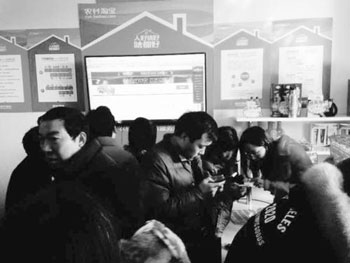
Inside a rural Taobao village-level service station (file photo source: Shanxi News Network)
In June 2015, Liu Jinhui, a young woman working away from home, heard that her hometown Yuanqu County in Shanxi Province was going to build Taobao service stations in villages and was recruiting partners to join. She was somewhat tempted but also hesitant: rural e-commerce was a fresh and fashionable sunrise industry, and she could use this platform to start a business. But e-commerce depends on consumption volume and logistics capacity, and whether rural areas far from cities could make it work was still worth pondering.
On January 6, the Yuanqu County rural e-commerce and Alibaba rural Taobao project officially launched. The first batch of county-level warehousing and logistics, service centers and 30 village-level service stations opened at the same time. Liu Jinhui got her wish and became a partner of the Rui Village Taobao service station. On opening day, more than 100 orders and a transaction volume of nearly 50,000 yuan gave her reassurance.
Weren't Liu Jinhui's original concerns exactly the same difficulties facing other rural e-commerce ventures?
Connecting consumption and logistics at the county and township levels is the "last kilometer" for bringing online goods to the countryside and agricultural products to the cities, and it is also becoming the breakthrough point for the government and e-commerce enterprises in developing rural e-commerce. From the cooperative practice between Yuanqu County and Alibaba, it may be possible to discover the development code of current rural e-commerce.
Choosing the right e-commerce partner and connecting with the rural market
At the Rui Village Taobao service station in Huafeng Township, one storefront room, two computers, one network cable, one wall-mounted TV and some physical display products made up Liu Jinhui's entrepreneurial assets. "From registration and training to becoming a partner of a rural Taobao service station, I invested less than 20,000 yuan. Apart from the display products which I bought myself, everything else was provided by the government," she said. This also eased her initial worries and pressure about startup capital, and made her feel more at ease.
"With the help of 'Internet Plus,' developing rural e-commerce is an opportunity for Yuanqu, which is relatively lagging economically but has ecological advantages," said Wang Xiaoyuan, deputy county magistrate of Yuanqu County. Local e-commerce enterprises were few and weak, and platforms were limited. Choosing a capable, big-brand e-commerce enterprise to connect with the rural market became the government's consensus.
Going beyond the county, Yuanqu County set its sights on national e-commerce platforms, focusing on the long term, and directed its vision toward the resource dividends that e-commerce possesses. "After connecting and exchanging with several domestic e-commerce enterprises, we chose Alibaba, valuing its comprehensive resources in circulation, finance, healthcare and information. The introduction of these resources will enable agricultural products to go out and extend the industrial chain of rural e-commerce," said Wang Guoping, director of the Yuanqu County Economic and Information Bureau.
Only by planting the parasol tree can you attract the phoenix. Yuanqu County started with infrastructure construction, financial support and cultivation of consumer awareness to pave the way for the entry of e-commerce enterprises.
Following the approach of "government investment and construction, professional team operation and management, and free early-stage entry for enterprises," Yuanqu County established a team led personally by the county government's top leader, invested in building an "e-commerce park," set up a 2,500 sq m county-level warehousing and logistics and service center, and planned to build 100 village-level Taobao service stations, aiming to reduce the investment costs of e-commerce enterprises.
At the same time, it built a county-township-village service system, went into villages and households to publicize e-commerce, cultivated villagers' consumer awareness, encouraged young people working in townships or away from home and college students to participate in entrepreneurship, guided the site selection of service stations, and screened and determined locations with convenient transportation and concentrated populations.
In June 2015, Yuanqu County applied to the Shanxi Provincial Department of Commerce for the "Comprehensive Demonstration County for E-commerce Entering Rural Areas" project, and became one of 200 such counties nationwide and 8 in the province. It secured funding and policies for e-commerce entering rural areas.
In October 2015, Yuanqu County formally cooperated with Alibaba, and the rural Taobao project was signed and implemented.
Building a talent network for rural e-commerce
"I want to buy an exhaust fan and a pair of shoes," villager Zhou Jiwen said to the partner at the Wuhen Village Taobao service station in Yingyan Township on opening day.
After asking about the size and usage conditions, partner Jin Nana skillfully found several products on the website and introduced them to the villager: "This one is cheaper, and it's a five-star online store with good reviews."
On the wall-mounted TV, the villager watched the introduction and entrusted the partner to place the order and make the payment.
"When it's time to pick up the goods, the villagers pay us in cash," Jin Nana explained. The service station makes purchases and payments on behalf of villagers, which solves the problem of villagers not knowing how to go online or pay.
After three rounds of examination, screening and training by Alibaba, Jin Nana became a partner. From simple purchasing guidance to service station management, she said there is quite a lot of knowledge involved.
"First, villagers buy things for cheapness, practicality and durability, so choosing a good item is very important. Second, seeing and touching physical objects is villagers' shopping habit, so cultivating their online shopping habits and confidence is also very important." After training, she invested more than 10,000 yuan to buy common daily necessities as physical display products, letting villagers look before buying.
Jin Nana was just one of the trainees trained by the Alibaba rural Taobao project team. From basic e-commerce business knowledge and abilities to management and operation concepts, the first step of the rural Taobao team is to train and guide partners.
"Popularizing purchasing on behalf is one level for partners. More importantly, in the future, agricultural products will be sold online. This is not just taking a product photo and putting it online for sale; it involves industrial chain content such as supply, distribution, channels and maintenance," said Yun Jizhong, general manager of Alibaba Group's Shanxi region. Support and training for partners is about building a talent network for rural e-commerce.
"At the same time, the rural Taobao project also needs to solve the logistics difficulties in rural areas," Yun Jizhong said. Reducing logistics costs is the key link in connecting county, township and village circulation.
At present, high logistics costs are the reality of logistics from county to village, becoming a cost-accounting problem that makes many e-commerce companies hesitate to move forward. How to solve it determines the pace of e-commerce going to the countryside.
"Our approach is to build a county-township logistics system within the region. The county-level warehousing center is the logistics distribution center, and through logistics companies within the region, goods are delivered to rural Taobao service stations," Yun Jizhong explained. In this way, goods are gathered to form a unified price, avoiding the high cost of individual courier deliveries. "At present, logistics is subsidized in the form of 2-3 yuan per item, without making farmers and entrepreneurs pay."
Connecting the "first kilometer" and the "last kilometer"
A group of college students and young migrant workers joined the entrepreneurial development team one after another. Rural Taobao became an entrepreneurial incubation base for them. At the same time, Alibaba will also bring in Alibaba Finance to provide financial support to trustworthy farming households. They do not need to mortgage property and can enjoy interest-free loans based on credit alone. Moreover, the introduction of Alibaba system enterprise resources such as Alibaba Health, Cainiao Logistics, Taobao University, Alibaba Travel and Featured China will form entrepreneurial resources. Yun Jizhong said this will greatly solve the employment problem of the rural labor force and attract outstanding talent to return.
During the interview, the reporter learned that some local e-commerce enterprises expressed concern about the entry of this project: it will intensify competition and survival pressure for local enterprises.
But Wang Guoping had his own assessment: "In the short term, market competition in e-commerce will become fierce, but in the long run, survival of the fittest will force local e-commerce enterprises to learn from each other's strengths, make up for their weaknesses, and improve their own branding and marketing capabilities."