Smart soil and fertilizer technology helps make agricultural products high-quality
Original title: Materializing complex technology into "a bag of fertilizer"
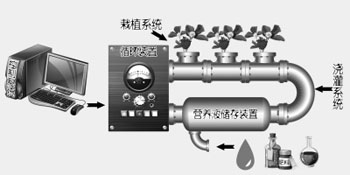
Schematic diagram of circular integrated water and fertilizer system (Illustration: Wang Peng, Gao Qichen)
In recent years, with the application of digitalization, intelligentization and informatization in agricultural production, the Soil and Fertilizer Workstation of the Beijing Municipal Bureau of Agriculture proposed the concept of "using smart soil and fertilizer to create the future of agriculture" and explored and formed a number of efficient, ecological and safe technologies and technical products. So what exactly is "smart soil and fertilizer"? What benefits can "smart soil and fertilizer" bring to production? Does it have reference significance for other places? Recently, reporters visited the Beijing Soil and Fertilizer Workstation and several agricultural cooperatives in the suburbs of Beijing to find out.
Soil and fertilizer database
Farmers know field conditions without leaving home
In Hancunhe Village, Fangshan District, Beijing, major grain grower Du Xin turned on his computer, clicked the mouse lightly and brought up the Beijing soil and fertilizer information website. In the soil testing and formulated fertilization section, he clicked in and found the landmark data for his field, and the field information was clear at a glance. Following the system prompts, Du Xin entered data such as the soil nutrient content and target yield of his 800 mu of cultivated land into the corresponding form and confirmed it. The computer screen immediately displayed the soil testing and formulated fertilization technology for the corresponding crop, and he ordered special formula fertilizer online from the district soil and fertilizer station. The whole process took no more than 3 minutes.
"Since using this system, fertilizing is much more convenient than before. I know what my field lacks and what should be supplemented, and I also know what kind of fertilizer should be used for which crop, as well as the yield increase range of the crops." Du Xin told reporters.
The reason Du Xin could obtain the crop's "electronic prescription" in such a short time all depends on the soil and fertilizer database established by Beijing. Mentioning this database, Zhao Yongzhi, director of the Soil and Fertilizer Workstation of the Beijing Municipal Bureau of Agriculture, showed considerable pride. It was jointly developed and established by the Beijing Soil and Fertilizer Workstation and China Agricultural University over 6 years.
So what kind of database is this? What convenience can it bring to farmers?
Zhao Yongzhi introduced that the database stores massive information such as the patterns, types and area quantities of the spatial distribution of soil in Beijing, as well as various soil attribute data such as soil organic matter, pH value, total nitrogen, total phosphorus and total potassium. With reference to relevant standards, 50-mu plots are used as soil units, and different attribute data in the soil attribute database are organically linked, so that the database covers the cultivated land and soil around all of Beijing.
When querying, users only need to enter the code of a soil unit or the name of an administrative village to learn the corresponding cultivated land and soil information, as well as the cultivated land and soil information of relevant points, and this information and data are dynamically updated.
In addition, the database also stores the soil boundaries, soil types, topography and landforms, drainage and irrigation systems, more than 30 years of soil test results, chemical fertilizer use and historical yield results of the suburbs of Beijing. By analyzing field yield variation from historical yield maps, soil and fertilizer experts identify different crop yield zones, and then, by comparatively analyzing the yield maps and other related factor layers, calculate the main limiting factors affecting crop growth. On this basis, they formulate precise fertilization technology for the crops planted in that plot.
The specific process is to input data such as soil nutrient content and supply capacity, fertilizer requirement patterns of different crops, and the quantities of nitrogen, phosphorus, potassium and medium and trace elements required for the target yield into the soil and fertilizer database for analysis, and formulate fertilization technology for a certain crop planted in a certain plot or region, so as to supplement whatever element the soil lacks and supply as much as the crop needs, control fertilizer input within a scientific and reasonable range, and achieve balanced supply of various nutrients to meet crop needs.
"The soil and fertilizer database is a very important component of smart soil and fertilizer." Zhao Yongzhi said that so-called smart soil and fertilizer is actually the integration of the Internet, mobile Internet, cloud computing and Internet of Things technology. Relying on various sensing nodes and wireless communication networks deployed at agricultural production sites, it realizes intelligent perception, intelligent early warning, intelligent analysis and online expert guidance for the soil and fertilizer production environment, and provides precise services, visual management and intelligent decision-making for soil and fertilizer production. In this way, it achieves the goals of reducing chemical fertilizer use, increasing crop yield, improving the quality of agricultural products and maintaining soil ecological health and sustainable use.
Integrated water and fertilizer
Real-time monitoring saves both water and fertilizer
Cui Weiguo, chairman of the Xinchengyuan Fruit Professional Cooperative in Xingshou Town, Changping District, Beijing, stood in the experimental area of the circular integrated water and fertilizer cultivation technology model in the greenhouse, carefully checking the field trial records.
"Ahem, this circular integrated water and fertilizer cultivation technology actually used nearly 80 cubic meters less water and more than 10 kilograms less fertilizer per mu than the previous drip irrigation cultivation technology." Cui Weiguo discovered delightedly.
According to him, strawberries have a whole growth and fruiting period of more than 9 months each year, making them a "big eater" that can really consume food and drink. Back in 2008, strawberry topdressing used the traditional "water pushing fertilizer" method, that is, spreading chemical fertilizer in the field and then watering, so that the chemical fertilizer dissolved in the water and infiltrated into the ground along with it. For watering, micro-sprinkler technology was used. At the time, it was considered very advanced, but even so, each mu of strawberries used as much as more than 200 cubic meters of water and nearly 100 kilograms of chemical fertilizer over one growing season.
"Actually, we knew that strawberry growth could not use so much water and fertilizer at all, but there was no better way." Cui Weiguo recalled.
Zhao Yongzhi's words also confirmed Cui Weiguo's feeling: the traditional "water pushing fertilizer" method requires watering regardless of whether the strawberries lack water, wasting both water and fertilizer; while micro-sprinkler technology only changed traditional flood irrigation into sprinkler flood irrigation and did not produce a qualitative change in the irrigation method. Such water and fertilizer application methods cannot achieve true resource conservation. The circular integrated water and fertilizer system is different. Its biggest feature lies in circulation.
According to the introduction, the circular integrated water and fertilizer technology model consists of three parts: the control system, the irrigation system and the planting system. The planting system is composed of PVC pipes and fixing frames, and the PVC pipes are horizontally fixed on the fixing frames. Equidistant round holes are drilled in the upper part of the PVC pipes for planting strawberry seedlings. The irrigation system is composed of nutrient solution storage devices, circulation devices and other parts.
The nutrient liquid stored in the storage tank is specially prepared according to the nutrient elements and proportions required at different stages of strawberry growth and development, and can fully meet the strawberries' needs for various nutrients at different growth and development stages. After the strawberry seedlings are planted, the control system starts and shuts down the irrigation system according to set time periods. After the irrigation system starts, within a certain period of time, under the control of the circulation device, the nutrient liquid continuously flows from the front end of the PVC pipe to the end and then back into the storage device. During the circulation of the nutrient liquid, the strawberries also absorb water and nutrients.
"Users only need to complete all operation processes in the control room outside the greenhouse, and can watch the crop growth conditions through real-time monitoring. If problems arise, soil and fertilizer experts are also available for online guidance throughout the process, completely changing the previous model of relying solely on experience for agricultural production." Xu Mingze, deputy director of the Changping District Soil and Fertilizer Station, told reporters.
According to estimates, when strawberries are cultivated with the circular integrated water and fertilizer cultivation technology model, only 40.9 cubic meters of water and 45.5 kilograms of fertilizer are used per mu; compared with the water pushing fertilizer cultivation technology model, it saves nearly more than 160 cubic meters of water per mu and more than half of the chemical fertilizer; compared with the drip irrigation integrated water and fertilizer cultivation technology model, it also saves nearly 90 cubic meters of water and 14.5 kilograms of chemical fertilizer per mu.