Loach farming helps Shanglin County, Nanning, Guangxi onto the road to prosperity
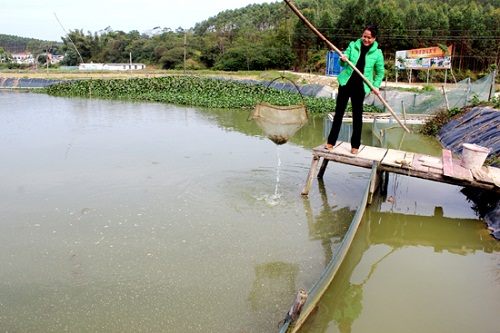
Four years ago, Qin Fenglan, who was in the cosmetics business, never would have imagined that she would become a skilled loach farmer, with a sizable farming base of her own in Xiangxian Town.
Targeting a market gap to farm loach
Recently, starting from Xiangxian Town, our reporter reached Gongxun Village in Dashan Village after a half-hour drive. At the bend of the road at the foot of the hill beside the village lies a fish pond of more than 6 mu, its surface shimmering, with foraging loaches occasionally stirring up splashes. That is Qin Fenglan's loach farming base.
"A few years ago, I started farming loach, all using recirculating culture," Qin Fenglan said happily. "This year, I will sell at least more than 10,000 jin of loach. At a wholesale price of 25 yuan per jin, I expect an income of more than 200,000 yuan."
Qin Fenglan, now in her thirties, gives the impression of being full of confidence, optimistic and capable.
A few years ago, she ran a cosmetics business in Guangdong, with a considerable income. In 2012, just when business was going smoothly, she chose to withdraw at the peak and decided to return to her hometown to try farming loach, starting another career of her own.
"I am a farmer. Away from the land, I feel uneasy inside," Qin Fenglan said wittily.
The way of thinking determines the way out; the head determines the pocket. First, Qin Fenglan looked up farming information online, then through market visits and research, she learned high-density ecological loach farming technology and basically mastered the skills of loach farming.
In early 2012, Qin Fenglan invested more than 40,000 yuan to dig up more than 6 mu of idle low-lying land on her own property and began farming loach.
At the beginning of farming, due to a lack of practical experience and insufficient technical skills, the loach Qin Fenglan farmed either died or escaped, or was eaten by birds and snakes. A fall into a pit, a gain in your wit. Qin Fenglan did not lose heart. Instead, learning from the lessons, she increased her investment, enclosing the entire area around the pond with nylon netting 30-40 cm from the bank, and reinstalling pumping and aeration equipment in the middle of the pond, which both kept out natural enemies and helped regulate water temperature and quality.
Qin Fenglan explained that in high-density ecological loach farming, the most crucial thing is to control water temperature and pH, especially keeping the water temperature moderate. If the farming water does not meet standards and the feed formula is unsuitable, loach may develop rotten mouths, white heads and white tails, or even die.
"Farming loach is really a technical job. Not only must you prevent escape and guard against birds and snakes, you also have to carefully observe water quality and regularly disinfect and aerate the water," Qin Fenglan said.
Self-hatching loach fry to cut costs
Less than 200 m from the loach farming base is Qin Fenglan's 16-mu greenhouse loach fry hatching base. Because she crossbreeds local loach with Taiwan loach, the hatched loach fry are lively, do not burrow into mud, have strong disease resistance, good quality and a high survival rate, so more and more farmers and business owners come to her door to buy them.
Qin Fenglan said that to obtain maximum benefits from loach farming, one must take the path of self-breeding and self-raising, so as to reduce expenditure and increase income, and also reduce the spread of pathogens.
Qin Fenglan's greenhouse loach fry hatching base can produce 60 million loach fry a year. Most are hatched to order, while a small portion is kept for her own farming. In this way, she both encourages more people to farm loach and increases her own income.
Leading the masses to prosperity together
Previously, several farming households in Gongxun Village had also farmed loach, but all ended in failure due to inadequate technology and site construction.
Qin Fenglan said loach is rather picky about its environment and the rearing technology is very demanding, so mastering the techniques is crucial.
Last year, Qin Fenglan established the Gongxun Village Women's Entrepreneurship Professional Cooperative and held several loach farming training sessions. All 23 households in the village were interested in joining the cooperative. Qin Fenglan said that for anyone in need of farming help, as long as they come to ask, she will carefully guide them in management, disease prevention and other aspects. After others have mastered the farming techniques, she also helps farming households solve sales problems and provides free technical consulting services at any time during the farming period.
"Getting rich alone does not count as getting rich. Only by leading nearby villagers to farm together can the industry become bigger and stronger." After her success, Qin Fenglan still has a bigger dream: to provide loach fry and technical assistance free of charge, and lead nearby villagers, and even poverty-stricken households with the right conditions across the county, to farm loach together and "farm" a road to prosperity.