The Bamei pig is here: get to know this distinctive local pig breed
He was once a security team leader. After a family tragedy, he quit his job to raise pigs, only to face opposition from his family and criticism from his friends. One decision he made while starting his business struck everyone as even more baffling. How did he, crossing into a new industry, build a company with annual sales of more than 20 million yuan in just 2 years?
This is a farmhouse restaurant run by a local Tu ethnic family. Steamed sausage and roast pork ribs are two signature dishes when local Tu people prepare a Bamei pig feast. Today, Bao Haining is going to hold a whole-Bamei-pig banquet here.
Bao Haining: The Tu people's methods for preparing this Bamei pig are very special. Besides boiling and roasting, they also do a lot of roasting, braising and curing. There are many steps, and there is still a certain gap between this and our traditional pork preparation, so it makes it easier for our guests to experience the flavor of the Bamei pig.
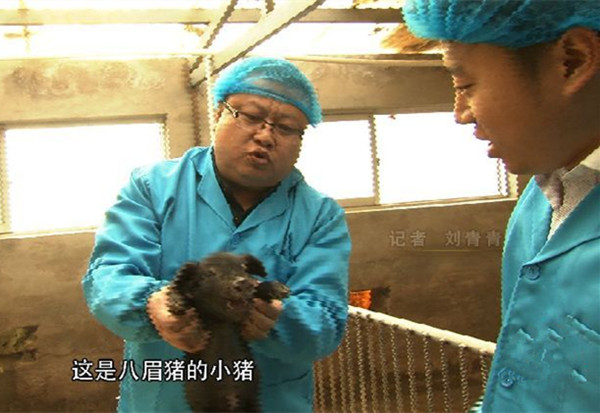
This pig with a face full of wrinkles is the Bamei pig, named for the character "eight" (ba) shaped wrinkles on its forehead. This pig has long bristles and big ears, so locals also call it the big-eared pig.
Today Bao Haining invited the owners of several local restaurants here to taste a whole-Bamei-pig banquet in order to promote his Bamei pig products. As soon as the roast pig was served, it won the guests' approval.
Huang Xiulian, owner of a hotpot restaurant: We're planning to start serving Chinese cuisine, switching to Chinese cuisine to sell these and promote them with all our effort.
Reporter: How does it taste?
Restaurant owner: Delicious, really delicious.
Dong Shangwen, owner of a restaurant: In the past I wouldn't eat pork, but with this meat, you see, I eat both the fatty and the lean. Of this meat I can eat almost a jin.
After eating the roast pig, Bao Haining showed the guests his products.
Restaurant owner: Meat like this can be made directly into steamed pork with rice flour, and it's quite delicious this way. A piece of meat like this can also be used to make braised pork slices.
Restaurant owner: Business isn't easy these days, and once your Bamei pig meat came out, we can definitely promote it as a specialty dish from now on.
Bao Haining: Right, so that's why I invited everyone here. You see, pooling ideas is much better than sitting at home thinking.
Relying on this Bamei pig, Bao Haining built a company with annual sales of more than 20 million yuan in just 2 years.
Wang Suping, director of the Animal Husbandry Bureau of Huzhu County, Qinghai Province: By building this leading enterprise, he has played a driving and leading role in the entire pig production. A few years ago, the number of pigs slaughtered in our county was around 300,000 a year. In the past two years, through processing and production at his factory, our current average annual slaughter volume has remained at around 400,000 pigs.
However, few people know that just 2 years ago, when Bao Haining had just entered the Bamei pig industry, there was not a single person around him who was optimistic about him.
Friend Cheng Wen: At the time I thought, are you doing this because you really have an idea, or are you doing this project just because you don't want to be a security guard anymore?
Wife Feng Xiaohong: At the time I felt it was a bit unlikely, so I made mental preparations, afraid that he would fail or something.
Bao Haining: Actually, a lot of things you only know after you've done them. Even if I fail, so what if I go back and be a security guard again, right? I tried, I struggled.
In 2 years, Bao Haining transformed from a security guard into a leading figure in the Bamei pig industry, with annual sales of more than 20 million yuan. How exactly did he do it?
Bao Haining was born in Xining, Qinghai Province. In 1995, after graduating from secondary school, Bao Haining did some small business, but never made much money. In 2005, Bao Haining came to Huzhu Tu Autonomous County at an altitude of 2,700 m. He found a job as a security guard at a liquor-making company here and stayed for 8 years. He rose from security guard to security team leader. However, in 2013 he gave up this hard-earned position.
Friend: He resigned quite quickly. I was also rather surprised at the time. Resigning, I thought there should have been some transition in between. Resigning all at once, because the income was gone, and he has a family, elders above and children below.
Family member: I felt he had never done this kind of thing (the pork industry), and every day it was just going to work and coming home. I thought it would be very difficult for him to do these things.
Why did Bao Haining suddenly resign to start a business? The person photographed with Bao Haining is Bao Haiming, Bao Haining's older brother. Their father died when Bao Haining was 2 years old, and his older brother always took care of him. Two years ago, his brother suddenly died of illness. This was a heavy blow to Bao Haining.
Bao Haining: The eldest brother is like a father. Given our special family situation, this brother always disciplined me, supported me, helped me and guided me. Human life is actually very fragile. With such limited life, shouldn't we do something? Even if we fail, we can still start over.
So what exactly did Bao Haining want to do?
In 2013, he heard from a friend that a local specialty, the Bamei pig, was becoming harder and harder to buy. After investigating further, Bao Haining found that Bamei piglets were very expensive. The reporter followed Bao Haining to learn about the market prices of Bamei piglets.
Xu Fafang: Do you want to weigh this one?
Farm manager Xu Fafang: Right now it's between 40 jin and 50 jin.
Bao Haining: Let me weigh it. This one is already 40 jin.
Bao Haining: Today this crate of 5 is mainly original-stock Bamei sow piglets. The price of this sow is about 3,000 yuan each. For breeding pigs, if it's a good boar, it's about 10,000 yuan.
Bamei piglets are expensive, yet most local farmers are unwilling to raise them.
Villager Zhang Chao: The Bamei pig has a relatively long growth cycle and grows relatively slowly. If you compare it with the same new breed of pig, its feed cost is relatively high.
Farm manager Xu Fafang: By this calculation, for a Bamei pig with a live weight of 100 jin, you only get about 50 jin of carcass pork. With some high-quality, excellent foreign pig breeds, it reaches 70 percent. If ordinary people are going to invest, they must have a certain output.
As a local pig breed, although Bamei pig meat is very popular among local people, because of the long raising time and low meat yield, many farmers are unwilling to continue raising Bamei pigs. However, Bao Haining saw a business opportunity in this.
Bao Haining: As something scarce, a product has a market. Also, such an excellent pig breed, combined with our unique and excellent breeding environment on the Qinghai-Tibet Plateau, is very suitable for making what for us is a mid-to-high-end pork product, one that wins by quality.
In early 2013, Bao Haining spent 200,000 yuan locally to rent the storefront in front of us and opened a pork specialty store. Bao Haining bought Bamei pigs from nearby farmers and sold them himself. At the time, local ordinary pork was 12 yuan a jin, and Bao Haining priced his Bamei pork at 20 yuan a jin. But after selling for a few days, a problem appeared. Ordinary pork sold well, but his Bamei pork attracted no buyers at all.
Partner Wang Jun: When we first opened, everyone really didn't accept this new brand of pork, because everyone ate Bamei pig every day. Bamei pig, they were all used to it. So why was your Bamei pig selling so expensive? Then at the time a lot of Bamei pork would be left over.
Wang Shaozong: It had name recognition, but people still had doubts about whether Bamei pig was really Bamei pig, so they didn't quite accept it.
Original-stock Bamei pigs are black, but most Bamei pigs commonly raised locally are breeds crossed with other pig breeds. After changing skin color, the Bamei pig inherited the original breed's characteristics of long hair, big ears and tolerance for coarse feed.
Researcher in pig genetics and breeding at the Qinghai Academy of Animal Science and Veterinary Medicine: Black pigs are a bit more difficult to dehair, and after dehairing there are black spots on the skin. Their appearance and other aspects are not very good, and when sold on the market people don't quite accept them. So we try as much as possible to raise white pigs.