Tiny QR Codes Crack the Hard Nut of Pesticide Regulation
Original title: Tiny QR Codes "Scan Open" the Pesticide Regulation Dilemma
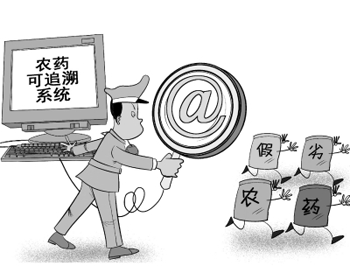
Pesticide traceability system (illustration: Jiao Haiyang)
How to properly manage pesticides in the links of production, circulation, use and packaging waste recycling is a major matter of concern to the whole of society. It must be admitted that the existing regulatory means and instruments cannot yet well adapt to the requirements of the development of China's pesticide industry and market, and are relatively lagging behind. Practice in various places has proven that internet technology, represented by QR codes, is a powerful lever, and is expected to establish a traceability system and crack the dilemma of pesticide regulation in China under the circumstance that large-scale agricultural production has not yet been fully realized.
The Real Dilemma: Fake pesticides detected, but manufacturers refuse to acknowledge them
As an essential input for agricultural production, pesticides are closely tied to the dietary safety of hundreds of millions of people. It can be said with certainty that our government's legislation on counterfeit and inferior pesticides and highly toxic banned pesticides is very strict and its crackdown is very strong. "But there is a strange phenomenon in pesticide industry regulation: every year many unqualified pesticide products are found in spot checks, yet when it comes to holding someone accountable, the manufacturing enterprise cannot be found. When regulators find the manufacturer named on the packaging, it says it did not produce the product, that it is a counterfeit and inferior product. Law enforcement officers are often helpless." said Zhong Hangen, chairman of Jiangsu Huifeng Agrochemical Co., Ltd. The reason, he said, is that in current pesticide sales, not issuing invoices and cash transactions are widespread, there is no basis for tracing, and it is hard for the government to regulate.
This situation is caused by the circulation pattern of China's pesticide industry. At present, China has 2,700 pesticide suppliers, 60,000 city- and county-level distributors, and 800,000 rural retailers, and the market form is severely fragmented. It is extremely difficult to regulate market transactions with such small-scale, dispersed circulation and sales methods. In addition, with many pesticide registrations, a low threshold, a large number of practitioners and weak awareness of standardized operation, unlicensed and non-compliant operations are prominent, leaving "breeding" space for unqualified pesticide products, borrowed or fraudulently used certificates (customized products), hidden ingredients and so on.
There are so many rural retailers because they must serve 240 million farmer households. It can be said that the root of this problem lies in the scattered, household-by-household operation of agriculture. Moreover, young and middle-aged people generally go out to work, and the farmers left behind are older and have a relatively low level of education, making it difficult for them to determine whether a pesticide is fake, inferior or highly toxic; they choose and use pesticides based on their own farming experience and a psychology of seeking bargains. "A considerable portion of retail stores' agricultural technical guidance services aim to sell pesticide products. In extreme cases, half of the pesticides in a store are real and used to solve problems, and half are fake and used to make profits." said Li Guangze, a director of Noposion Agrochemicals Co., Ltd. This is also one reason for the abuse and misuse of pesticides in China.
The reality is that regulating ordinary farmers' scientific pesticide use behavior is a long-term process, strengthening the rural grassroots agricultural technology extension system faces certain institutional obstacles, and advancing appropriately scaled agricultural operation and cultivating new types of agricultural business entities cannot be accomplished overnight either. Given the many small, scattered pesticide enterprises, the many levels of distribution and retail, and the many small, scattered farming households, it is biased to simply blame the government for ineffective pesticide regulation.
So, where does the road of pesticide regulation lie?
The Breakthrough: Use QR codes, and pesticides become traceable
At its fourth session of the ninth council, the China Pesticide Industry Association released the rules for pesticide commodity QR codes (draft for comment), aiming squarely at the hard problem of pesticide regulation. "The pesticide commodity QR code provides a unique identifier for pesticide commodity objects within China's pesticide industry. One QR code identifies only one entity object, and it is extensible, confidential and secure. The introduction of this technology is expected to use 'Internet Plus' to find a breakthrough for pesticide regulation out of its dilemma." said Li Zhonghua, secretary-general of the China Pesticide Industry Association.
With the rapid development of smartphones and mobile internet, precise and efficient full-process regulation of pesticide products has become possible. "Because a QR code can correspond to a single product, even a small package of 5 milliliters or 10 milliliters, it is an intelligent management information system integrating multiple functions such as anti-counterfeiting, output control, sales statistics, fake goods alarms and tracking, not just a simple traceability system." said Du Hui, president of Beijing Yanhua Yongle Pesticide Co., Ltd.
Enterprises can use QR codes to trace detailed product information such as production, warehousing, logistics and consumer information, providing real and scientific data for enterprise production plans and reducing inventory risk and financial costs. "With QR codes, it is very helpful for the company to grasp product sales and inventory conditions. Where the product was scanned, how much was sold, when more was sold, and the nationwide sales distribution can all be captured with precise data." said Zhang Hengchang, manager of the planning department of Shandong Lubao Chemical Co., Ltd.
More importantly, QR codes can not only help users distinguish genuine pesticides from fake ones, but also quickly find clues to product counterfeiting, and can effectively crack down on counterfeit and inferior products. For each product, from leaving the factory to being sold, the number of scans during the whole process is limited. If the same code is scanned many times, it indicates that the product may have been counterfeited; the system will issue a warning and will also easily lock onto the location of counterfeiting and selling fakes.
"QR codes can not only help enterprises publicize and manage products and prevent counterfeit and expired products from entering the market, but more importantly, they can link the information systems of production, operation and use for collection and association, so that pesticide products can truly achieve traceability." said Yang Lijian, director of the Shandong Provincial Institute for the Control of Agrochemicals.
With this powerful tool of QR codes, the circulation dynamics of pesticide products are online in real time, government regulation will be more targeted and the objects of accountability clearer and more explicit, which helps purify the pesticide market, crack down on the "low-price advantage" of fake, inferior and illegal highly toxic pesticides, and protect the lawful rights and interests of legitimate pesticide enterprises, thereby reversing the undesirable tendency of "bad money driving out good money" in the pesticide market.
Development Path: Enterprises change packaging, the government builds a platform
It seems that promoting and applying QR codes in pesticide regulation is truly necessary. So, is its cost high? Is promotion and application difficult?
"Many pesticide enterprises have this demand, but they do not know how to implement it and think it is technically difficult. In fact, they only need to add an online QR code collection system to the original production line. The transformation cost of one production line is about several tens of thousands of yuan." Zhang Hengchang introduced. Pesticide manufacturers often have hundreds or thousands of products of different types and specifications, so rolling it out all at once is difficult. For single products with large volumes, QR codes are easier to implement, and implementation can start with highly toxic, highly toxic and high-risk pesticides.
"In this regard, we can learn from the nationally unified QR code traceability system for veterinary drug products that China has already built, to achieve traceability management of the production, operation and use of veterinary drug products." Sui Pengfei believes that we can also learn from Hainan's pesticide filing model, use internet technology to join with enterprises, establish a unified pesticide QR code or barcode system, and implement it uniformly with regulatory authorities. This is a model for standardizing China's pesticide market management.
Du Hui suggested that the government should introduce relevant regulations as soon as possible, for example requiring pesticide manufacturers to use a QR code traceability system within three years. On the one hand, enterprises change packaging and use QR codes or barcodes for data warehousing and outbound operations; distributors file products; retailers sell them; farmers use and query them; and supervisory departments carry out supervision, ultimately completing the data filing and entry of pesticide products into the national information traceability system for real-time query and tracking. On the other hand, the Ministry of Agriculture establishes a government platform or an outsourced platform, uses data collection equipment, and, based on enterprise-filed products, builds a product information database and generates exclusive QR codes or barcodes for products, similar to WeChat's scan feature, convenient and quick. The key points are access and terminals, regulating transaction data and product flow, with data synchronized to the government regulatory platform.