Red-fleshed apples are not for sale, reserved exclusively for guests to taste
Original title: Planting red apples attracts golden phoenixes
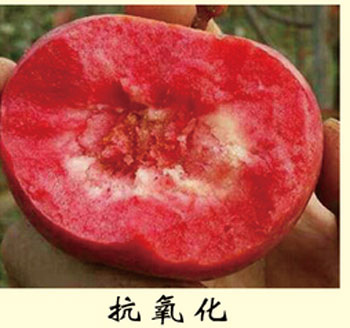
Red apples have antioxidant properties
Red apples are large and well-shaped, with a beautiful appearance
Red apples are very familiar to people; some even eat one every day for nutrition and health. But when it comes to red-fleshed apples, far fewer people know about them. In Yanjin County, an ordinary farmer has made a specialty of red-fleshed apples, yet only after looking closely will you discover that he is not as ordinary as he appears.
Flying by plane to do grafting
Shen Yanbing was born in Shenwan Village, Wanglou Township, Yanjin County. From childhood, his family had an apple orchard, and in his memory, his father was always busy in the orchard. In 1993, his father arranged for him to go to Yangling, Shaanxi, to stay with a relative. This relative worked as a technician at the fruit tree base of Northwest A&F University, and his father hoped Shen Yanbing could learn solid cultivation techniques there while also finding a better path in life. Over 3 years, Shen Yanbing ate, lived and worked alongside his relative, accumulating very valuable fruit tree management experience.
In 1996, Shen Yanbing returned home and took over the apple orchard from his father. After becoming his own boss, he immediately renovated the family apple orchard, phasing out old varieties previously planted such as Guoguang and Hongyu, and introduced varieties such as Jonagold and Scarlet Spur from the Zhengzhou Fruit Research Institute for top-grafting. However, even though the varieties were upgraded, the apple market remained poor for several consecutive years.
Around 2000, Shen Yanbing heard that the Yanjin County Forestry Research Institute was promoting greenhouse apricots, so he rented a greenhouse and began growing greenhouse apricots. After two years, the apricot trees were growing well, and just as he was about to reap his first pot of gold, the fruit was stolen clean.
Despite this, Shen Yanbing did not give up on fruit tree cultivation. In 2006, he introduced Ukrainian large cherries from the Taiyuan Fruit Research Institute in Shanxi, but this variety was not suited to the saline-alkali soil of Yanjin. After a single watering, nearly all the cherry trees died.
For a period afterward, Shen Yanbing bore considerable pressure. He had not made money, and people often said he was "just messing around." On the surface, Shen Yanbing appeared to have settled down to farm honestly, but deep down he was not so "obedient." In 2011, hearing that the market for colored-leaf trees was good, he could not hold back again.
After making several inspection trips to other places, Shen Yanbing unhesitatingly spent tens of thousands of yuan to buy back some colored-leaf poplar scions, then threw himself wholeheartedly into raising and grafting colored-leaf poplars. When grafting in summer, people sitting in air-conditioned rooms still complained of the heat, yet Shen Yanbing would squat in the field for a whole day. Sweating profusely and being bitten by mosquitoes were nothing to him.
His hard work was not in vain. The colored-leaf poplars Shen Yanbing cultivated sold for a good price, and his reputation as a "colored-leaf poplar expert" spread quickly. That year, a client from Chongqing once invited him to provide technical guidance, booking a high-end hotel and providing round-trip air tickets, which for him was a "first in his life."
Red-fleshed apples gain popularity
The market is ever-changing and unpredictable, and the colored-leaf poplar market could not keep rising either, so Shen Yanbing began looking for other ways to get rich. By chance, he heard a friend say that Shandong had a type of red-fleshed apple. Extremely sensitive to this, Shen Yanbing immediately inquired thoroughly and developed a strong interest.
After making inquiries through various channels, Shen Yanbing bought some red-fleshed apple saplings from a place in Shandong. After planting them, he began eagerly hoping this new variety would open a new chapter for his business. The next year, the trees bore fruit, but the fruit was only as big as hawthorn, the flesh was sour with no sweetness, and only the core was slightly reddish. Clearly, he had bought fake saplings.
Could it be that there are no true red-fleshed apples? Shen Yanbing was not resigned to this and continued making inquiries everywhere. In 2012, he finally managed through an acquaintance to buy a batch of red-fleshed apple saplings at great expense from a foreign trade company in Shandong. This apple is named Redlove, a new variety cultivated by a Swiss horticultural expert.
At that time, Shen Yanbing had already transferred over 200 mu of land and was growing many fruit trees at the same time, including red pears introduced from the Zhengzhou Fruit Research Institute, grapes introduced from Changli, Hebei, and honey peaches introduced from Zibo, Shandong. But he treated the newly purchased red-fleshed apple saplings as a key protected subject and began research and trial planting. Based on years of accumulated cultivation experience, Shen Yanbing adopted a management model of no pruning and no trunk heading. The trees had no main branches, and the medium and short fruiting branches growing from the trunk could all bear fruit. With the new variety plus new management techniques, the trees could bear fruit in the second year and reach high yield in the third year. According to Shen Yanbing, this management model can also be applied to ordinary apple trees and pear trees, allowing fruit trees to enter the high-yield period as quickly as possible.
In 2013, the planted Redlove began to bear fruit. This apple not only has red leaves and red skin, but even the flesh is red. When cut open, it does not oxidize and turn brown like ordinary apples, and the taste is also very good. According to Shen Yanbing, Redlove is the name of a category of varieties. In fact, this series includes 6 varieties, with differences not only in taste but also in maturity period. The earliest variety matures in mid-August, after which one variety matures every 20 days, with the latest continuing until National Day. This combination of early, mid and late maturing varieties is more conducive to capturing the market and obtaining better returns.
Never relaxing in the study of techniques
In addition to the management model mentioned above, Shen Yanbing's seedling-raising technique is also outstanding.
Han Shouwei is a retired senior engineer from the Forestry Bureau of Yuanyang County. According to Han Shouwei, Shen Yanbing is not only very sensitive to new varieties but also very persistent in technical research. For example, in conventional apple seedling cultivation, as rootstock, crabapple seeds must first undergo sand storage for 100-120 days, emerge in spring, be grafted in July-August, be cut off at the graft point the following spring, and only after the sapling grows for another year can it leave the nursery. But the seedling technique Shen Yanbing now applies can already be considered "beyond conventional." Here, crabapple seeds are sown in March, grafted in June, and the saplings can leave the nursery by October.
Such saplings, sown in the same year, grafted in the same year and leaving the nursery in the same year, are called "three-same-year saplings" in the industry. Han Shouwei said that elsewhere, perhaps someone using facilities such as greenhouses could also achieve this effect, but Shen Yanbing achieved it without any facilities, which is very rare. In this way, saplings can leave the nursery one year earlier, and the propagation speed is much faster.
As early as when he was growing greenhouse apricots, Shen Yanbing became acquainted with Wang Baoyu, chairman of the Yanjin County Association for Science and Technology. Over the years, whenever he encountered problems in development, Shen Yanbing always liked to chat with Wang Baoyu, who came from a formal agricultural education background. Wang Baoyu recommended products such as biological pesticides and microbial fertilizers to him, which were quickly applied in production. As a result, the fruit produced by the cooperative has already reached the standard for pollution-free products. Last year, the cooperative was rated as a provincial science popularization demonstration base, and in the second half of the year, on the recommendation of the county Association for Science and Technology, it was selected to participate in the evaluation for a national science popularization demonstration base. It must be said that this is the result of Shen Yanbing's emphasis on agricultural science and technology.
Zhang Jidong from Liyuan Village, Shipogu Township, Yanjin County bought 8 mu of pear saplings from Shen Yanbing in 2008. Starting from the fourth year, the income per mu reached ten thousand yuan. Now, 8 mu of land can easily earn over one hundred thousand yuan a year. Speaking of this, Zhang Jidong admires Shen Yanbing greatly and said he plans to also plant several mu of red-fleshed apples this year. "With Yanbing's technical guidance, I am very confident."