How to protect vegetables and citrus from cold waves? Ministry of Agriculture goes to the countryside to guide
Original headline: Ministry of Agriculture urgently formulates technical guidance for vegetable and citrus production
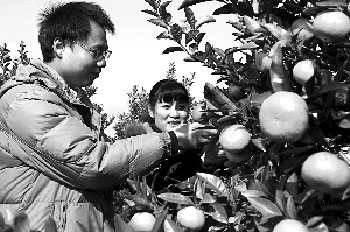
Agricultural technicians go deep into citrus bases to give on-site guidance to fruit growers on freezing protection and insulation for fruit trees. (Online illustration)
Recently, an ultra-strong cold wave accompanied by strong winds, rain and snow, and sharp temperature drops has been sweeping from north to south across the central and eastern regions of China, with the cooling intensity in most areas unseen in more than 30 years. To reduce the impact of meteorological disasters on agricultural production, the Ministry of Agriculture recently urgently formulated technical guidance for vegetables and citrus under severe temperature drops and rain and snow weather, requiring agricultural authorities at all levels and agricultural technology extension agencies in major vegetable-producing areas to act urgently, and to fully mobilize and guide vegetable farmers to carry out scientific disaster resistance and mitigation measures suited to local conditions. Major citrus-producing areas should pay attention and make preparations for cold and freezing protection to reduce losses.
Regarding the management of protected vegetables, the guidance requires all localities to strictly prevent disasters from strong winds, rain and snow, appropriately add supports in greenhouses with weaker frames, seal greenhouses, press down greenhouse films, fix external insulation coverings, strictly prevent wind disasters, promptly clear snow from greenhouses, and dredge drainage ditches in greenhouse areas; strengthen heat storage and insulation measures, appropriately increase temperature and store heat during the day, add external insulation coverings, and strengthen internal insulation measures; adopt emergency supplemental heating measures; enhance plant stress resistance, spray foliar nutrients, strictly control irrigation, and harvest fruit vegetables in a timely manner.
Regarding the management of open-field vegetables, the Yangtze River Basin should harvest and market vegetables in a timely manner before the cold wave arrives, and for vegetables still in the field, ditches should be cleared and soil moisture regulated to prevent waterlogging. During the cold wave, efforts should be made to bring as much as possible to market; after the cold wave, every possible means should be used to strengthen shade and covering, delay the freeze-thaw process, and prevent vegetables from being frostbitten and losing their marketability. In the hot regions of South China and Southwest China, active covering for cold protection should be carried out, creating windbreak fences for cold protection, spreading ash to store heat for cold protection, and earthing up soil to protect roots for cold protection.
In response to severe temperature drops and rain and snow weather, citrus production should ensure that dry orchards are irrigated before freezing, branches and trunks are reinforced and ice is knocked off and snow is shaken off, the ground is covered, and trees are protected, including wrapping and protecting young trees, covering with plastic film, wrapping branches and trunks, earthing up around trunks, and spraying transpiration inhibitors, as well as smoke fumigation to prevent frost. Citrus orchards with fruit still hanging need to be harvested as soon as possible or covered with plastic film for protection. Mature fruit that has not yet been harvested should be harvested as soon as possible before low temperatures arrive. For mature fruit that cannot be harvested in time, or for late-maturing varieties whose fruit is not yet ripe, the tree canopy should be directly covered with white transparent plastic film. (Reporter Li Jinghan)