Busy with planting and farming to cope, putting up warm sheds and raising water levels
Original title: Building warm sheds and raising water levels, growers and farmers are a bit busy
While we admire the beautiful frozen West Lake, the baby bok choy, napa cabbage, and strawberries are fighting the cold and frost
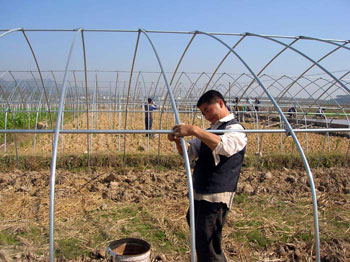
Building warm sheds (network image)
For growers and farmers, the snow and the "quick freeze" after the snow really pose a double hurdle. Yesterday afternoon, the reporter learned from the Hangzhou Municipal Agriculture Bureau that major vegetable and fruit planting bases and aquaculture bases in Hangzhou have already taken anti-freeze and insulation measures. As temperatures will remain relatively low today and tomorrow, anti-freeze and insulation will also be the main work for farmers and growers in the coming days.
Zheng Junhui, deputy director of the Crop Division of the Municipal Agriculture Bureau, said that relevant protection notices have been issued to 425 "vegetable basket" bases in Hangzhou, and basic anti-freeze measures at each base are already in place. Based on the current situation, normal vegetable supply is not a problem, but temperatures will remain relatively low today and tomorrow, so vegetable anti-freeze efforts still cannot be relaxed.
"Vegetables such as baby bok choy and napa cabbage are frost-resistant varieties, but they can only tolerate low temperatures of minus 1°C to minus 2°C. If the temperature drops to around minus 10°C, it will also have a major impact on these leafy vegetables, and the anti-freeze situation remains fairly severe," said Zheng Junhui.
Wang Guohai of the Economic Crops Division of the Hangzhou Municipal Agriculture Bureau said that the fruit crops most affected by this low temperature in our city are loquat and strawberry. "The strawberry planting area in our city is around 20,000 mu, and it is currently in the peak picking and sales season. Strawberries are berry-type fruits and are easily damaged by freezing at low temperatures, and their growth will also slow down. Growers should reinforce and insulate their planting greenhouses, and when necessary build arched sheds inside the greenhouses for insulation," said Wang Guohai. "The growth of young loquat fruits will also be affected and they are easily damaged by freezing at low temperatures, so this year's yield will suffer a certain loss. In addition, citrus fruit trees exposed to low temperatures will have their leaves frozen off, which will also affect fruiting. We have already organized professional personnel to provide relevant anti-freeze damage guidance to growers. For fruit farmers, anti-freeze work cannot be ignored."
Wu Xiaolan, deputy director of the Fisheries Division of the Hangzhou Municipal Agriculture Bureau, said that since the farming cycle for most aquaculture species has already ended, the cold wave's impact on aquatic products is not very great. However, for open-pond aquaculture, farmers need to improve some overwintering facilities, such as raising water levels and building warm sheds. In addition, for open-pond aquaculture, many conventional fish species require strengthened farming management to prevent fish from suffering frostbite.
Link: Recently, the Zhejiang Provincial Department of Agriculture and the Hangzhou Municipal Agriculture Bureau issued measures for the current main crops and fisheries to cope with cold waves, rain, snow, and freezing, which can serve as a reference for growers and farmers:
1. Vegetables
1. Harvest marketable vegetables early to avoid frost damage and snow pressure.
2. Do a good job of keeping warm and preventing freezing. Where conditions permit, emergency measures such as heating with electric heating wires, lighting candles, and burning smoke may be adopted; open-field vegetables may be appropriately covered with straw, shade nets, and so on.
3. Reinforce greenhouses to prevent collapse. Take measures such as installing supports inside the greenhouse for reinforcement and removing snow; when necessary, emergency measures such as breaking the film to protect the greenhouse frame may be adopted.
4. Strengthen post-disaster field management, and carry out measures such as ventilation, exposure to light, dehumidification, disease prevention, and light application of foliar fertilizer, so as to restore plant growth as quickly as possible.
2. Fruits
1. Tree body protection. Whitewash tree trunks; a lime slurry made from quicklime, lime sulfur mixture, salt, and water can be used to brush the main trunk; set up supports for young fruit trees, and do a good job of pruning fruit trees with excessive branches;
2. Shake off snow to reduce damage. Promptly shake off accumulated snow on the trees to prevent the snow from breaking branches; promptly clear accumulated snow on greenhouses and other facilities to prevent them from being crushed.
3. Promptly deal with broken branches and trunks. For completely broken branches and trunks, saw them off early, smooth the wounds, and apply protective agents such as grafting wax; for branches and trunks that have been torn but not broken, first lift them with ropes or prop them up with supports, apply grafting wax and so on to the injured parts, and bind them firmly to promote healing and restore growth;
4. Strengthen cultivation management. Spray foliar fertilizer. Promptly drain accumulated water in the orchard. Prevent and control pests and diseases. Frozen tree bodies are prone to disease. Prune appropriately. (Trainee reporter Li Ming)