The market outlook for Sima rabbits is promising, and now is the right time for rural people to start raising them
The market outlook for rural people raising Sima rabbits is promising. At present, rural areas have begun raising Sima rabbits one after another, and through this kind of specialty breeding, ordinary people have embarked on the road to prosperity. China is also stepping up efforts to encourage more farmers to return to their hometowns for development, thereby increasing farmers' economic income and stabilizing their lives. Rural areas are rich in crop resources and suitable for developing such grain-saving animals. Sima rabbit farming is a rural specialty breeding project with low investment, a short cycle, easy raising and high returns. In recent years, as people's health awareness has grown, Sima rabbit meat, as a "three high and three low" health meat, has become even more favored by people. Its consumer market has gradually expanded, and its price has shown a continuously rising trend, with good potential in both international and domestic markets.
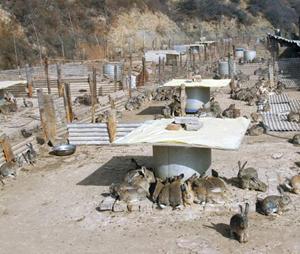
First, its diet is mainly grass, making it a typical grain-saving herbivorous livestock. The Sima rabbit is a monogastric herbivorous livestock and has the strongest tolerance for roughage. In the feed formula for Sima rabbits, the proportion of raw grain averages 23%, while for pigs and poultry it is about 60%. Experiments show that when the same amount of feed is used to feed Sima rabbits and beef cattle, the weight of rabbit meat obtained is 5 times that of beef, indicating that the monogastric herbivorous Sima rabbit is more efficient than the ruminant herbivorous cattle at converting grass into meat. For China, where grain is relatively tight and forage resources are abundant, vigorously developing the Sima rabbit breeding industry is of great practical significance. By raising Sima rabbits, farmers can convert abundant forage resources into rabbit meat, rabbit skins and rabbit fur, which is a good way to become prosperous.
Second, it has multiple births and high yield, a short raising cycle and a high meat yield. Sima rabbits reach sexual maturity early, at about three to four months, are first mated at 6 months, have a gestation period of 1 month, and give birth to an average of 7~8 young per litter. After giving birth, they can come into estrus and be mated again, and can produce more than 6 litters a year. The young rabbits grow quickly, are weaned at 1 month, and after weaning need about 60 more days of raising to reach 2.5 kg and be ready for market. One female rabbit can produce 35~40 offspring in 1 year, equivalent to 20~25 times the female rabbit's own weight. For cattle and sheep, it is only 0.35~0.63 times. Among the other livestock currently raised, it is very difficult to compare with the Sima rabbit. Therefore, vigorously developing the Sima rabbit breeding industry is an important way to solve people's source of meat and enrich China's food supply.
Third, raising Sima rabbits requires little investment, brings quick results and yields high returns. Compared with raising other animals, the investment in Sima rabbits is relatively small and the input-output ratio is high. The investment in raising Sima rabbits in rural areas can be roughly divided into breeding rabbit costs, feed costs, epidemic prevention costs, cage and housing costs, and so on. If five groups of breeding rabbits are raised, the annual gross profit can reach nearly more than 20,000 yuan.
Fourth, it occupies little land and requires little labor, and every household can do it. Sima rabbits can be raised on the ground or in multi-tier cages; they can be raised indoors or outdoors; they can be raised on the ground, underground, or on rooftops. Small-scale household raising can use courtyards or idle rooms and old buildings. An ordinary household courtyard can accommodate a scale of about 30 foundation female rabbits. Raising rabbits involves no heavy physical labor, and both the elderly and women can do it. Rabbits like to be active at night, so raising rabbits does not conflict with the labor needed for farming. Farmers can completely use their spare time to raise them without delaying farm work.
Fifth, rabbit meat is a well-known health meat and beauty meat, with dual market potential both internationally and domestically. Rabbit meat has the characteristics of "three high and three low," and its comprehensive nutritional value is higher than that of pork, beef and chicken. Rabbit meat not only has relatively high nutritional value, but its fibers are fine and tender, and after processing it is easily digested and absorbed by the human body. It is a good nutritious food for the elderly, the sick, pregnant women and young children. In addition, people who often eat rabbit meat are less likely to gain weight, can maintain a beautiful figure, and also gain health benefits, with good effects on preventing atherosclerosis, high blood pressure and heart disease. Therefore, rabbit meat has long been called bodybuilding meat and beauty meat by developed countries and is deeply loved by people. At present, the vast majority of rabbit meat produced in China is exported. In recent years, eating rabbit meat has gradually become a habit in some places in China, and in some places there is even a situation where no banquet is complete without rabbit. Therefore, the potential of rabbit meat in both international and domestic markets is very great, and Sima rabbit farming is worth vigorously developing in rural areas.