She returned to her hometown to make a fortune from sheep and helped nearly a thousand households get rich, and unexpectedly found love
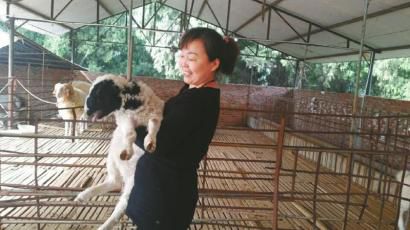
He Junhua holding a lamb, as close as mother and child.
Small-tailed Han sheep
Having been abducted and swindled, and having lost everything growing watermelons, He Junhua, a villager from Baimiao Village, Wencheng Town, Langzhong City, suffered repeated setbacks on her entrepreneurial path. In 2011, unwilling to give in, she returned to her hometown to start a business again, founded Junhua Livestock Breeding Farm, and by raising small-tailed Han sheep set out on the road to prosperity. She also unexpectedly found love.
As Sichuan's first farmer to successfully raise small-tailed Han sheep, after more than 5 years of construction her farm has now become a comprehensive breeding professional cooperative integrating breeding stock cultivation, mutton sheep raising and mutton hot pot, with an annual output value of nearly ten million yuan. It has radiated out to drive 10 counties and districts and 110 townships nearby, with nearly a thousand farming households jointly making a "sheep" fortune.
On February 19, a reporter from Huaxi City Reader walked into He Junhua's small-tailed Han sheep farm to explore the wealth story behind her. First time raising sheep: coming into contact with sheep raising because she was "lured" "The mountain doesn't turn, but the water does; the water doesn't turn, but the clouds do..." At noon on February 19, pleasant music played over the broadcast at He Junhua's farm. At the Junhua farm, which covers more than 1,000 sq m, the small-tailed Han sheep are penned by size in different sheds; the largest are close to the size of a cow, and even the smaller ones are bigger than local goats.
Why play music for the sheep? "Lambs that have just been weaned cry nonstop because they want to nurse, and when the lambs cry, the adult sheep cry along with them." He Junhua said that playing music can reduce the restlessness of the small-tailed Han sheep and increase their feed intake.
"This was also discovered by chance." He Junhua said that once, while she was checking the growth of the lambs in the shed, a phone call suddenly came in. When the ringtone sounded, the lambs that had been restless suddenly quieted down. From then on, the farm began playing music. "Mainly light music; you can't play anything loud and stirring, because it will make the flock restless." At the same time, the sheep are afraid of the dark, so the farm also keeps the lights on all night.
As she spoke, He Junhua picked up a small-tailed Han sheep just like holding a child, and introduced the situation of her farm to everyone.
When He Junhua was 16, she was "lured" by a fellow villager to Baoding, Hebei. "The person who tricked me said you could earn 300 yuan a month working outside, while at that time workers employed by a work unit earned only 45 yuan a month." He Junhua said that because her family was too poor and all the brothers and sisters had to rely on their parents to support them, in order to share the burden with her parents, tempted by the high wages, she followed the fellow townsman out to work.
But after arriving in Baoding, the fellow townsman did not take He Junhua to work. Under the fellow townsman's carrot-and-stick pressure, He Junhua was forced to marry a local villager. Because her husband's family raised many breeds of sheep, He Junhua began her life herding sheep, and it was here that she first came into contact with small-tailed Han sheep.
Several years passed in a flash, and her husband's family relaxed their watch over He Junhua. On a market day, He Junhua took her newborn daughter and fled back to her hometown of Langzhong.
First venture: heavy losses growing watermelons
After returning to her hometown, He Junhua planted crops while thinking about doing some small business.
"At that time I had no skills, so I followed others to learn how to make tofu." He Junhua said that after finishing her training, she started a tofu business in Langzhong. Over more than two years, after expenses there was not much surplus. Her daughter grew day by day, and the pressure of life weighed so heavily on He Junhua that she could hardly breathe, so she thought about changing to something else.
In 2003, He Junhua contracted dozens of mu of land in Xishan Township, Wencheng Town, to grow watermelons. But fate played another joke on her: a sudden rainstorm caused her heavy losses and nearly bankrupted her.
That year, the dozens of mu of melon fields were about to have a bumper harvest. A sudden rainstorm washed He Junhua's watermelon fields almost completely away. The heavy rain, which lasted nearly a week, not only washed away the watermelon buyers' orders, but also cost He Junhua nearly 100,000 yuan, her entire family fortune. The reality of the situation did not crush the unyielding He Junhua, and she packed her bags and went to Shenzhen to work.
In 2007, Shenzhen housing prices plummeted. With only 50,000 yuan, He Junhua made a down payment on a home of more than 80 sq m in Longgang, Shenzhen. In 2009, when Shenzhen housing prices rebounded, He Junhua sold the home and made a net profit of more than 800,000 yuan. With this money, He Junhua bought two more homes in Shenzhen and successively earned some more money.
In 2010, seeing that the housing market was unstable, He Junhua returned from Shenzhen to her hometown of Wencheng Town, Langzhong.
Starting a business again: choosing to raise small-tailed Han sheep
After returning to her hometown again, He Junhua did not choose an easy life. She thought about starting a business again, and what project exactly to do left her very conflicted.
By chance, while watching TV, she discovered that small-tailed Han sheep had high prices and good market prospects. "The first time I returned to Langzhong, I thought about raising sheep, but at that time the land in my hometown was all used to grow crops, and there was no green grass or straw for raising sheep." He Junhua said that she had once come into contact with small-tailed Han sheep in Baoding and knew that they have a short growth cycle, a high lambing rate and good economic returns, and she had also learned some sheep-raising techniques, so she made up her mind to raise small-tailed Han sheep.
In August 2011, He Junhua built sheep pens on the land in front of her home. In November, she went to Jiaxiang County, Jining, Shandong, to buy breeding sheep. "At the time, we made contact online, but when we met we discovered they were sheep dealers." He Junhua said that by chatting with the people around her, she learned that Liangshan County in Jining raised small-tailed Han sheep on a more large-scale basis. "The sheep dealers followed me every step of the way, meaning that if I didn't buy breeding sheep I couldn't leave. While I was buying clothes, I took advantage of the crowd and ran, without even taking my bag or luggage."
After escaping, He Junhua stopped a taxi and went straight to Liangshan County. After asking the locals, He Junhua came to Chen Fengli, a major local small-tailed Han sheep breeder, to buy breeding sheep. "I had originally planned to buy 500 small-tailed Han sheep to raise back home." He Junhua said, but Chen Fengli did not approve and suggested that she raise a small number of small-tailed Han sheep for the first time. In the end, He Junhua accepted Chen Fengli's suggestion and bought 27 Boer goats and 3 small-tailed Han sheep.
Unexpected gain: finding love because of raising sheep
How to transport 30 breeding sheep from Liangshan back to Langzhong without injury became a problem that made He Junhua anxious. Chen Fengli prepared feed and medicine in advance for possible situations during transport, and told He Junhua how to identify and handle these situations. On the nearly 30-hour, 1,500-kilometer journey, He Junhua stayed close to the 30 breeding sheep the whole way, escorting them home safely.
As soon as this originally lively and lovely batch of breeding sheep arrived in Baimiao Village, they showed symptoms of cold, tearing and diarrhea. This made He Junhua extremely anxious, and she quickly called Chen Fengli. On the phone, Chen Fengli taught He Junhua in detail how to provide emergency treatment. But because He Junhua was not accurate in gauging the drug dosage, the sick breeding sheep became even worse, and one Boer goat in more serious condition died.
He Junhua called Chen Fengli again. Unexpectedly, a few days later, a familiar figure appeared at He Junhua's farm: Chen Fengli had come from Liangshan to Langzhong. Under Chen Fengli's careful care, the sick breeding sheep regained their former vitality. It was also during this period that He Junhua discovered that Chen Fengli was someone worth entrusting herself to, and the feelings between the two grew warmer day by day.