A post-80s returnee from France grows vegetables with the "Forrest Gump spirit"
After working at a real estate company for two years, Wang Mian, a "returnee" who spent 6 years in France, decided to give up his nine-to-five job and plunge headlong into the countryside to grow vegetables. Today, the "Natural Symphony" farm he founded has brought more than 60 kinds of organic vegetables cultivated with biological pest control technology to the dining tables of Beijing residents.
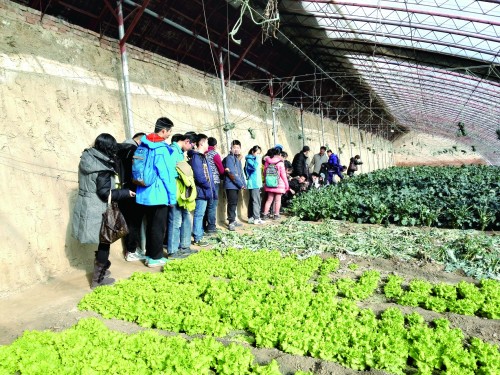
The vegetables at "Natural Symphony" farm are growing beautifully.
Slowing down to follow the rhythm of plant growth
On the coldest day of this winter in Beijing, Wang Mian, wearing a coat and with his hands tucked in, walked briskly along the farm path, beside which lay a long-frozen lake. He turned his head and shouted to a Youth Reference reporter who was barely keeping up, saying he planned to raise fish in it someday, but his voice was quickly swallowed by the shivering cold wind.
In the freezing weather, the restroom standing alone in the garden had long been frozen solid, but as soon as one stepped into Wang Mian's "destination" - the kitchen - a wave of heat rushed over them. The aunt hired to cook had prepared noodles and fried sauce, and three or four young men stood around the steaming stove, holding bowls and eating quickly; there was no need at all to add a few more chairs in the cramped room.
The vegetable greenhouse, covered with thick cotton quilts and exposed to direct sunlight, became the only warm place during the day. That afternoon, Wang Mian sat inside and chatted with the reporter for more than two hours. Natural Symphony's employees sat nearby drinking water, listening to music and reading books, thoroughly at ease.
Growing vegetables really does not take much time. Several young people live together in a small wooden house next to the park, wash vegetables and cook together, then spend another three or four hours chatting about everything under the sun, which in Beijing, a city accustomed to restlessness and a fast pace, seems almost luxurious. In Wang Mian's words, this leisurely and carefree life is like "slowing down to follow the rhythm of plants."
Since childhood, Wang Mian has suffered from a disease that currently cannot be cured. He does not have particularly abundant energy, and in the afternoon he has only one or two hours when he can handle affairs; he may even fall asleep regardless of time or occasion. In the past, when working a nine-to-five job, he had to spend two or three hours commuting every day and also had to check WeChat and make phone calls, which left him feeling stretched beyond his strength. Today's slow-paced life seems almost tailor-made for him.
In the eyes of Wei Xuke, who is in charge of customer relations, this boss, who speaks slowly and deliberately and smiles with warm simplicity, is capable, clear-minded and has unique insights into problems, "very charismatic," and is also a "wildly imaginative" talent whom no one can refute even when he is being unreasonable.
Wei Xuke quit a good job in the medical device industry to grow vegetables. His family naturally did not agree, feeling that he was "asking for trouble, jumping from comfort and stability into deep water and scorching fire." But this post-90s boy's reason was that he "wanted to seriously do something," which is probably the common idea of many young entrepreneurs. This startup has few employees, and every one of them could be considered a highly educated elite, but so far no one has taken a single cent in salary.
"Boss Wang is a person with ideas, he has a good grasp of the general direction, and we trust his ability." Wei Xuke told Youth Reference, "The next outlet should be agriculture, and there will be progress."
"Don't stick the 'returnee' label on me"
Wang Mian, born in 1981, is a genuine old Beijinger. After graduating from Dalian University of Technology in 2004, this engineering student, who liked to think when he had nothing else to do, planned out of "boredom" to go abroad to "get a diploma and broaden his horizons." That trip lasted 6 years.
During the three and a half years he studied in France, the phrase "no money" was almost the main theme of Wang Mian's life. In order to repay student loans from the government and banks and pay living expenses, every day besides studying he worked: washing dishes, chopping vegetables, preparing cold fresh food and making desserts in restaurants; picking peaches and apricots and harvesting lavender on farms; cleaning toilets at train stations; handing out newspapers in subway stations; and driving to big cities such as Brussels and Cologne to buy LV bags on behalf of people back home. As long as it met his own moral standards, he "did everything."
Fortunately, France is a very inclusive country with diverse value standards. When poor students evaded fares on the bus, the driver always turned a blind eye, and would even open the back door to help them escape when someone was checking tickets. This made Wang Mian realize that not everyone has to copy the same behavioral system.
"Whether it is bitter or not is only your own inner feeling." Wang Mian recalled to a Youth Reference reporter, "At that stage, I was able to live peacefully, living a life I recognized and that had value."
After graduation, this boy, who had gone abroad with the idea of "giving his parents and himself one more choice," stayed in France to struggle. At first, he could only rent a cheap bunk in a high-rise building; 3 bunk beds in a 10-square-meter space housed 5 people, and most of his roommates were undocumented migrants from around the world harboring a "European dream," each with their own story.
After paying off his loans, Wang Mian, who had obtained two master's degrees in economics, smoothly got a job at the Paris representative office of the Export-Import Bank of China, but the monotonous days made him tired of it. His original goal had already been achieved, France's social environment was too dull, and his personal growth had hit a ceiling - all reasons he wanted to leave. Wang Mian originally had the opportunity to immigrate (Weibo) to Canada to marry, but that place was not suitable for his parents, nor did it offer much room for him to develop.
And so, Wang Mian, who had not returned to China even once in 6 years, unexpectedly came back to Beijing. Half a month later, he, who had originally planned to travel in Southeast Asia for half a year, got a job opportunity, and so naturally joined the real estate company "Sunshine 100."
When he first returned to China, because his Chinese expression was poor and his speech was slow, Wang Mian did go through a period of adjustment to fit in. But whenever "returnee" was mentioned, he hurried to draw a clear line, saying, "Don't stick a label on me."
Wang Mian did not feel he was a typical "returnee," nor had he joined any association, because "the social circles and ways of entertainment are all different." In his view, "returnees" do not have traits or commonalities that distinguish them from other groups; instead, differences in family background are obvious, and the family brands of "rich second generation," "official second generation" and "grassroots" can be seen at a glance.
In 2012, after working at "Sunshine 100" for two years, Wang Mian, dissatisfied with the existing benefit distribution system, decided to end his blind rushing about and do a career that could "reflect his own value." Soon, agriculture, which could "satisfy his and his friends' need for clean vegetables," entered his field of vision.
"Forrest Gump grows vegetables": what is needed is persistence, simplicity and clear goals
When he first quit his job to start a business, the reason Wang Mian, who knew almost nothing about agriculture, chose to "become a farmer" was more than half because agriculture had a "low threshold" and little competition, so even "grassroots" people without much capital could enter. After plunging headlong into the countryside, he realized that the seemingly low threshold was actually because "inside and outside the door are the same, wind blows through from all sides, and the roof leaks rain." Once he stepped in, "it was deep up to his neck, and he nearly drowned."
During the year and a half of growing organic strawberries in Changping, Wang Mian roughly found his direction and way out, but he had no funds to carry out his ideas, and was even fooled quite a bit by cunning local farmers. His girlfriend at the time lived with him in a small farmyard with 3 rooms, and the living conditions were bitterly poor; in winter there was no heating, and when taking a shower they shivered with cold.
The path of entrepreneurship is never easy. After sinking several hundred thousand yuan of savings into it, Wang Mian realized that he "did not have the ability to manage something that big." In 2013, he moved to the Jiuxianqiao area, which was closer to the city and had higher rent. To save costs, he dismissed all the workers and mobilized his parents to grow strawberries with him; the family of three lived in a crude tool room beside the greenhouse. While friends of the same age steadily settled into stable lives with cars, homes, marriage and children, Wang Mian, busy "stirring things up," broke up amicably with his girlfriend.