Leather tycoon returns home to raise pigs, high-end talent flows back to explore a new path for agricultural transformation
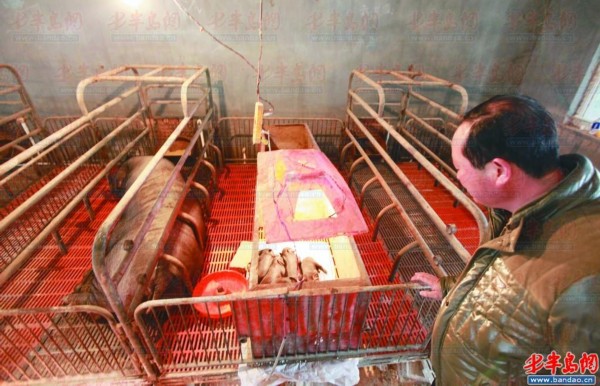
At the Jiaozhou Licha Black Pig Breeding Base, newborn piglets are placed in incubators.
Liangxiang No. 1 Village, a thousand-year-old village in the northwest corner of Licha Town, Jiaozhou, sits at the junction of Gaomi, Zhucheng, Jiaozhou and Qingxi New Area. Its location is relatively remote, but it is precisely in such a place that rows of Western-style buildings have recently sprung up, and a modern residential community with uniform decoration stands out strikingly. During the holidays when visiting relatives, villagers from far and wide come here to take a look. If you ask what lies behind all this, the answer is one phrase: high-end agriculture.
No more yangge dancing, now it's square dancing
On February 20, at the start of the Chinese New Year, more villagers moved into the village-built community one after another. On the paved roads, modern community facilities can be seen everywhere. At the square at the entrance of the village, several elderly people are practicing square dancing. The village has also built a kindergarten and an activity room, and no parent has to worry about difficulty getting into kindergarten. "I really envy them. Seniors aged 65 can move in with just their bags, and it doesn't cost them a cent. Once they moved into the buildings, they stopped doing the big yangge and switched to square dancing." Mrs. Zhang, who came from Zhucheng to visit relatives, lives only a few kilometers from this village. In her eyes, Liangxiang No. 1 Village has already achieved "moderate prosperity" ahead of schedule.
"Living in there is very comfortable. Every building is equipped with heating, water heaters and elevators. Since moving into the building, even my arthritis has gotten better." Mr. Zhao, 70, and his wife lived in a tile-roofed house for most of their lives, and never expected to live a "city life" in their lifetime. In the eyes of the villagers, all of this is thanks to their leader Zhao Bo. These buildings were all built with his personal funds.
Raising pigs is "raising credibility"
Who is Zhao Bo? The "Licha Black Pig" brand well known to Island City residents comes from him. Today, it can be seen not only within the province, but also in major cities such as Beijing and Shanghai. "It could quickly reach the whole country in such a short time because of credibility." Zhao Bo, head of the Jiaozhou Licha Black Pig Breeding Base, said that it looks like they are raising pigs, but in fact they are "raising credibility."
Zhao Bo said that raising credibility starts with raising safety. "I supervise the entire breeding process. All sales stores are directly operated. Anything unsold after 42 hours is fully removed from the shelves. There can be no negligence whatsoever in food safety." Over the years, the "Licha Black" brand has won recognition from more and more consumers, which is why it has advanced step by step to the whole country.
Zhao Bo's other identity is village director of Liangxiang No. 1 Village, Licha Town, Jiaozhou. In the 1980s, after graduating from a secondary specialized school, he was assigned to a bank in Jiaozhou. Years of working in the bank allowed him to accumulate a lot of experience, especially in judging economic trends, where he "had a knack." During that period, he became interested in export trade, so he resolutely resigned from the bank and entered the leather trade, thereby earning his first pot of gold. When business was good, annual export volume reached hundreds of millions.
With money in hand, Zhao Bo returned to his hometown to open a pig farm. He said it was not to make money. The Licha Black is a pig breed with local characteristics, but many people do not know about it and have neglected its protection. Seeing such a good breed on the verge of extinction, he felt it was especially regrettable. As a true native of Licha, Zhao Bo has always had deep feelings for black pigs. With the government's help, by the end of 2007, he built a breed conservation farm of more than 100 mu.
"Every year the state also allocates some funds to support me in operating the breed conservation farm. At first, raising pigs was just for breed conservation. When the pigs grew up, they were not sold, and were generally only kept for relatives and friends to eat." Zhao Bo recalled that after a few years, the inventory gradually increased. "We simply could not eat it all, and only then did we think of selling externally." Since then, black pork began to leave Licha, reach Qingdao, reach the province, and then move toward the whole country.
Zhao Bo revealed that Licha black pork has already established a one-stop sales network from production and breeding to finished pork. Its sales method is through the currently popular membership system, with the highest price reaching 80 yuan per jin, five to six times that of ordinary pork. Even so, it is often in short supply.
Why is Licha black pork so precious? In Zhao Bo's view, the first reason is the pig breed. It is a distinctive calling card for Jiaozhou, Qingdao and even Shandong Province. "Licha black pigs are large in size and have 1 to 2 more thoracic and lumbar vertebrae than ordinary pigs. It is China's only pig breed and the world's second pig breed with the multi-rib trait. It also has more lean meat, making it more suitable for modern people's eating habits." Zhao Bo said.
The original ecological breeding method is another weight on the scale: natural mating, natural growth and free movement. "It can be said to be pigs fed with grain." Zhao Bo said that some farms currently mainly feed formula feed, and pigs can generally be sent to market in four and a half months or even faster. "These pigs are locked in cages, with less than 0.7 sq m of floor space, and can hardly move." Zhao Bo said that each pen in his farm is divided into three parts: a fermentation bed, an exercise area and a concrete floor. Each pen is about 1,500 sq m, and no more than 100 pigs are raised inside.
"The feed is all mixed by ourselves. The only ingredients are corn, bran, soybeans, bone meal and salt. It generally takes more than 10 months before they are sent to market." Although he currently has two farms and an annual market volume of only a few thousand head, "right now it is basically in short supply, and we steadily make millions a year."
Can sentiment really put food on the table?
Licha black pigs are just one example of the development of high-end agriculture in Island City. In recent years, high-end agriculture has blossomed everywhere in Island City, and a large number of agricultural brand enterprises have emerged. According to data from the Qingdao Municipal Agriculture Commission, as of January 2016, the city had more than 700 leisure agriculture operators above designated size, accounting for 10% of the province.
Returning to tradition and returning to nature, through developing ecological agriculture, the vegetable base in Lijiapo Village, Jiangshan Town, Laixi, has also tasted the sweetness. Especially during this year's Spring Festival, sales in just a few days exceeded 2 million yuan. "Winter output is inherently low, and the base's agricultural products were basically all sold out." On the afternoon of February 21, base head Li Hongtao said in an introduction.
Li Hongtao was originally a real estate developer who made his fortune from land, yet deep in his heart he always held another kind of feeling for the land. "Farmers working the land all depend on the weather for their living. Without a brand, they cannot get a good price, and the added value of the land is too low. Moreover, because of the abuse of pesticides and chemical fertilizers, the grain and vegetables grown in the fields also make people uneasy to eat... Can this situation be changed? Of course it can! Didn't our ancestors also grow grain and raise generation after generation?" In 2009, he decided to return to his hometown to grow vegetables.
That year, he transferred 100 mu of land and restarted his life as a farmer. "It is about returning to tradition, using the most ordinary planting model, not applying a single grain of chemical fertilizer, not spraying a single drop of pesticide." Li Hongtao uses farmyard manure to grow vegetables, catches insects by hand and weeds by hand. Although he suffered repeated setbacks at first, he did not give up and kept exploring continuously. His vegetable-growing experience became richer and richer. Especially starting in 2014, his planting methods achieved results. Not only did output increase, but more importantly, "green and environmentally friendly" won recognition from consumers. Losses turned into profits. In 2015, Li Hongtao's income reached 2 million yuan.
The villagers also benefited. After land transfer, farmers can receive fixed rent every year and can also work on Li Hongtao's farm to earn money. "In the past, growing wheat and corn, we worked hard all year and could not earn much money. Now, not only do we collect rent every year through land transfer, but we have also realized the dream of working near home to earn money. Working at the vegetable base for a year, you can get more than 20,000." said Old Li, a villager in his 70s.
High-end talent returns home to promote transformation