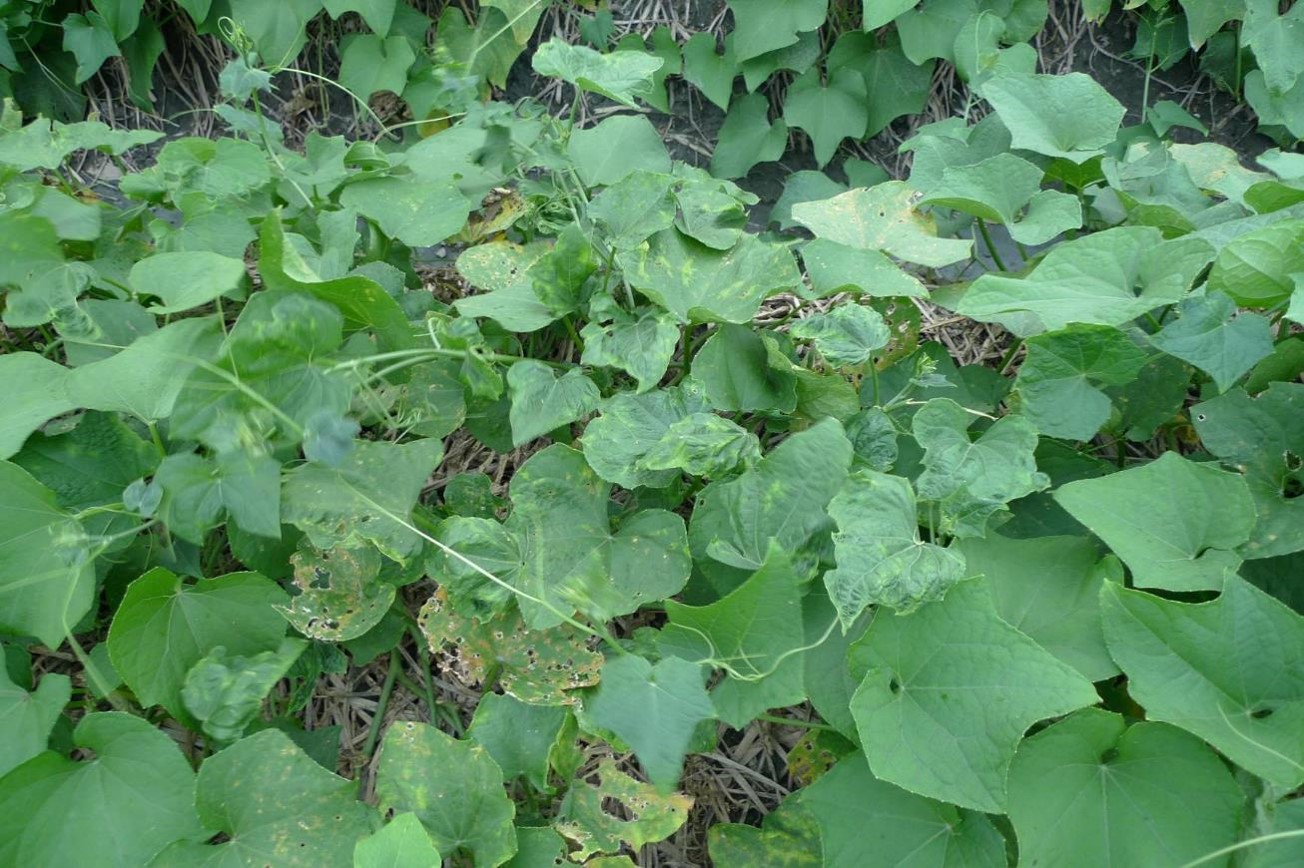
How to prevent and control gummy stem blight and viral diseases spreading in farmland due to temperature and continuous rainfall?
Recently, temperatures have gradually risen, and combined with continuous rainfall, the weather has been unstable. The Hualien District Agricultural Research and Extension Station has found that "gummy stem blight" and "viral diseases" are gradually spreading in the chayote shoot fields of the Ji'an area in Hualien County. Farmers are advised to take preventive measures as early as possible to avoid affecting subsequent yields.
According to statistics from the Council of Agriculture, in 2017 (the 106th year of the Republic of China calendar), the planted area of chayote shoots reached 361.27 hectares, of which Hualien County accounted for 184.27 hectares, with production areas concentrated in Ji'an Township.
How to prevent gummy stem blight? The Hualien Station recommends the following
If chayote shoots are infected with gummy stem blight, severe cases can even cause the plants to wither and die. Gummy stem blight generally begins to occur from mid-to-late April to early May, especially in continuously cropped fields, where planting is too dense, ventilation is poor, and nitrogen fertilizer is excessive, the disease occurs more severely. Gummy stem blight can be spread by airflow, rain and wind splashing, or irrigation water. The pathogen can survive in diseased plant residues and soil, becoming a continuous source of infection.
The Hualien Station recommends that since gummy stem blight can be spread through seedlings, using healthy seed gourds is the primary task for reducing the disease. Farmers should remove diseased plants and not discard diseased plants in the field; continuous cropping of the same crop will gradually accumulate the pathogen population. Farmers can adopt a 3-to-5-year cycle of rotation with different crops or fallow, especially rotation with paddy fields, which is most effective in reducing disease occurrence.
As for whether to use chemical control? Cai Yizhen, assistant researcher at the Hualien Station, said that because chayote shoots are relatively vigorous plants, local farmers rarely spray chemicals. If chemical application is needed, consult the Plant Protection Information System. When applying, use chemicals prudently to avoid damage and excessive pesticide residues.
The Hualien Station also recommends that after rain, snails easily hide in the bushes and chew on chayote plants, and the wounds caused may also increase infection. Farmers are advised to apply pesticides or approved materials at appropriate times to control snails; do not apply excessive nitrogen fertilizer to avoid worsening the disease; organic farmers can apply microbial preparations and non-pesticide materials such as phosphorous acid for control to alleviate pest and disease problems.
No recommended chemicals for viral diseases; removing diseased plants is advised
As for viral diseases causing new leaves to appear unevenly yellow-green with curled leaf shapes, affecting young shoot yields, Cai Yizhen pointed out that there are currently no recommended chemicals for controlling viral diseases. Farmers are advised to remove diseased plants as much as possible to avoid leaving infection sources in the field. Viral diseases can be transmitted by silverleaf whiteflies. Farmers can apply pesticides to control whiteflies and carry out proper field management to reduce disease occurrence in the field. If farmers have questions about the prevention and control of gummy stem blight and viral diseases in chayote shoots, they can contact the Hualien District Agricultural Research and Extension Station or make good use of online diagnosis.