Wang Hui has every wheat trait memorized after half a century of breeding
Original title: Breeding expert Wang Hui: Half a century watching over wheat fields, cultivating the "breeding dream"
In 1995, his breeding of the wheat variety Xinong 84G6 won the second prize of the Shaanxi Provincial Science and Technology Progress Award. In 1999, his breeding of the wheat variety Xinong 1376 won the first prize of the Shaanxi Provincial Science and Technology Progress Award. In 2012 he was honored with the "Shaanxi Highest Science and Technology Achievement Award". In November 2015 he received the title of "2015 Touching Shaanxi Figure"...
Now he is an old man past seventy, yet he still works the wheat fields himself and devotes himself to research. The excellent breeding results obtained through half a century of arduous labor have not only made outstanding contributions to national food security, but also brought tangible well-being to the people.
He is the famous Chinese breeding expert and professor at Northwest A&F University, Wang Hui.
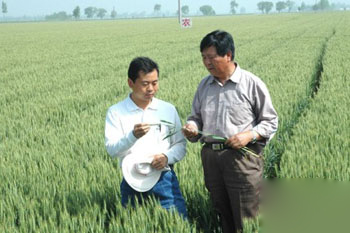
May 2010, Wang Hui (right) and a team assistant inspecting wheat seedling emergence. Photo courtesy of Wang Hui
Facing the reporter, he was plain and sincere: "I must be worthy of these honors. Although I am old, as long as my health allows, I will still keep at it and carry this work on."
A dream takes root and sprouts in youth
In that era, the dream of most young people was to get into university. In 1964, Wang Hui was admitted to Northwest Agricultural College as he wished. "After the three years of natural disasters, I saw what it was like for farmers to go hungry, so studying agriculture came from the heart." Concerned for the food and clothing of his fellow villagers, Wang Hui chose the agricultural science major without hesitation.
During his time at university, Wang Hui treasured the opportunity to study especially highly, leaving early and returning late every day. Agriculture students would face production in the future, so besides studying theoretical knowledge, learning grassroots production techniques was also indispensable. In 1968, after graduating from university, Wang Hui entered a military farm for training and went through a tough learning process, but the rewards were rich as well. Through this practical training, Wang Hui gained a basic grounding in and mastery of practical production operations such as cultivation, breeding and field management, laying a solid foundation for his later wheat breeding research.
Taking love as the starting point, washing away the hardships of research with the joy of harvest
In 1987, Wang Hui was transferred to the breeding teaching and research group to do teaching, with research work as a side duty. So he began breeding research in the school's two-mu breeding teaching experimental field. At first there was no experimental funding, so he made up for it with his own salary. When manpower was insufficient, he called on his family to serve as free labor. Every September he prepared the soil, applied fertilizer, marked rows, divided plots and set up experiments; in October he sowed; in winter and spring he carried out field observation records, disease-resistance identification, pollination and hybridization and field management; in summer he carried out harvesting, drying, indoor seed selection, experiment summaries and experiment arrangements... And so, day after day, year after year, Wang Hui began his field breeding career full of hardship and sweat.
Once this began, it lasted for more than several decades. In the wheat fields, he was the most plain and honest old farmer, drop after drop of sweat falling into the soil, blending with the wheat fields through the changing seasons into scene after scene of diligent labor, whether sowing, tilling or harvesting; in the laboratory in the evening, he was the most focused scientific research expert, reviewing, recording and organizing the data observed in the wheat fields during the day. The agronomic traits of every wheat material, how fast it developed, and so on, were all imprinted in his mind, vivid before his eyes.
Looking during the day and summing up at night, forming an impression in his mind, is a habit Wang Hui has kept for many years. "If breeding work cannot achieve this, and relies only on writing it in a notebook, it is useless. In the end, the records and the person become separated," Wang Hui said.
October 2012, Wang Hui during autumn sowing. Photo courtesy of Wang Hui
If decades of hard field labor and painstaking research are the key factors in Wang Hui's success, then his love for the cause of wheat breeding is the starting point of everything. From the initial simple and plain dream of solving the food and clothing problem of his fellow villagers, to successfully developing many excellent wheat varieties and bringing real benefits to the people, he has always had the common people at heart and never felt that he was making some sacrifice or contribution; everything was so natural. For him, the greatest reward was none other than seeing the scene of harvest. "Standing in the vast wheat fields of Xinong 979, seeing the farmers' joy at harvest, my mood is like a breeze blowing over wheat waves in golden autumn; that sense of ease and joy can wash away all fatigue and hardship," Wang Hui said.
Leaving the wheat field and the laboratory, in order to bring the excellent varieties he had bred before the people and turn scientific research results into real productivity, he was also the most tireless person rushing about everywhere. Shaanxi, Henan, Anhui and Jiangsu all bear his footprints.
Wang Hui said: "Although breeding is rather hard, once a variety is successfully bred and you see its contribution to society, you feel very happy inside. There is hardship and joy, but I think there is still more sweetness." Amid hardship and sweetness, one variety after another came into being... From 1991, when his first wheat variety "Xinong 84G6" was born, to Xinong 1376, Xinong 2611 and Xinong 979, which passed national approval, and other wheat varieties, a total of 11 have been developed, with promotion area exceeding 150 million mu, cumulative increased wheat production of more than 4 billion kg, and newly added output value of about 9 billion yuan.
November 2015, Wang Hui (second from left) and team members inspecting wheat seedling emergence. Photo courtesy of Wang Hui
Never forgetting his teachers' grace and keeping inheritance in mind, the breeding dream is passed on from generation to generation
An old man past seventy could have retired after success and enjoyed leisure. But Wang Hui has never stopped, nor has he ever thought of stopping. He said: "Breeding is a process of continuously fulfilling dreams, without end. I still want, through my own efforts, to dedicate more and better varieties to society."
He keeps inheritance in mind: "I learned a great deal from the older generation of breeders at the local bases and from my esteemed teacher Academician Zhao Hongzhang. Therefore, I also hope to pass on some of my unique insights in breeding, especially practical experience, to young people engaged in breeding work, so that they can grow quickly and play their due role as soon as possible, and also pass on the breeding sentiments of the older generation together."
To young people engaged in wheat breeding, Wang Hui stressed that wheat breeding must not only value experiments, but even more value field practice. He said: "Breeding work is like raising a child; if you do not come into contact with the child, you cannot understand the child's temperament. Wheat is the same. Only by frequently observing and recording can you know what problems exist in a material and from which aspects to improve it."
He also stressed the need to carry out more production surveys and understand problems in production. He said: "Breeding is a work of exploration and innovation. Whether this innovation truly meets the needs of agricultural production can only be determined through verification in production practice."