Three generations of grain kings discuss grain farming: nothing beats grain farming
Original title: "Grain kings" talk about grain farming in early spring
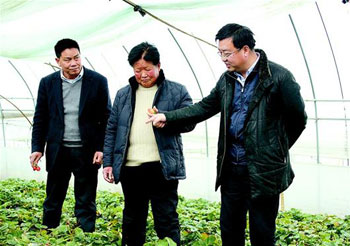
Tan Lunwei (first from right) is introducing strawberry cultivation to Wu Huaping (first from left) and Liu Wenbao (center). (Online image source: Hubei Daily, photographed by reporter Jiang Yuebo)
On February 17, the tenth day of the first lunar month, "first-generation grain king" Liu Wenbao and "National Top Ten Farmer" Wu Huaping made a special trip to Chunhui Agricultural Cooperative in Xiaonan District, Xiaogan City, Hubei Province, to visit Tan Lunwei, a deputy to the 12th National People's Congress and chairman of the Chunhui Cooperative. With the new year came new conversation, and their shared cause of grain farming quickly got the three "grain kings" chatting familiarly.
Liu Wenbao, now in his seventies, was one of the earliest typical representatives of large-scale operations in the early period of China's rural reform. In 1989, he walked from the field ridges of Xiangyang, Hubei, into Zhongnanhai and became a "first-generation grain king" praised by the State Council leader at the time. Over the years, through family-based land reclamation and operation, he endured many setbacks but remained unwavering, moving between Hubei, Ningxia and other places to grow grain on tens of thousands of mu.
Old Liu was the first to open up. Looking back on his investments in non-agricultural industries in recent years, returns were ordinary, and he felt that "after a lifetime of growing grain, it feels uncomfortable not to grow it now; I still want to return to agriculture." Last year, he took his two sons to Inner Mongolia and other places to investigate, preparing to develop desert land and grow grain again. This visit to Chunhui was also to see whether there was suitable land for subcontracting. But Old Liu also pointed out that relying only on family operation makes it hard to become big and strong. To grow grain well on a large scale, one must both think quickly and rely on economic strength.
"Last year's grain price situation was ordinary. On the surface, for ordinary farmers it was a crisis, but for Huafeng Cooperative, it was an opportunity." The 53-year-old Wu Huaping is from Tianmen, Hubei. At the beginning of this year, he was just named one of the "National Top Ten Farmers" by the Ministry of Agriculture. For more than 30 years, Wu Huaping has never left the word "agriculture." He said that in the past the cooperative had to beg farmers to transfer land, but now farmers take the initiative to find the cooperative to transfer land.
Why is that? Isn't it because the cooperative's returns are good! Wu Huaping, once awarded the title "National Major Grain Grower and Seller" by the State Council, has led Huafeng Agricultural Professional Cooperative through 10 years of development. With the cooperative leading large households in grain farming as its main mode of operation, it has already transferred more than 80,000 mu of land, and members' average annual income is 86,000 yuan. Wu Huaping said that selenium-enriched rice and ratoon rice are the main products for the cooperative's future development of premium grain, and projects such as combining planting and breeding, straw utilization, and overseas grain farming are under negotiation and implementation.
"On the land transferred by Chunhui, grain farming is still the main business." The Chunhui Group founded by Tan Lunwei, who is not yet 48, is a large private enterprise featuring "integration of industry and agriculture, urban-rural integration, and fusion of primary, secondary and tertiary industries." In 2010, relying on Chunhui Rice Industry as the leader, it implemented the "Chunhui model" of land operation and transfer through "enterprise + cooperative," hailed as a banner of modern agriculture in Hubei. In recent years, its farmland has been around 100,000 mu, making it a new-generation "grain king" in Hubei.
"No matter how market conditions change, Chunhui's promised guaranteed rent to farmers of 360 jin of medium indica rice per mu will not change." Tan Lunwei admitted that in research activities organized by the National People's Congress, he found that under current grain market conditions, labor and production material costs only rise and never fall, and the pressure of grain farming is growing. Chunhui also has to rely on developing comprehensive agricultural projects to subsidize fields that purely grow grain crops.
Tan Lunwei introduced that starting in 2012, Chunhui gradually adjusted its grain farming structure. First, it optimized grain varieties, shifting from ordinary middle rice to high-quality rice. Then it adjusted low-yield rice areas such as mountainous and hilly land to grow vegetables, melons and fruits and other cash crops, and developed forestry, breeding, and sightseeing and leisure agriculture. The Chunhui Modern Agricultural Expo Park, built by making use of the landscape, has already begun to take shape. (Staff reporter He Hongwei, Le Mingkai, Hubei Daily reporter Jiang Yuebo)