Migrant workers who move to the city may see their dreams come to nothing once they lose their jobs
Original title: Farmer representatives from the Hunan delegation vie to speak about "agriculture"
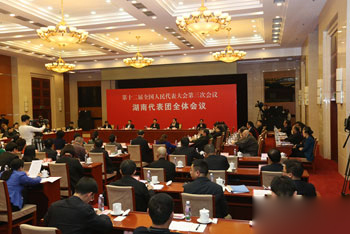
On the afternoon of the 3rd, the Hunan delegation attending the Third Session of the 12th National People's Congress held its first plenary meeting at its residence. (Online illustration: Photo by Zhang Mu, Hunan Daily reporter)
On the afternoon of March 3, in Room 1519 of the Guoyi Hotel, the residence of the Hunan delegation to the National People's Congress, heated discussion could be heard. Zhang Qing'e, a villager from Yanfeng Village in Anhua County, Zhang Xiaoqing, a marketing promoter at Hunan Sunward Intelligent Equipment Co., Ltd., and Yang Juanjuan, director of the village committee of Zhanwang Village in Caojia Town, Xinhua County, gathered in the room of their "big sister" Pan Runlan, secretary of the Party branch of Huaminglou Community in Ningxiang County, heatedly discussing the new problems they had found in grassroots rural areas over the past year. Seeing the reporter come in, they invited the reporter to sit down, "Come and listen to the voices of the farmers we bring."
Tax rebates to help leisure agriculture get through the winter off-season
"During last year's autumn harvest, a farmer friend in my social media feed posted a photo of golden corn. I commented, 'Another bumper harvest year.' But the farmer friend replied that grain doesn't sell for a good price, and they can't even come up with the labor cost for harvesting the corn." Zhang Xiaoqing, whose hometown is in rural Shandong, opened up the conversation.
"Exactly. Last year I went to Xi'an in Shaanxi and Shanghai for research, and representatives from various places mentioned this problem in discussions. A bumper grain harvest is a good situation, but how to increase farmers' incomes still requires new support policies." Zhang Qing'e picked up the thread.
Zhang Qing'e is no ordinary rural woman. In the 1980s, she organized her hometown's first transport fleet. Now she has also built the Meishan Culture Park, which carries on fishing and farming culture. In her research, she found that farmers cannot rely solely on farming to earn money. "Leisure agriculture is a good path to increasing farmers' incomes, but leisure agriculture also has a 'winter.'"
Through her research, Zhang Qing'e found that rural leisure tourism run by farmers has almost no visitors for one-third of the year. "In winter, the leaves fall, the lake freezes, and the roads into the mountains are hard to travel. Who would come to visit? This makes it impossible for leisure agriculture to support people, retain people, or develop sustainably."
"Moreover, when farmers open agritainment businesses, the catering tax is more than eight percent, which is itself a heavy burden. And if leisure agriculture is done well, it is itself the best solution to the rural 'three left-behind' problem." Yang Juanjuan added.
"Could we propose a support policy of tax reduction, exemption and rebates for leisure agriculture?" Zhang Qing'e suggested. "Return the taxes collected in peak season to farmers at a certain proportion during the off-season, lighten their burden, and support them in developing with more staying power." Zhang Qing'e's proposal was endorsed by several representatives.
Migrant workers have entered the city, but still far from living and working in contentment
Zhang Xiaoqing is a representative of migrant workers. Born in rural areas, she has now bought a house in Changsha and lives a "city person's" life. But through research in multiple communities, she found that migrant workers who have entered the city are still far from living and working in contentment.
"Many migrant workers rent or even buy homes in urban communities, but they rarely participate in community cultural activities, training or exchanges. I did research in one community and asked whether migrant workers living in the neighborhood could receive vocational training organized by the residents' committee if they lost their jobs. The answer was that if they came forward to register themselves, they could participate, but almost no migrant workers had ever actively come to register." Zhang Xiaoqing said.
"Migrant workers have put in hard work building the city, and now destocking also needs the new generation of migrant workers to contribute. But when it comes to enjoying unified urban social services, migrant workers are still a weak spot." The suggestion Zhang Xiaoqing brought this time is to incorporate migrant workers who are "scattered fighters" into community services, into unemployment insurance and training. "If the city wants to accept these people, it must organize them well, register them, and bring them into the insurance system."
Pan Runlan said: "Not just unemployment insurance. In rural areas, after many elderly migrant workers lose their labor capacity, their children become the new generation of migrant workers, and they themselves become left-behind elderly people who can't even get a hot meal. The pension insurance payments are too small. How to build nursing homes that rural elderly people can afford is the key to solving the elderly care problem for farmers."
Building their hometowns, farmers expect fairer resource distribution
"The Party Central Committee proposed 'mass entrepreneurship and innovation.' This path has stimulated rural vitality. Many young people have returned home to start businesses and build rural areas more beautifully. But there are almost no 'entrepreneurship incubation bases' in rural areas like there are in cities. Funding and policy support are scarce in rural areas. How to help those post-80s and post-90s farmer entrepreneurs overcome obstacles in starting businesses, and support them so they still have a chance to make a comeback after failure? Local governments need to come up with supporting policies, resources and funding support plans." Zhang Qing'e said.
Pan Runlan nodded. "The biggest obstacle to urban-rural integration is unequal distribution under the dual system." She gave an example: our country's policy on compensation for death is that after civil servants, including retired personnel of enterprises and public institutions, die, there is compensation of 20 to 40 months of their basic salary or basic retirement pension. Farmers have none. "Everyone should be equal. Moreover, the base for farmers' pension insurance is very low. I have brought a suggestion this time that after farmers die, compensation should also be given at 24 months based on the existing pension insurance base. This would also help encourage rural children to support their elderly parents."
Yang Juanjuan said, we also call for the medical and health system to tilt toward rural areas. Although the new rural cooperative medical system has basically achieved full coverage in rural areas, grassroots medical and health conditions are too poor. Once farmers contract a relatively serious illness, they can't even buy medicine at grassroots hospitals. If they go to large provincial or municipal hospitals for treatment, the reimbursement rate drops sharply, directly leading to many cases of "poverty caused by illness" and "returning to poverty due to illness." "We hope medical reform will tilt toward county- and township-level grassroots hospitals and solve the problems of farmers having difficulty seeing doctors and high medical costs as soon as possible."
It was already mealtime, but the representatives were still not done talking. "After the 18th National Congress, farmers' lives have gotten better day by day, and rural areas have become more beautiful day by day. But we still hope that in the broader effort to build a moderately prosperous society in all respects, farmers can run faster, rural weak spots can be filled more completely, and rural areas won't hold back the cause of building a moderately prosperous society in all respects." said Pan Runlan, who has served as a grassroots village Party secretary for many years. (Reporter Guo Shaoya)