The Secret of How Modern Agriculture Helps Farmers Increase Their Income
Original title: Accelerate the Development of Modern Agriculture and Promote Steady Growth in Farmers' Income
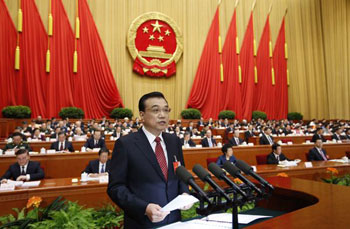
On March 5, 2016, at the fourth session of the 12th National People's Congress, Premier Li Keqiang of the State Council delivered the government work report. (Online illustration)
This year, we must accelerate the development of modern agriculture and promote steady growth in farmers' income. We will continue to work tirelessly on matters related to agriculture, rural areas, and farmers, improve policies that strengthen agriculture, benefit farmers, and enrich rural areas, deepen rural reform, expand channels for farmers' employment and income growth, and focus on improving the quality, efficiency, and competitiveness of agriculture.
Accelerate agricultural structural adjustment. The consecutive increase in grain output has provided a strong guarantee for stabilizing prices and improving people's livelihoods, but it also faces problems such as a substantial increase in inventory and falling market prices. We must guide farmers to adjust their planting and breeding structures in response to market demand and appropriately reduce the corn planting area. Following the principle of "market pricing and separation of price from subsidies," we will actively and steadily advance the reform of the corn purchase and storage system to protect farmers' reasonable returns. We must take multiple measures to digest grain inventory, vigorously support intensive processing of agricultural products, and extend the agricultural industry chain; formulate a new round of plans for returning farmland to forest and grassland, returning 15 million mu of farmland to forest and grassland this year. This is a measure that yields multiple benefits, and we must do it well. Actively develop various forms of appropriately scaled agricultural operations, improve support policies for new types of operating entities such as family farms, specialized large-scale farmers, and farmers' cooperatives, encourage farmers to transfer contracted land in accordance with the law, voluntarily, and with compensation, and carry out land share cooperation, joint operations, or land trusteeship. Deepen reform of rural collective property rights, state farms, collective forest rights, state-owned forest farms, farmland water conservancy, and supply and marketing cooperatives.
Strengthen the foundational support for agriculture. Comprehensively complete the designation of permanent basic farmland and implement special protection, strengthen the construction of high-standard farmland, increase deep-loosened land by 150 million mu, and add 20 million mu of efficient water-saving irrigation area. Explore pilot programs for crop rotation and fallow systems on cultivated land. Strengthen innovation in and promotion of agricultural science and technology, carry out in-depth efforts to create green, high-yield, and high-efficiency grain production, and implement an action plan for zero growth in chemical fertilizers and pesticides. Guarantee fiscal investment in agriculture, establish a nationwide agricultural credit guarantee system, improve the agricultural insurance system, and guide and mobilize more funds toward modern agriculture.
Improve rural public services. Increase investment in rural infrastructure, build or renovate 200,000 kilometers of rural roads, and accelerate the connection of qualified townships and administrative villages to hardened roads and bus services. Step up the new round of rural power grid renovation and upgrading, and within two years achieve stable and reliable power supply services in rural areas and full coverage of electrification for motor-pumped wells in plain areas. Implement projects to consolidate and improve drinking water safety. Promote e-commerce in rural areas. Build beautiful and livable villages.
Implement the poverty alleviation project. Resolutely win the battle against poverty, lift rural poor people under China's current standards out of poverty, remove all poor counties from the poverty list, and resolve regional overall poverty. This year, we must complete the task of lifting more than 10 million rural poor people out of poverty, including more than 2 million through relocation from inhospitable areas, and continue to promote the renovation of dilapidated houses for poor farmer households. Central government poverty alleviation funds will increase by 43.4%. Promote the integration of agriculture-related funds in poor counties. Persist in targeted poverty alleviation and eradication, with measures tailored to different people and places. Vigorously cultivate distinctive industries and support employment and entrepreneurship. Solve problems such as access to roads, water, electricity, and networks, and enhance the development capacity of contiguous areas of extreme poverty. All national policies benefiting the people and livelihood projects should be tilted toward poor areas. Carry out in-depth designated poverty alleviation and East-West collaborative poverty alleviation, and support social forces in participating in the battle against poverty. Poverty alleviation and eradication are hard tasks. Governments at all levels have made solemn pledges and must complete them on time with quality and quantity assured.
Expected economic growth of 6.5%-7%
The main expected goals for development this year are: GDP growth of 6.5%-7%, consumer price increase of around 3%, more than 10 million new urban jobs, registered urban unemployment rate within 4.5%, imports and exports stabilizing and improving, a basically balanced international payment position, and residents' income growth basically in step with economic growth. Energy consumption per unit of GDP will fall by more than 3.4%, and emissions of major pollutants will continue to decrease.
The expected economic growth target of 6.5%-7% takes into account the need to align with the goal of building a moderately prosperous society in all respects and the need to advance structural reform, and it also helps stabilize and guide market expectations. Stabilizing growth is mainly to protect employment and benefit people's livelihoods. A growth rate of 6.5%-7% is enough to achieve relatively full employment.
Supply-side structural reform
This year, we must strengthen supply-side structural reform and enhance the momentum for sustained growth. Focusing on resolving prominent contradictions and problems in key areas, accelerate the removal of institutional obstacles, use supply-side structural reform to improve the quality and efficiency of the supply system, and further stimulate market vitality and social creativity.
Advance the reform of streamlining administration, delegating power, combining decentralization with regulation, and optimizing services to greater depth. Continue to vigorously cut administrative approval items, focus on solving the problems of unsynchronized, uncoordinated, and incomplete delegation of power, and for delegated approval items, ensure that local authorities can take them on and manage them well. Vigorously promote "Internet + government services," realize data sharing among departments, and let residents and enterprises make fewer trips, get things done more easily, and encounter fewer obstacles. Simplify excessive and harsh regulations, prohibit unlawful inspections, and give the people more equal opportunities and greater room for creativity.
Fully unleash the entrepreneurial and innovative potential of society as a whole. First, strengthen the principal role of enterprises in innovation. Second, give play to the multiplier effect of mass entrepreneurship and innovation and "Internet +" in pooling wisdom and strength. Third, deepen reform of the science and technology management system.
Focus on resolving overcapacity and reducing costs while increasing efficiency. Focus on cutting overcapacity in difficult industries such as steel and coal, adhere to market pressure, enterprise as the main body, local organization, and central support, and use economic, legal, technical, environmental, quality, and safety means to strictly control new capacity, resolutely eliminate backward capacity, and orderly withdraw excess capacity. Take measures such as mergers and reorganizations, debt restructuring, or bankruptcy liquidation to actively and steadily handle "zombie enterprises." Improve supportive policies such as fiscal and financial policies. The central government will allocate 100 billion yuan in special reward and subsidy funds, focusing on the resettlement of workers.
Strive to improve the supply of products and services. First, improve the quality of consumer goods. Accelerate the alignment of quality and safety standards with international standards and establish a punitive compensation system for commodity quality. Encourage enterprises to carry out personalized customization and flexible production, cultivate a craftsman spirit of striving for perfection, increase variety, improve quality, and create brands. Second, promote the upgrading of manufacturing. Deepen the advancement of "Made in China + Internet," build a number of national-level manufacturing innovation platforms, implement a batch of intelligent manufacturing demonstration projects, and launch major projects such as industrial foundation strengthening, green manufacturing, and high-end equipment. Implement accelerated depreciation policies and organize the implementation of major technological transformation and upgrading projects. Third, accelerate the development of modern services. Launch a new round of national comprehensive reform pilot programs for the service sector, implement innovation projects for high-tech services, and vigorously develop the digital creative industry. Relax market access and improve the specialization of producer services and the refinement of consumer services. Build a batch of optical network cities, promote fiber-optic access in 50,000 administrative villages, and let more urban and rural residents enjoy digital life.
New economy
Accelerate the continuous transformation between old and new growth drivers. Economic development inevitably involves a process in which old and new drivers iterate and replace one another. When traditional drivers weaken, new drivers need to emerge rapidly and traditional drivers need to transform, forming a new "dual engine" to drive sustained economic growth and reach a new level. At present, China's development is in such a critical period, and we must cultivate and strengthen new drivers and accelerate the development of the new economy. We must promote the rapid growth of new technologies, new industries, and new business forms, use institutional and mechanism innovation to promote the development of the sharing economy, build sharing platforms, expand emerging industrial clusters such as high-tech industries and modern services, and create a powerful new engine. Use modern technologies such as information networks to promote changes in production, management, and marketing models, reshape industrial chains, supply chains, and value chains, and transform and upgrade traditional drivers so that they radiate new vitality and vigor.