Southern China may face a late-spring cold spell with low temperatures and heavy rain, putting agricultural production to the test
Original title: Parts of central and eastern China to see localized temperature drops of over 10°C next week; southern China may face a late-spring cold spell
According to China Weather Web, next week (March 8-11), a strong cold air mass will sweep across most of China, bringing sharp temperature drops to central and eastern China, with some areas seeing temperature drops of 10-12°C. Southern China may experience a "late-spring cold spell," and localized areas in Jiangnan will see minimum temperatures approaching historical extremes. This cold air mass will reverse the current pattern of above-average temperatures, with the cold striking back.
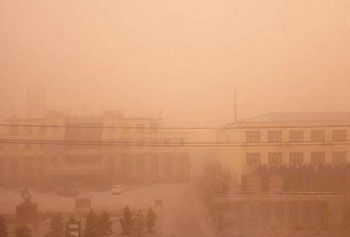
On March 4, Inner Mongolia was hit by a strong sandstorm, with the sky turning a murky yellow. Photo by Liang Shuai
At 8 a.m. on the 5th, snow accumulation in the Greater Khingan Mountains reached 9.8 cm. (Image source: Greater Khingan Mountains Meteorological Observatory)
The cold air mass that began affecting China on the 3rd is now nearing its end. Under the influence of this cold air mass, northern China experienced its largest-scale sandstorm event of the year so far, and northeastern China saw heavy snowfall. As the cold air moves eastward and southward, temperatures in the middle and lower reaches of the Yangtze River and other areas will drop noticeably today. However, because this cold air mass is relatively weak, the temperature fluctuations for most areas will not be significant, and overall temperatures will remain at relatively high levels. The middle and lower reaches of the Yangtze River and Jiangnan will still feel as warm as April.
Next week, a strong cold air mass will sweep across most of China. Compared with the previous one, this cold air mass will be stronger, bringing drastic temperature drops to a wide range of areas across China, reversing the current pattern of above-average temperatures, with the cold striking back. Southern China will be more strongly affected, with significant temperature drops and widespread rain and snow, and many places may experience a "late-spring cold spell." Localized areas in Jiangnan will see minimum temperatures approaching historical extremes.
National minimum temperature forecast map (March 8-11)
The National Meteorological Center forecasts that from the 8th to the 11th, temperatures in eastern Northwest China, North China, southern Northeast China, and the Huanghuai region will drop by 6-8°C. Among these, the Beijing area, affected by the strong cold air mass, will see temperatures drop by 6-8°C from the 8th to the 10th, with nighttime minimum temperatures dropping to around minus 4°C. Southern China will experience cold wave conditions, with temperature drops in Jianghan, Jiangnan, and northern South China reaching 10-12°C; around the 11th, minimum temperatures in parts of Jiangnan and Guizhou will drop to around 0°C, and minimum temperatures in northern South China will drop to 2-4°C; localized minimum temperatures in Jiangnan will approach the extreme low for the same period in history (mid-March) of -1°C.
National precipitation forecast map (March 7-10)
At the same time, Jiangnan, South China, and other areas will see significant rainfall, and the middle and lower reaches of the Yangtze River will also see rain turning to sleet. The National Meteorological Center forecasts that from the 7th to the 10th, southern Jianghuai, southern Jianghan, Jiangnan, and northern South China will see moderate to heavy rain (15-30 mm), with localized rainstorms in Jiangnan (50-80 mm); around the 10th, parts of the middle and lower reaches of the Yangtze River will see rain turning to sleet.
In addition, parts of Northwest China and Inner Mongolia will also see dusty weather. The National Meteorological Center forecasts that from the 8th to the 9th, most of Northwest China and North China will see winds of force 4-6, with gusts reaching around force 7. Among these, the Beijing area will see northerly winds of around force 4, with gusts of force 6-7; **the southern Xinjiang basin, western Qinghai, western Gansu, northern Ningxia, and western Inner Mongolia will see floating dust or blowing sand, with localized sandstorms in the southern Xinjiang basin.
Affected by the strong cold air mass, daily minimum temperatures in parts of Jiangnan may drop to around 0°C, and daily average temperatures in northern South China may drop below 12°C, which is unfavorable for rapeseed growth and rice seedling cultivation; field management needs to be strengthened, and defenses against low temperatures and frost damage need to be well implemented. In addition, measures such as reinforcing facility greenhouses should be taken to defend against the adverse effects of strong winds.
At the same time, it is also necessary to guard against the adverse effects of rain and snow on transportation, urban operations, and other aspects in central and eastern China. Southern China, especially Jiangnan, also needs to guard against geological disasters that may be triggered by localized heavy rainfall.
In addition, Northwest China and other areas need to pay attention to guarding against the adverse effects of strong winds and dusty weather on human health, facility agriculture, animal husbandry, and transportation.