Be a Good "Lead Sheep" for the Hui People on the Road to Poverty Alleviation and Prosperity
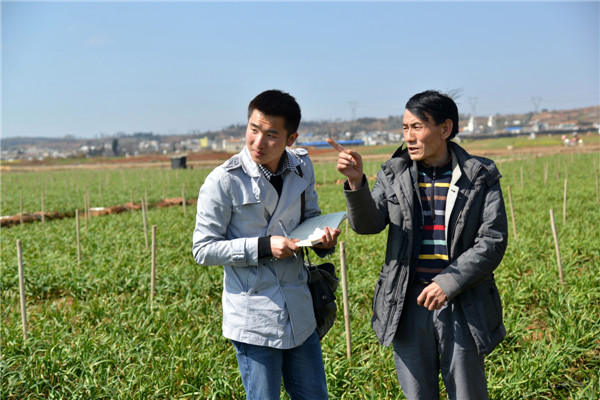
Reporter interviewing Ma Zhenhua at the yellow-bud chive planting base
Just after the Spring Festival, the 350 mu of yellow-bud chives in Hongxing Village regained their vitality after a heavy snowfall, and the stubble that had been cut not long ago was showing new green. Ma Zhenhua was busy among the field ridges in the chilly spring, patiently guiding the workers as they watered and fertilized the chives.
"What I feared most was that this heavy snowfall would freeze even the chive roots. Fortunately, we only lost one round of chives, and that was already unavoidable! As long as we tend and cultivate them carefully, the loss can soon be made up." Ma Zhenhua told the reporter with full confidence that farming is a livelihood that depends on the weather, and it is impossible to avoid risk altogether. As long as we do our utmost to provide technical support to the people, help them withstand risks, keep sales channels open, and develop together as a group, we can lead the people to prosperity together.
"I have only one goal: to lead the people to prosperity!"
Hongxing Village is located in the western flatland area of Baishui Town, Luxi County. It is a traditional Hui village with more people and less land, and the problem of farmers' poverty is relatively serious. Ma Zhenhua, now 54 years old, is the Party branch secretary of Hongxing Village. After graduating from high school, he entered the Hongxing Village group and successively served as head of the Hongxing Village group, deputy director and director of the Hongxing Village committee, and in 2013 became Party branch secretary of Hongxing Village, a position he has held to this day. "Do as much as your ability allows. I have only one goal: to lead the people to prosperity!" This is Ma Zhenhua's promise to the people. "Secretary Ma never makes empty promises." In the eyes of the people, he is a trustworthy village cadre.
For many years, Hongxing Village relied on the "single tobacco economy." In recent years, because flue-cured tobacco planting has been subject to policy regulation and other "substitute" crops have been emerging, the people's income growth has been slow, and the collective economy was once at "zero." Seeing that his fellow villagers' "pockets" still could not swell, Ma Zhenhua felt the heavy burden on his shoulders. If they only developed traditional industries and relied on the people to struggle alone, even daily living expenses would be a problem, let alone achieving prosperity. So what could be relied on to lead the people out of poverty and toward prosperity? Ma Zhenhua tossed and turned night after night, and finally came up with a new path for the people to prosper: only by adjusting the industrial structure, developing high-efficiency agriculture, and implementing a "shareholding cooperative economy" project around distinctive industries could they boost the "double increase and win-win" of both the people and the collective!
"The people of Hongxing have no habit of doing business or going elsewhere to work. For generations they have been farmers, living off 'a small plot of land.' 'Food is the first necessity of the people.' As long as we put enough effort into the land, we can lead the people out of poverty and toward prosperity." Ma Zhenhua decided to go first himself and find a path suited to Hongxing Village's current conditions. "If you want the people to be willing to follow you, your own path to prosperity must stand the test." He knew this road was full of thorns, but he had to walk it. Only after succeeding himself could he feel at ease leading the people. To lead the people in adjusting the industrial structure, Ma Zhenhua took out a loan of 200,000 yuan and led 3 Party members to jointly transfer 110 mu of land to plant Erigeron breviscapus. He voluntarily bore the risk himself, becoming "the first person to eat the tomato" and taking the "key first step" of experimenting first. After the Erigeron breviscapus attempt failed, he began trying to develop marigolds, pyrethrum, and ginkgo. Due to lack of experience, an unstable market, and many other factors, after several years he lost everything and was in debt everywhere.
As the saying goes, money buys experience. Ma Zhenhua had paid his "tuition" in full, and he had become more meticulous, but "poverty gives rise to the desire for change," and his courage did not shrink. In order to fulfill his promise to the people, he became braver with each setback. "Enthusiasm alone cannot accomplish great things!" He had never felt such urgency to learn knowledge as he did now. He began to spend all day looking up materials to study and traveling everywhere to investigate. In 2015, taking the "dual advancement" as an opportunity, he repeatedly led village and group cadres to investigate and learn about the market at places such as Mile Dongfeng Farm and the Eastern Yunnan Agricultural Products Trading Market. He found that planting yellow-bud chives had a high price, a good market, small investment, and technology that was easy to learn. After sufficient investigation and demonstration, Ma Zhenhua carefully calculated an economic account. Wanting to "borrow strength" to solve technical support and open up sales channels, he invited technicians and sales experts from Mile and Yuxi. He signed a purchase "order" with Yuxi Chengliang Agricultural Development Co., Ltd., and Hongxing Village launched the yellow-bud chive planting project under the "shareholding cooperative economy" for strengthening the foundation and benefiting farmers. In the first round, more than 100 mu were planted, and by the time the first round of chives was cut, his costs had already been recovered. When the people saw the tangible benefits, they rushed to follow suit. The enthusiasm of those working at the base and those learning techniques, eager to build prosperous families, was suddenly ignited.
"Only when the two committees work as one rope and speak with one voice can the people have cohesion!"
The news that Ma Zhenhua was leading the people to prosperity spread quickly, and everyone praised him behind his back and to his face as "amazing." He had his own explanation: "I alone can do nothing. Only when the village committee's 'two committees' work as one rope and speak with one voice can the people have cohesion!" Today, the "shareholding cooperative economy" projects in Hongxing Village are blooming in every village, professional cooperative organizations are springing up, religious relations are harmonious, and a magnificent picture of strong organization, excellent service, thriving industry, and prosperous people is unfolding across the red land. This is thanks to Hongxing Village having a contingent of grassroots cadres with strong politics and fine work style, guiding Party members, cadres, and the people to trust the Party more, rely on the Party, and support the Party, striding forward under the Party's leadership and jointly pursuing the road to moderate prosperity and prosperity.
"Uniting the Hui people to build a Hui village with harmonious religion and prosperity and strength is my bounden duty!" Ma Zhenhua is a veteran Party member and also a Hui cadre, and he well understands the heavy responsibility on his shoulders. He has never interrupted his study of the Party's political theory and principles and policies. How to publicize the Party's principles and policies through the mosque management committee and be a good "clear-minded person and leader"? How to strengthen the Party's leadership and political function, guide the people in developing industries, and lead the people to prosperity? These are the questions Ma Zhenhua has thought about most since becoming Party branch secretary. "We usually have many opportunities to participate in study. The 'three meetings and one lesson,' the Party member distance education platform, and so on are all means for us to study. The content is mainly the Party's principles and policies and ideas on how to become prosperous." Village Party members said that, in addition to improving his own political literacy, Secretary Ma never relaxed for a moment about the study and growth of the team members.
Ma Zhenhua always put "doing a good job in Party building to promote development" first, grasping both the software development of the village Party branch and the hardware development of rural infrastructure. In response to problems among some Party members and cadres such as outdated knowledge, weakened ability, and rigid thinking, Ma Zhenhua led by example, taking the lead in earnestly studying policy theory, practical rural technology, market economy knowledge, and more. He gave prominence to team building, held many meetings, analyzed the problems existing in the team, and carried out targeted rectification of the work style of the "three committees." He took the "three meetings and one lesson," the distance education platform, and other measures as specific rectification steps, insisting on organizing one concentrated study and discussion every month and conducting practical rural technology training every 2 months, leading village cadres to pressure themselves and improve themselves. At the same time, he secured 2.7 million yuan in funding for the "Beautiful Homeland" construction project and built a new 120-square-meter Party branch activity room in Xiaohongxing Village; coordinated 60,000 yuan to repair 7 schoolrooms of the former Kebao Primary School and convert them into a 150-square-meter Party member activity room; and led Party members and the people to actively integrate into the "dual advancement" work of poverty alleviation and development and grassroots Party building in Baishui Town. In the 1,070-meter village access road hardening project in Hongxing Village, cadres and the people worked together to handle the "three piles" cleanup, sanitation improvement, traffic control, dispute mediation, manpower supplementation, and other tasks during construction.
Ma Zhenhua actively promoted "grid-based management services." According to standards ranging from 50 to 150 households, Hongxing Village was divided into 10 grids, and each grid elected 1 grid leader, allowing the more than 4,800 grid Party members and people in Hongxing Village's 10 grid areas to be "active" in grid services. They carried out services in batches on a rotating basis, including duty shifts, comprehensive governance patrols, sanitation improvement, industry publicity, and household errands. In this way, village reserve cadres, Party member development candidates, and capable prosperity leaders were trained, produced, and tempered in the grids. As a result, a regular working pattern naturally formed of organizing people through grids, cultivating people through grids, serving people through grids, and uniting people through grids. The Party building "small grid" gradually became a "big stage" for people's self-governance in ethnic and religious areas. The Party's work gradually extended to the "nerve endings," and the role of grassroots Party organizations was continuously brought to the forefront.