Eel Farming Success: Guangdong Woman Achieves Wealth Through Self-Taught Skills Near Age 50
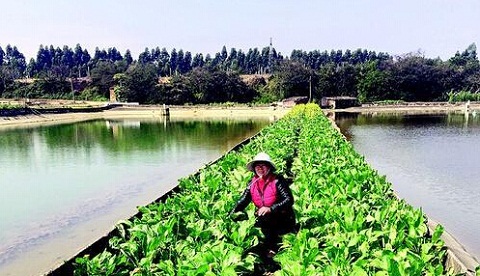
After becoming wealthy, Liu Qiumei still continues to tend her vegetable patch.
Goose City Tales Abound
International Women's Day is coming up soon. With comprehensive economic and social development, women are receiving more and more applause in life and in the workplace. Among the townships of Huicheng District, many people who have found prosperity are hardworking, down-to-earth rural women who dare to think and act boldly. On their journey of entrepreneurship and chasing dreams, they have had laughter and tears, but never once thought of giving up. Liu Qiumei, a villager from Henghe Village, Ma'an Town, Huicheng District, is exactly such a woman who forever runs on the road of building dreams. Nearly 50 years old, she struggled and strived for 8 years for her ideals and carved out a path to prosperity by farming soft-shelled turtles and eels.
Working to Learn Skills, Then Opening an Eel Farm
The time goes back to 1998, when Ma'an watermelons were making a name for themselves in the Guangdong market. At that time, Liu Qiumei was just an ordinary rural woman, growing green vegetables and watermelons in her fields. Liu Qiumei often gazed at her tiny plot of land and felt despondent: toiling year-round, yet the family finances remained tight. It felt to Liu Qiumei as if she had swallowed an unripe fruit, a bitter and astringent feeling, and she was unwilling to accept it.
"I'm still young. I can't spend my whole life in the countryside in poverty like this." Liu Qiumei acted as soon as she decided, setting out to learn about agricultural product market information. She saw a business opportunity in Ma'an watermelon sales, contracted over 50 mu of wasteland in Henghe Village, Ma'an Town, and trial-planted the off-season "Black Beauty" watermelon introduced from Taiwan, China. Working from dawn to dusk, she and her husband earned their first pot of gold together.
After 2000, more and more people were growing watermelons on the market, and off-season watermelons had lost their competitiveness. Liu Qiumei began to think again and seek a new way out. "At that time, there were Taiwanese, China businessmen in the village farming soft-shelled turtles and eels on a large scale. Some villagers worked at the farms and could earn more than 1000 yuan a month, much more than farming." Liu Qiumei secured a job at a farm, learned some basic farming techniques on the job, and in her spare time pored over numerous books on eel and soft-shelled turtle farming. She and her husband encouraged each other and strove toward the ideal of having their own farm. In 2007, they finally had their own eel farm, and their entrepreneurial dream gradually became reality.
Teaching "Fish-Farming Secrets" to Fellow Villagers
Like all entrepreneurs, Liu Qiumei had to learn to face sudden setbacks and blows. At that time, there were no artificially bred seedlings yet; what they bought were all natural seedlings from the market. Due to lack of farming experience, the seedlings Liu Qiumei and her husband bought twice in a row were completely wiped out. More than 2000 seedlings were lost just like that, the borrowed money was spent, and reality dealt Liu Qiumei a heavy blow.
After a painful lesson, she took stock. The strong-willed Liu Qiumei did not give up. The experience of failure taught her that to ensure the survival rate of seedlings, one must pay attention to seedling quality when purchasing. Liu Qiumei preliminarily explored a new approach to eel farming. She kept researching relevant knowledge and even learned to go online to look up information. The eel farm slowly began to generate returns.
"Actually, life was really hard back then. I don't even know how I got through it." Liu Qiumei said that when the farm had just started, income was still unstable. She had to take care of the family's farmland and also work at the farm. She had to get up before dawn every day to add feed for the fry and disinfect the farm, and late at night she had to get up again to make a round of the farm to observe the fish's growth and health. If she found anything abnormal, she would diagnose and treat it promptly, not daring to be the least bit negligent.
"No matter how hard or tiring it is, I still have to grit my teeth and get through it. If my technical skills are insufficient, I must hurry up and learn." Although Liu Qiumei was so exhausted every day that her legs felt like they were filled with lead, she did not relax her technical studies in the slightest. She bought many books on eel farming and squeezed out time like wringing water from a sponge, gnawing through them one by one in every spare moment. Gradually she mastered techniques for eel breeding, harvesting, transportation, and grow-out farming, as well as knowledge of eel pond construction, water quality management, eel nutrition and feed, and eel disease prevention and treatment.
Excellence in work comes from diligence. Through study and practice, Liu Qiumei ultimately mastered the full set of eel-farming techniques. The eels she raised had plump, fine flesh, and merchants came to her door to buy them, with sales reaching as far as Guangxi, Jiangxi, and other places. This gave Liu Qiumei even more confidence, and she further expanded the scale of her eel farm. In 2009, the farm was expanded to 230 mu. She also diversified investment risks by developing the farming of the four major Chinese carps and soft-shelled turtles, and the current annual output value reached more than 1 million yuan.
Relying on her willingness to learn and work hard, Liu Qiumei, then 46 years old, finally figured out the path to prosperity. Even more admirable is that after becoming wealthy, Liu Qiumei did not forget her fellow villagers and did not hide her "fish-farming secrets." Whenever villagers came to ask for advice, she taught them everything she knew, sometimes even lending money to struggling villagers for cash flow, and even letting them take fry first and pay after selling the fish. Under her leadership and technical guidance, the surrounding villagers all began farming eels and soft-shelled turtles, increasing their incomes.