No idle time in the farming off-season: Bai Jingchao is busy starting a business and making money
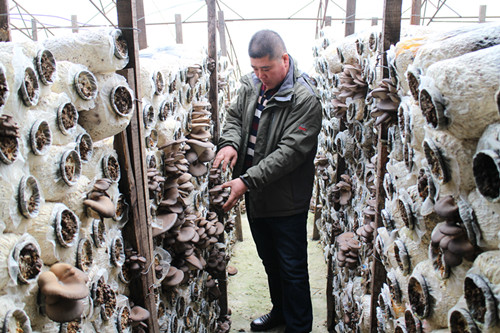
Photo shows farmers working at a mushroom cultivation cooperative.
The snow has not melted and the ground has not thawed. At this time of year, the farmers of Xinhua Tun, Shengxiang Village, Shuangfeng Street, Acheng District, who used to "hibernate" every year, are not idle this year. Busy with what? The reporter went to the tun to find out.
Walking into the home of villager Bai Fengxia, she was sitting on the kang tying plastic bags. "In the past, after the autumn harvest, we would 'hibernate,' playing cards and mahjong at home, visiting one household after another, and not start farming until the next spring," she told the reporter. "Ever since the Jingchao Mushroom Cultivation Base was set up in the village, we have all been busy." As she spoke, her hands did not slow down. In no time, the tied plastic bags beside her piled up into a heap. "These plastic bags are used to hold mushroom raw materials. Tying one bag earns 0.01 yuan. At most I can tie 3,000 bags a day, earning 30 yuan."
The Jingchao Mushroom Cultivation Base that Bai Fengxia mentioned was jointly founded by village resident Bai Jingchao and four other farming households. The reporter followed him into the greenhouse where the mushrooms are cultivated.
Inside the greenhouse, the reporter saw mushroom bags neatly placed on rows of shelves. A farmland microclimate observation instrument showed a temperature of 8°C and air humidity of 77%. Bai Jingchao picked up a spray nozzle and began watering the mushrooms. He told the reporter: "Generally, a greenhouse is fine as long as the temperature is not below minus 5°C. In order to control the temperature and humidity inside the greenhouse well, I have to get up many times at night. It is hard, but after all, this is my own business."
Before starting his business, Bai Jingchao worked for a mushroom grower in another province, learning cultivation techniques while working. Relying on his toughness and willingness to endure hardship, after several years of unremitting effort he mastered mushroom cultivation techniques, and his income during this period kept rising. He could have lived a comfortable life, but he was not satisfied with the status quo. He said: "I can clearly feel that from our country to the local government, the support policies for rural areas, farmers, and agriculture are getting better and better. If I do not make good use of these policies, I feel I would be letting the government down and letting myself down." So he resolutely returned home to start a business and realize his own value.
While chatting, Bai Jingchao yawned repeatedly. "Mushrooms can be produced all year round, with a short cycle, quick results, and high benefits. While enriching citizens' vegetable baskets, they also allow villagers to earn money in winter without going out." Bleary-eyed, he said: "Last night we kept picking mushrooms until nearly 2 a.m., and this morning they were loaded onto trucks and transported to Hada Market for sale." During the interview, the reporter learned that all the workers at the cooperative are farmers from the village. "There are more than 40 households in the whole tun, and more than half of them work at the cooperative." Farmers can both help at the cooperative and not delay cultivating their own land, so it can be said to serve two purposes at once. A villager working there told the reporter: "Working at the cooperative pays 70 yuan/day, and for full attendance each month there is an additional 100 yuan reward. It is much better than sitting idle at home."
Not only that, Bai Jingchao also passed on cultivation techniques to many young people, leading more people to prosper together. Under his demonstration and guidance, another 5 young households began growing oyster mushrooms, and he taught each household hands-on technical skills. Last year, each of these 5 households made a profit of more than 300,000 yuan.
Why help others? Ma Jingchao said frankly: "Starting a business on your own is not that easy. When our cooperative was first established, not only did we not make money, we kept losing money, and cash flow was poor. At that time I really wanted to give up. But later, after the district agricultural department learned about it, it actively helped coordinate with the credit union to lend me 300,000 yuan, helping me solve the funding gap and also helping me find shortcomings in production and operation. Only then did our cooperative get back on track. Tell me, when others have difficulties, can I just stand by and watch? If I can help, I help."
Now the cooperative's land scale has grown from the original more than 1,600 sq m to the current more than 5,000 sq m, and annual mushroom output has also increased from about 100,000 kg at the very beginning to about 200,000 kg now. In addition to growing mushrooms, the cooperative also interplants leafy vegetables and other cash crops in the greenhouses.
Speaking of the cooperative's future development, "Now our government encourages independent entrepreneurship and 'Internet Plus.' I must seize this opportunity well." Bai Jingchao said: "This year I plan to add a drying line. After processing fresh mushrooms, I plan to test the waters of online sales."
During the interview, the reporter learned from the Labor Transfer Office of the Harbin Municipal Agricultural Committee that farmers starting businesses can not only help farmers solve their own employment problems, increase income, and promote agricultural production and modern agricultural development; they also bring capital, technology, and advanced market concepts back to their hometowns. All of this makes superior resources flow from cities to rural areas, providing strong support for the construction of new rural areas and small towns.
In recent years, Harbin has also promoted institutional and mechanism innovation, stimulating the entrepreneurial and innovative vitality of the city's five million farmers. Relying on a series of production and operation entities such as specialized large households, family farms, and rural e-commerce, as well as rural entrepreneurial pioneers such as migrant workers, veterans, and college students, it has fully leveraged Harbin's rural resource advantages, accelerated the optimization and adjustment of the agricultural structure, cultivated and strengthened new rural industries and new business forms, and developed agricultural products suited to consumer needs. This will certainly play a positive role in promoting the continuous optimization of the structure of Harbin's market supply side and advancing agricultural supply-side reform.