Nationwide Strong Winds and Temperature Drop with Rain and Snow, Farm Work Precautions Urgent Around March 8
Original title: Ministry of Agriculture Urgently Deploys Precautions Against Strong Temperature Drop and Cold Wave Rain and Snow Weather
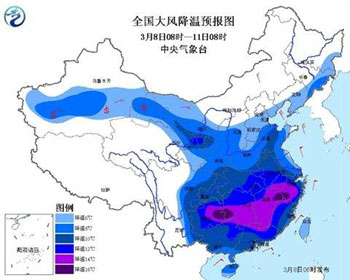
National Strong Winds and Temperature Drop Forecast Map (March 8, 08:00 - March 11, 08:00), file photo: China Weather Network
Currently, it is the critical period for wheat in main producing areas to turn green and joint, for rapeseed to flower, and for early rice seedling raising and transplanting. According to the China Meteorological Administration, from March 8-11, a large-scale rain and snow event and strong temperature drop will successively occur in the central and eastern regions of China, with temperatures dropping 6-8°C, and locally up to 10-12°C. In parts of Jiangnan and Guizhou and other places, the minimum temperature will drop to around 0°C, with some areas approaching historical extremes. In response, the Ministry of Agriculture attaches great importance to this and has urgently deployed precautionary work, requiring agricultural departments of all provinces (autonomous regions and municipalities) to effectively defend against strong temperature drops and cold wave rain and snow weather, make every effort to ensure agricultural production safety, and gain the initiative for winning a summer grain and oil harvest and a full-year agricultural bumper harvest.
First, strengthen organizational leadership. Strong temperature drops and cold wave rain and snow weather will adversely affect the growth and development of wheat and rapeseed, early rice seedling raising, and vegetable and fruit tree production. All localities should base themselves on fighting disasters to secure a bumper harvest, consciously take guarding against strong temperature drops and cold wave rain and snow weather as an important task in current agricultural production, effectively enhance the sense of responsibility and urgency, deploy early, implement responsibilities, conduct scientific assessment, strengthen measures, minimize disaster impacts and losses to the greatest extent, ensure the smooth progress of spring plowing production, strive for a good summer grain and oil harvest, and lay a good foundation for the stable development of agricultural production throughout the year.
Second, strengthen monitoring and early warning. It is necessary to strengthen communication and consultation, pay close attention to weather changes, and release early warning information in a timely manner. Strengthen disaster monitoring and scheduling to ensure timely and accurate information reporting. Use television, radio, mobile phone text messages and other media to release early warning information in a timely manner, and make early preparations in technology, funds, materials and other aspects for guarding against strong temperature drops and cold wave rain and snow.
Third, respond scientifically and effectively. In the northern winter wheat region, in view of the complex seedling situation this year, farmers should be organized to apply fertilizer and water according to local conditions, hoe and press, preserve soil moisture and increase temperature, promote seedling condition transformation and upgrading, and improve cold and frost resistance. For wheat fields with insufficient soil moisture, timely irrigation should be carried out, and according to the leaf color of wheat in the field, nitrogen fertilizer should be applied or foliar fertilizer and plant growth regulators should be sprayed to promote the frozen wheat to restore normal growth and development. In the southern region, rapeseed field management should be strengthened, guiding farmers to timely clear ditches and regulate soil moisture, drain waterlogging and reduce humidity, spray boron fertilizer, phosphorus and potassium fertilizer, etc., and improve stress resistance. Implement anti-freezing and snow-removal measures for vegetables and fruit trees, reinforce greenhouses, regulate temperature and humidity, and enhance heat preservation and cold resistance.
Fourth, provide good guidance services. Organize experts early to refine technical plans for defending against strong temperature drops and cold waves. Organize cadres and technical personnel to go deep into the production frontline and guide farmers to implement cold and frost prevention measures well according to local conditions, timing and seedlings. Once a disaster occurs, quickly organize agricultural technicians to investigate and verify the disaster, and help guide farmers in disaster relief and production recovery. Strengthen demonstration and guidance, and solidly advance the creation of high-yield and high-efficiency grain and research on yield-increasing models. Strengthen the adjustment and transportation of disaster relief production materials, ensure the needs of disaster resistance and self-rescue, and strive to minimize disaster losses. (Long Xin)