Two Sessions Focus: The key to technological innovation lies in treating frontline craftsmen well
Original title: Technological innovation requires treating skilled workers well
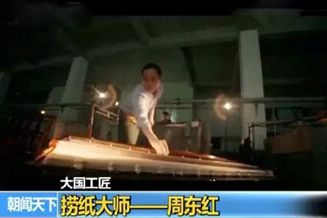
Feature film on craftsmen of a great nation
"Some time ago, I watched 'Craftsmen of a Great Nation.' In the construction of scientific projects, 'craftsman'-type talents play an important role, and they are also the elite of the nation. How do we reward them and protect their interests?" Holding the "Government Work Report" and seeing the importance of talent mentioned repeatedly in it, Wang Chen, a member of the Chinese People's Political Consultative Conference and a nanotechnology expert, once again raised the issue of the treatment of skilled workers, which has been hotly debated in public opinion for many years.
The "Craftsmen of a Great Nation" that Wang Chen mentioned is a series program by CCTV News. It turns its lens on 8 frontline workers in different positions. For example, Hu Shuangqian, the chief fitter in COMAC's large aircraft manufacturing, relies on a pair of hands and a traditional milling and drilling machine to process parts comparable to those made by CNC lathes.
Like Hu Shuangqian, many skilled workers are not project leaders, nor do they have high academic qualifications. However, in the view of Wan Baonian, a member of the Chinese People's Political Consultative Conference and vice president of the Hefei Institutes of Physical Science under the Chinese Academy of Sciences, they are indispensable in scientific teams. "What they can do, PhDs really cannot do!" When doing experiments and research, if instruments and equipment break down, the researchers in the team are helpless, but an experienced technician can fix it. And the importance of skilled workers has become even more prominent with the rise of intelligent manufacturing.
Just one day before this discussion, on the afternoon of the 5th, when President Xi Jinping participated in the deliberation of the Shanghai delegation, he emphasized in his speech that we must find ways to mobilize the enthusiasm of frontline workers, manufacturing workers, and migrant workers, which is also an essential requirement of socialism.
However, such talents also encounter real-world awkwardness. Jiang Hualiang, a member of the Chinese People's Political Consultative Conference and director of the Shanghai Institute of Materia Medica under the Chinese Academy of Sciences, had a lot to say, and he wanted to speak up for an old master worker in his team: "We have a worker in our institute who has done very well, rising from an ordinary worker to a senior engineer. But when it was time to retire, it turned out that 'workers transferred to cadre positions' had to have completed a full ten years to enjoy cadre retirement benefits. He was short by exactly one year, so he still had to retire as a worker." Jiang Hualiang said that by rough calculation, this worker responsible for instrument repair had saved their team 2 million US dollars in repair costs, and was a rare professional talent. "The growth of skilled workers depends on masters mentoring apprentices. But in this environment, how could young people be willing to learn from him? He himself is quite discouraged now and does not want to mentor." Jiang Hualiang lamented that talent should be selected without rigid standards, skilled workers should be given the social status and economic treatment they deserve, and more attention should be given to this workforce. (Reporter Zhang Gailun)