Guangdong rural e-commerce to achieve village-to-village coverage by 2020
Original title: Guangdong rural e-commerce development plan: coverage of all administrative villages by 2020
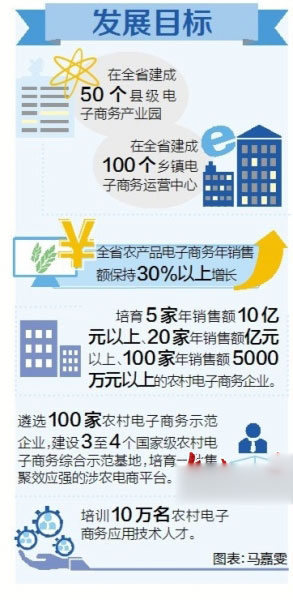
Illustrated guide to the "Implementation Plan for Promoting Rural E-commerce Development in Guangdong Province" (Graphic: Ma Jiawen)
The provincial government recently issued the "Implementation Plan for Promoting Rural E-commerce Development in Guangdong Province" (hereinafter referred to as the "Plan"), requiring coordinated advancement of rural e-commerce development across the province, exploration of the "Internet + Rural" and "Internet + Modern Agriculture" strategies, formation of an online-offline integrated pattern of two-way circulation of agricultural products into cities and agricultural inputs and consumer goods into villages, and promotion of agricultural supply-side reform.
Build 3-4 national-level rural e-commerce bases
The "Plan" proposes that by 2020, the level of rural e-commerce application across the province will be significantly improved, the supporting service system for rural e-commerce will be basically established, two-way circulation channels for urban and rural products will be basically formed, the scale of online sales of agricultural products and rural online shopping will continue to expand, and the overall development level will rank among the top in the country.
At the same time, 50 county-level e-commerce industrial parks and 100 township e-commerce operation centers will be built across the province, achieving full coverage of rural e-commerce service stations in administrative villages. The annual sales of agricultural products via e-commerce across the province will maintain a growth rate of over 30%. The competitiveness of rural e-commerce enterprises will be significantly enhanced, cultivating 5 rural e-commerce enterprises with annual sales of over 1 billion yuan, 20 with annual sales of over 100 million yuan, and 100 with annual sales of over 50 million yuan. Select 100 rural e-commerce demonstration enterprises, build 3 to 4 national-level comprehensive rural e-commerce demonstration bases, and cultivate a number of agriculture-related e-commerce platforms with strong clustering effects. Train 100,000 rural e-commerce application technology talents, significantly improving the quality of practitioners.
Encourage various types of capital to participate in rural e-commerce development
The "Plan" requires expanding funding sources, guiding and encouraging private capital and foreign investment in e-commerce, finance, commerce and trade, and circulation to invest in rural e-commerce. Improve methods and channels for the integrated development of agricultural capital and commercial capital, and support rural small and medium-sized e-commerce enterprises, e-commerce service enterprises, and modern agricultural input enterprises in growing stronger through the capital market.
Promote diversification of investment entities, and introduce well-known domestic and international comprehensive and specialized third-party e-commerce platforms or leading enterprises to invest in the rural market.
In addition, agriculture-related e-commerce enterprises should be developed and strengthened. Support the construction of national e-commerce into rural comprehensive demonstration counties (Longchuan County, Raoping County, Pingyuan County, Nanxiong City) and e-commerce demonstration counties of the All-China Federation of Supply and Marketing Cooperatives (Gaozhou City, Yangshan County, Yingde City, Xinxing County, Dabu County), and cultivate a number of influential rural e-commerce enterprises. Implement the provincial rural e-commerce demonstration project, plan and build clustering zones such as online-offline integrated rural e-commerce industrial parks, science and innovation centers, township e-commerce entrepreneurship centers, and incubation bases, and actively and steadily advance cross-border agricultural product e-commerce pilots.
Support entrepreneurship and employment through e-commerce. Accelerate the construction of rural e-commerce entrepreneurship parks, build rural e-commerce entrepreneurship platforms integrating entrepreneurship guidance, skills training, and investment and financing services for rural youth, and cultivate a number of rural e-commerce professionals. Cultivate new models for increasing farmers' income, promote close linkage between agricultural production, processing and sales, support family farms, large-scale growers, and farmers' professional cooperatives in opening "farmhouse online stores", innovatively develop contract agriculture and online marketing of specialty agricultural products, and drive more farmers to become wealthy through e-commerce entrepreneurship. (Reporter/Liu Qian)