Beidou herding cattle becomes reality, Wan Gang reveals domestic companies already using it
Original title: Companies already use Beidou drones and wifi to herd cattle
-- Minister of Science and Technology Wan Gang and others answer reporters' questions on issues related to "scientific and technological innovation and development"
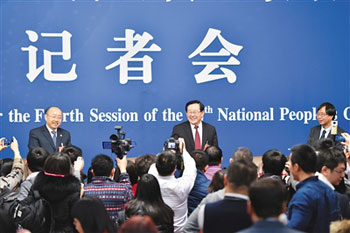
After the press conference, Wan Gang prepares to leave the venue. Photo by Xinhua News Agency reporter Li Xin
"How do we advance supply-side reform in the science and technology field?" "How do we deepen military-civilian integration in science and technology?" "How do we get scientific research results out of the laboratory and let them blossom and bear fruit in the tide of the market?"
On the morning of the 10th, Minister of Science and Technology Wan Gang, National Committee of the Chinese People's Political Consultative Conference member and Executive Vice President of the University of Science and Technology of China Pan Jianwei, and Director of the Zhejiang Provincial Department of Science and Technology Zhou Guohui answered questions from Chinese and foreign reporters on issues related to "scientific and technological innovation and development" at a press conference during the Fourth Session of the 12th National People's Congress.
1. Advancing supply-side reform first requires improving innovation capacity
On how to advance supply-side structural reform in the science and technology field, Wan Gang said the market has great potential demand for science and technology products, and only by improving innovation capacity and advancing supply-side reform can we keep pace with the market.
"The direction of our innovation policy is to enhance original innovation capacity, strengthen integrated innovation, supply in response to market demand, and at the same time carry out introduction, absorption, digestion and re-innovation," Wan Gang said.
Wan Gang said that advancing supply-side reform first requires strengthening innovation capacity, giving play to the momentum of innovation, promoting mass entrepreneurship and innovation, and stimulating the enthusiasm for innovation across society, especially among young people; second, we must focus on improving original innovation capacity, which requires accumulation and development.
2. Last year's 1.4 trillion yuan in R&D spending, over 70 percent from enterprises
The draft outline of the 13th Five-Year Plan proposes that China's whole-society research and development investment intensity should reach the target of 2.5 percent. Wan Gang revealed that among the ten indicators proposed in the 12th Five-Year Plan for science and technology, apart from the ratio of research and experimental development expenditure (R&D) to gross domestic product (GDP), all other indicators have been completed and exceeded their target values. At present, enterprises have become the main body of technological innovation, and many major projects led by enterprises have emerged, such as high-speed rail, nuclear energy, and ultra-high-voltage power transmission and transformation.
Wan Gang said that in 2015 China's whole-society research and development expenditure reached 1,422 billion yuan, of which enterprise spending exceeded 77 percent, and the mode of allocating science and technology resources across society has undergone major changes. "Because enterprises have increased their investment in technological innovation, government funds can be shifted more to basic frontier fields, social public welfare, and national strategic key areas such as aerospace and deep diving, making contributions to building the nation's long-term innovation capacity," Wan Gang said.
3. Praises AI development, but prefers person-versus-person games
In recent days, the "human-versus-machine Go battle" between South Korean 9-dan Go player Lee Sedol and Google's artificial intelligence AlphaGo has been widely discussed, and it also drew the attention of China's Minister of Science and Technology Wan Gang.
He praised the development of artificial intelligence for pushing human labor to a more advanced state, but joked that from the perspective of playing Go, he still prefers person-versus-person games.
On March 9, AlphaGo won its first victory in the match against Lee Sedol. "This match is to be played over five games in total, and we are also paying close attention to what happens later," Wan Gang said.
Wan Gang noted that China has also achieved good development in supercomputers and artificial intelligence, such as Tianhe-2, which has been applied extensively in earthquake simulation, large aircraft design, Ebola virus drug screening, and simulation of the origin of the universe.
4. More than 50,000 fishing boats use Beidou navigation
Speaking of the relationship between major national science and technology projects and people's lives, Wan Gang said that China's major science and technology projects and major engineering projects are closely integrated with daily life. He said, for example, with Beidou navigation, more than 50,000 fishing boats in China use Beidou navigation, and fishing boats can obtain short messages when there is no network; the Jiaolong has dived more than 100 times, and many scientists have followed it into the undersea world.
Wan Gang used the experience of an earlier field visit to explain how closely major science and technology projects and engineering projects are integrated with life: "Recently I went to Inner Mongolia for a field visit. One company uses Beidou to herd cattle, putting collars on the cattle and also using WI-FI. They know what grass the cattle eat and where they are. If they cross the boundary, the herders send a drone to drive them back."
Wan Gang said that a batch of major projects to be implemented during China's 13th Five-Year Plan will, on the one hand, support the accumulation of original innovation and achieve breakthroughs in scientific knowledge. "On the other hand, they will also improve our lives and promote our economic and social development."
5. Make coordinated arrangements for aerospace, deep-sea diving, supercomputing, and more
Wan Gang said that military-civilian integration in the science and technology field currently has some problems of insufficient coordination and poor connectivity, and coordinated arrangements and joint planning will be carried out in aerospace, deep-sea diving, supercomputing, and information technology applications.
Wan Gang said that many private enterprises have already participated in the research and procurement of national defense equipment, and in the future it will be necessary to promote military-civilian integration through mutual openness and mutual use of scientific research facilities, and through talent cultivation. "Scientific exploration actually has no distinction between military and civilian use; the question is where it is used and how to make it play its role more effectively," Wan Gang said.
Pan Jianwei said that as for the sharing of facilities, not only can all domestic scholars share general-purpose scientific research facilities, but scientific research facilities can also be shared through international cooperation.
6. Makerspaces in the future will focus more on the real economy
Wan Gang said that at present there are about 500 makerspaces nationwide that have received various types of national support, and together with the existing business incubators, various university science parks, high-tech zones, and independent innovation demonstration zones, they have formed an entrepreneurship system.
How can makerspaces be better developed next? Wan Gang said that the State Council has issued a document clearly requiring that makerspaces in the future focus more on the real economy in their development, make more use of scientific and technological achievements to drive the upgrading of traditional industries that are large in scale and broad in scope, and better respond to new market demand and potential demand, so as to advance supply-side structural reform. At present, the innovation practices of many enterprises are bringing inspiration. For example, Haier's approach of opening up market sales channels, opening up component resource channels, and opening up manufacturing services both advances the development of mass innovation and advances enterprise transformation and upgrading. (According to Xinhua News Agency, Beijing, March 10 dispatch, reporters Li Wenxi, Han Jie, Luo Sha)