Veteran soldier returns home to start a business in specialty agriculture, leading villagers to prosperity
Farmer Dong Liang holds potatoes in his hands, beaming with joy. Nan Zeliang. In Dongwan Village, Fangdong Town, Luxian County, flocks of plump gray geese can be seen from time to time, waddling along with their feet turned outward, now flapping their wings and searching for food here and there, now flying toward the reservoir with loud honking calls.
The owner of the geese, Zheng Yingwei, was discharged from the Tank Training Regiment of the Wuhan Military Region in November 1985. He worked in Chengdu in the textile industry as a company manager. In March 2013, he returned from Chengdu to his hometown, Group 6 of Dongwan Village, Fangdong Town, and began to pursue his recipe for prosperity through specialty agriculture.
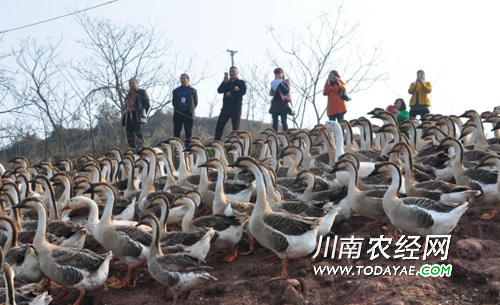
Gray geese
Through more than 3 years of effort, Zheng Yingwei established an ecological circular breeding farm. He now has more than 15,000 geese, an annual turnover of 1,500 sheep, an annual fish output of more than 40,000 jin, sales revenue of 10 million yuan, and profit of more than 1 million yuan, making him a skilled expert in breeding and prosperity in Luxian County. Now he has also planted specialty forest fruits such as moringa and oil tea. Zheng Yingwei has provided employment for more than 50 local farmers in his specialized cooperative, with income of more than 700,000 yuan.
Recently, a reporter from the Agriculture Channel of China Central Television visited his home for a one-week interview to produce a special report on his crop cultivation and breeding business.
Rare breeding brings rapid prosperity
After Zheng Yingwei returned to his hometown of Dongwan Village, with him investing capital and taking the lead, he rented more than 350 mu of land and 27 mu of ponds, set up a family farm, and established a farmers' specialized cooperative.
Zheng Yingwei said, "The goose is also called the wild goose, a swan type, a large migratory bird. It has the characteristics of fast growth, high survival rate, strong reproductive capacity, and strong disease resistance. The goose is not only a delicious dish on people's dining tables, but also an excellent nutritious tonic for strengthening the sinews and boosting yang."
That year his farm raised more than 3,000 geese. In 2014, he planned to expand to more than 10,000, and by 2015 it grew to more than 15,000, including more than 1,500 breeding geese. In artificial breeding of geese, the main food is giant grass, followed by corn and wheat bran. Generally, after about 120 days of feeding, the body weight can reach 4-5 kg, and at the heaviest can reach 8-10 kg.
On July 29, 2014, Chen Zhengli, a professor of animal husbandry at Sichuan Agricultural University, and Wang Haixiang, a PhD in planting science who returned from Canada, came to inspect Zheng Yingwei's family farm and specialized cooperative and encouraged him: "The goose breed is well chosen, and there is huge market space."
The geese he raises are sold exclusively to hotels in Chengdu and Chongqing, and when the price is high, they fetch 70 yuan per jin. The output value of the geese reached more than 2 million yuan, with net profit of more than 800,000 yuan. The giant grass planted in 2013 was expanded to 1,000 mu in 2014. He took the lead in demonstrating grass planting for breeding, driving and guiding farmers to vigorously develop industries such as pigs, sheep, poultry, and fish. After 5 years, he can drive farmers in surrounding areas to plant 10,000 mu of giant grass and build the farm's specialized cooperative into a demonstration base for desertification control seedlings and ecological agriculture in the southern Sichuan region.
Giant grass can be used as feed for geese, goats, free-range chickens, beef cattle, pigs, fish, and other livestock and poultry. After harvesting, the roots and stems of giant grass are also a good raw material for raising goats. Walking into his farm, the keepers were feeding the goats green fodder such as giant grass, and the flock scrambled to eat.
Starting in 2013, Zheng Yingwei built a standard goat farm of more than 3,000 square meters. At present, Zheng Yingwei raises several hundred local goats and practices self-breeding and self-raising, gradually developing to an annual turnover of more than 1,500 adult sheep. The current live sheep sell for 60 to 80 yuan per kg, and annual income can reach more than 600,000 yuan.
Specialty moringa soon to be put into production
Walking into the cooperative's mountain terraces, one can see moringa and rosewood trees more than 2 m tall swaying in the wind.
"In 2013, 4,000 moringa trees were planted. Because moringa is an introduced tree species, it is relatively difficult to overwinter, and in addition there is still a relative lack of technology, so now only more than 1,500 remain. In 2018, it can be put into production, and in the future he will gradually expand the planting," Zheng Yingwei said.
According to reference materials, moringa is hailed as the "tree of life" and the "diamond among plants." It has dietary therapy and health care functions and is widely used in medicine. It is an ornamental tree, and its seeds can be pressed for oil for industrial and craft use. Rosewood is an excellent tree species for greening around homes and in shallow mountainous areas, and is a material for fine woodworking.
Zheng Yingwei plans to build a forestry base of more than 2,000 mu in Dongwan as seedling cultivation for desertification control.
Oil tea planted, awaiting its fragrance
In October 2015, through land transfer, Zheng Yingwei acquired more than 200 mu of land across 24 hills at a transfer fee of 200 yuan per mu. Relying on technical guidance from the Southern Sichuan Forestry Research Institute, he planted more than 30,000 oil tea trees.
According to reports, tea oil is clear in color and fragrant in taste, and is the best edible oil. Every 100 kg of dry tea seeds can be pressed into 23-30 kg of tea oil, and the quality of tea oil can rival that of olive oil. Its main components are unsaturated fatty acids dominated by oleic acid and linoleic acid, with content reaching 88%; tea oil contains no erucic acid or behenic acid, which are difficult for the human body to digest, and contains only extremely low amounts of arachidic acid. After consumption, it is easily digested and can also promote the absorption of fat-soluble vitamins. Tea oil contains no cholesterol that causes hardening of human blood vessels and increased blood pressure, and has a certain therapeutic effect on preventing and treating heart disease and high blood pressure. Therefore, the oil quality is excellent, and tea oil is resistant to storage, not prone to rancidity, and will not produce aflatoxin that can cause cancer in humans.
Looking to the future, Zheng Yingwei told the Southern Sichuan Agricultural Economics Network with great pride: "I will lead nearby villagers to participate in the construction of the oil tea forest base, with a planned planting area of more than 1,000 mu, implementing contracted planting, contracted purchasing, and contracted marketing; at the same time, I will develop agricultural sightseeing and star-rated agritainment, so that more people can experience rural development and nearby villagers can walk the road of common prosperity."