Leading villagers to prosperity, bringing the people's aspirations to the National Two Sessions
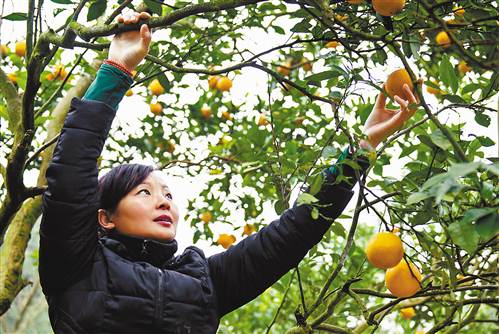
Wang Haiyan picking fruit at the farm.
"Representative Wang, come and look, the water hyacinth is growing so fast it's about to seal off the river surface." On the eve of this year's Spring Festival, by the Qiongjiang River in Tongliang, a villager pointed at the water hyacinth-covered river surface and said to Wang Haiyan.
Wang Haiyan is the Party branch secretary of Fozhen Village, Tianjia Town, Tongnan District, and chairwoman of the Jinguiyuan Cooperative, as well as a 2015 "Chongqing March 8th Red Banner Pacesetter." In addition, she holds another identity - a deputy to the National People's Congress.
Wang Haiyan noted down the demands of the local villagers one by one; she intended to submit a proposal on managing the Qiongjiang River at this year's Two Sessions.
Wang Haiyan had long been concerned about the water pollution of the Qiongjiang River. In 2015, residents of Tongnan, Tongliang, Hechuan and other places had all reported that the water quality in the Qiongjiang River basin was very poor, and during the dry season some sections of the river would give off an odor. Through extensive investigation, Wang Haiyan found that the root of the problem lay in substandard discharges of livestock and poultry farming waste, industrial wastewater, and domestic sewage from upstream provinces.
"It is suggested that the national environmental protection authorities carry out unified planning and coordinated action from top to bottom, establish an ecological compensation mechanism to force water pollution treatment, and promote full coverage of sewage treatment plants." At this year's Fourth Session of the 12th National People's Congress, Wang Haiyan prepared the "Proposal on Advancing Comprehensive Environmental Remediation of the Qiongjiang River Basin."
Wang Haiyan, now 40 years old, worked away from home for 11 years after graduating from high school. After returning home, she used her savings to start a business, planting osmanthus trees and raising free-range chickens. In just over 4 years, she became a major livestock and poultry farmer in Fozhen Village and also became the chairwoman of the cooperative. An elderly Party member in the village approached Wang Haiyan and encouraged her to run for village secretary and lead the villagers to prosperity together.
Wang Haiyan hesitated about the position of village secretary; the cooperative needed managing, and running the chicken farm was no easy task either. After much deliberation, Wang Haiyan still decided to lead everyone forward: "Only when everyone is prosperous will the village become better and better."
In October 2010, Wang Haiyan was elected village secretary. She made a promise to the villagers: she would never give up halfway, and besides leading the villagers to develop industries, she would also pave a village road within 3 years.
How could she lead the villagers to prosperity together? Wang Haiyan chose the "base + farmer" model, leading the villagers to raise chickens and grow mountain vegetables. She would provide the chicks, seeds and technology; the villagers would pay for feed and fertilizer, and she would coordinate sales channels.
In 2012, Wang Haiyan fulfilled her campaign promise - the village's first paved road was completed. She then set a new goal and announced at the villagers' meeting: all roads in the village would also be paved.
"Now the village has 3 pig farms, 1 chicken farm, and 1 goat farm. About 10,000 chickens are raised per year, and 5,000 pigs are marketed annually. The annual per capita income has grown from 4,000-5,000 yuan in 2010 to about 15,000 yuan today." Wang Haiyan proudly introduced that in recent years, by guiding migrant workers to return home and start businesses, not only have all the village roads been paved, but ecological agriculture has also been developing better and better.
Today, against the backdrop of the nation vigorously developing the traditional Chinese medicine industry, Wang Haiyan has led the village to plant Chinese medicinal herbs such as Salvia miltiorrhiza and Gardenia jasminoides. Not only that, she also plans to lead the whole village in developing e-commerce, further expanding sales channels while building Fozhen Village's branded agricultural products, "selling agricultural products farther and helping villagers earn more money."