Porcupine farming helps Deng Zumin get rich
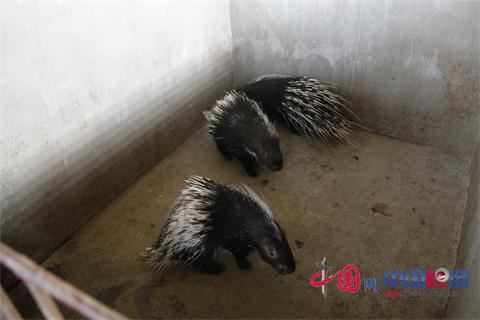
At the porcupine breeding base of Deng Zumin, a villager of Wenguang Village in Wenjing Town, I saw the legendary porcupine for the first time. Their whole bodies are brown, and their backs are covered with black-and-white quills. From a distance, they look like a large hedgehog.
Walking into the nursery pen, I saw the mother porcupine, noticing a stranger approaching, desperately pushing her babies toward the corner of the pen while raising all her quills, the colliding quills making a "swish, swish" sound, and her mouth continuously making "puff... puff..." sounds. Having often seen pictures online of various animals injured by porcupine quills, I retreated in fright. The owner of the farm, Deng Zuming, said with a smile: "Porcupines during lactation are easily startled. She thinks you are going to hurt her young, and is giving you a warning!"
Deng Zuming and his wife are both genuine farmers. The family's economy relied entirely on his wife farming and him working away from home. In 2011, Deng Zuming saw porcupine farming on television. After carefully reading the introduction to the breeding techniques, he became interested in this industry. After hearing that someone in Zhenyuan County was farming porcupines, he immediately went to investigate. After returning and discussing it with his wife, Deng Zuming borrowed 60,000 yuan from relatives and friends that same year, introduced 5 pairs of breeding stock from Zhenyuan, built pens on his own private plot, and began farming porcupines.
"A porcupine is a treasure from head to toe. The meat, brain, oil, heart, liver, gallbladder, stomach, and quills are all medicinal. A commercial porcupine generally weighs about 30 jin, and the price is 2,000 yuan each. Within Jingdong County, we all slaughter them and deliver them to the door!" Deng Zuming said. Porcupines are not picky eaters. They eat corn, wheat, fruits and vegetables, wild vegetables, and wild grasses, everything. Because no feed is given, the farming cost is even a bit lower than that of ordinary pigs, and the profit from one porcupine can reach several hundred yuan.
"At present, my farm has more than 150 adult porcupines and more than 30 young ones. The carefully selected breeding stock is kept for breeding young, and is also sold, while the others are sold as commercial porcupines." In 2014, having earned some money from porcupine farming, Deng Zuming was even more optimistic about the market prospects of porcupine farming. He borrowed more than 600,000 yuan from the credit union, expanded the farming scale, bought 6.5 mu of barren hill land in the village, built a porcupine breeding base, and planted on the barren hill medicinal herbs that porcupines like to eat, such as Chuandifeng, mutong, plantain, mint, and beggarticks. "Now that people's living conditions are better, they pay more attention to health preservation. Many places regard porcupines as a nutritious health treasure, and our place is no exception. With long-term feeding of various medicinal herbs, the medicinal value of domesticated porcupines is no lower than that of wild ones..." Speaking of porcupine farming, Deng Zuming seemed full of confidence.