Tian Enrong of Zhongxian County Returns Home to Grow Herbs, Making His Fortune Dream Come True with Peucedanum praeruptorum
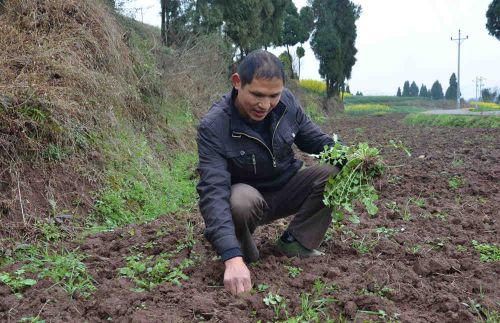
Tian Enrong weeding in the Chinese herbal medicine field.
Early in the morning on March 10, thick fog shrouded Jinlong Community in Sanhui Town, Zhongxian County. The ground, freshly soaked by rain, was somewhat slippery. Not far away, in a large field of medicinal herbs, Tian Enrong was weeding.
"In a few days, when the weather warms up, these herbs will sprout," Tian Enrong said. Whether it was sunny or rainy, he would go to visit those "little treasures" in the field.
Tian Enrong, 43 years old this year, lives in Group 6 of Jinlong Community, Sanhui Town, Zhongxian County. He has had a strong interest in growing Chinese herbal medicines since childhood, but for various reasons, he had never been able to realize it.
In 1989, after graduating from junior high school, Tian Enrong worked in garment factories in Guangdong, Zhejiang and other places. Having worked away from home for more than 20 years, he never gave up his dream of growing medicinal herbs.
At the end of 2013, Tian Enrong decided to return to his hometown to develop his career. After learning of Tian Enrong's plan, his father, who knew about Chinese medicinal herbs, told him that growing Scutellaria barbata (barbed skullcap) had a short cycle and good returns. Each mu was expected to yield 500 kg per year, generating an income of 3,000 yuan.
After the Spring Festival in 2014, Tian Enrong transferred more than 80 mu of land in the village, and then introduced more than 500 kg of Scutellaria barbata seeds from Anhui, beginning his herb dream.
Unexpectedly, just after the seeds were planted, continuous rainy weather set in. In June of that year, due to insufficient management experience, all the Scutellaria barbata he had planted rotted in the field, and the 130,000 yuan he had invested was completely lost. Tian Enrong found that the only purchasing point for Scutellaria barbata was in Bozhou, Anhui, so he gave up continuing to grow it.
Tian Enrong did not lose heart. In September 2014, he planted the original more than 80 mu of land with 6 kg of kohlrabi seeds sent by his cousin Tian Huaqing, which basically made up for the losses apart from labor costs.
In October 2014, the Zhongxian County Poverty Alleviation Office sent Tian Enrong to Wanzhou to attend free training in Chinese herbal medicine cultivation techniques. During that time, he met Lei Zeliang and Zhang Qun, residents of Shizhu County who grew Peucedanum praeruptorum. After 10 days of training, Tian Enrong gradually mastered medicinal herb cultivation techniques. Tian Enrong then went to Lei Zeliang's medicinal herb field to learn from his experience. He found that the climate conditions in his hometown were very suitable for the growth of Peucedanum praeruptorum. Upon returning home, he immediately used 10 mu of land to trial-plant Peucedanum praeruptorum. Unexpectedly, it succeeded on the first try, with each mu of Peucedanum praeruptorum reaching a yield of 400 kg and generating an income of 4,000 yuan.
In April 2015, Tian Enrong went to downtown Chongqing to attend free training in Chinese herbal medicine cultivation techniques, mastering the cultivation techniques for Peucedanum praeruptorum. That year, his Peucedanum praeruptorum planting area reached 130 mu.
Seeing Tian Enrong's business grow bigger and bigger, Lei Zeliang and Zhang Qun were very envious. In March this year, they jointly established Zhongxian Mengyu Co., Ltd., expanding the Peucedanum praeruptorum planting area to 300 mu.
"Our next step is to build a fruit base and develop diversified industries," Tian Enrong said full of confidence.