Gansu villagers join forces to escape poverty and become rich, with a strong sense of fulfillment
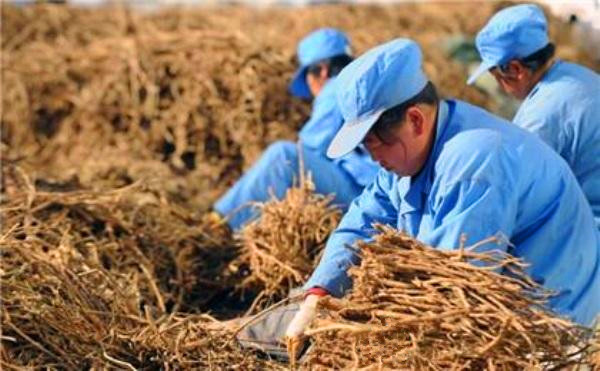
In the warm spring month of March, it is still chilly. In Zhanpo Village, Lianfeng Town, Weiyuan County, Dingxi City, Gansu Province, machines roar in the workshop of the Kangrong Chinese Medicinal Herbs Professional Cooperative, where more than a dozen members are slicing and processing their stock of selenium-enriched Astragalus membranaceus.
"Selenium-enriched Astragalus is our golden egg for getting rich," said a cooperative member operating a slicing machine.
Selenium is called the "king of anti-cancer" among trace elements in the human body by some scientists, and it helps boost immunity and prevent diabetes and cardiovascular and cerebrovascular diseases. According to testing by the Jiangsu Provincial Selenium Bioengineering Technology Research Center, the selenium-enriched Astragalus roots produced by this cooperative have an average selenium content of 798 micrograms per kilogram, more than 6 times the selenium content of ordinary Astragalus.
Li Haidong, head of the Kangrong Chinese Medicinal Herbs Professional Cooperative, is a true farmer, but years of traveling to transport Chinese medicinal herbs gave him rich experience that made him realize early on the importance of getting rich through science and technology. In 2010, together with the Suzhou Xigu Technology Co., Ltd. and Gansu Agricultural University, he carried out joint research and development, applying "nano-selenium plant nutrient" selenium fertilizer into trenches, then transplanting Astragalus seedlings into the trenches for cultivation, successfully growing selenium-enriched Astragalus.
Li Haidong told reporters that ordinary dried Astragalus yields about 450 kg per mu, with a purchase price of 15 to 35 yuan per kg, while selenium-enriched Astragalus can yield more than 650 kg per mu, with the purchase price exceeding 200 yuan at its highest, and the market remains stable, unlike ordinary Astragalus, whose price fluctuates greatly.
Li Haidong, who tasted the sweetness of medicinal herb cultivation, did not forget to lend a hand to his poor fellow villagers. In 2010, he encouraged poor households to join the cooperative. Today, the cooperative where Li Haidong works has grown from more than 130 households in 2010 to more than 500 households, of which 203 are targeted poverty alleviation households.
Cheng Yuantai, a 53-year-old villager, joined the cooperative in 2014 and received free selenium-enriched Astragalus seedlings provided by the cooperative. "That year, my 6 mu of selenium-enriched Astragalus brought in more than 40,000 yuan," Cheng Yuantai said. Before that, he planted 10 mu of ordinary Astragalus and Codonopsis pilosula, which together brought in an annual income of just over 30,000 yuan. "The economic benefits of medicinal herbs are unstable, fluctuating up and down, but selenium-enriched Astragalus has high value and stable prices."
Li Haidong said that in 2015, the cooperative's annual processing volume of Astragalus exceeded 400 tons, with offline net income of 260,000 yuan, while also relying on the Alibaba platform to successfully obtain more than 100,000 yuan in net income. "Large output, high price, rich nutrition, selenium-enriched Astragalus is a treasure from head to toe." When talking about selenium-enriched Astragalus, Li Haidong smiled so widely he could not close his mouth.
Weiyuan, the source of the ancient Wei River, is rich in precious Chinese medicinal herbs such as Codonopsis pilosula, Angelica sinensis and Astragalus, with a planting area reaching 400,000 mu. In recent years, relying on scientific and technological development, more and more Chinese medicinal herb professional cooperatives and processing enterprises have emerged locally, just like the Kangrong Chinese Medicinal Herbs Professional Cooperative, becoming the "leaders" for the people to escape poverty and become rich.
Zhang Zhenya, deputy secretary of the Weiyuan County Party Committee, said that at present Weiyuan processes more than 55,000 tons of Chinese medicinal herbs annually, with a comprehensive output value reaching 1.39 billion yuan. Among the county's 217 administrative villages, 123 villages derive more than half of their income from the traditional Chinese medicine industry.
Zhang Zhenya stated that the Chinese medicinal herb industry has become a pillar industry and a prosperity-enhancing industry for Weiyuan's economic development. This year, the local area will also adopt multiple measures to strengthen the Chinese medicinal herb industry and lead more people onto the path to prosperity.
The setting sun was like molten gold, scattered across the workshop gate of the Kangrong Chinese Medicinal Herbs Professional Cooperative. "This year we plan to build a 2,000-mu selenium-enriched Astragalus base, so that more villagers can join the cooperative and work together to escape poverty and become rich." Speaking of this year's plans, Li Haidong was full of confidence.