New agricultural film for ecological rice seedling cultivation gains favor in Chongqing
Original title: Biogas residue for fertilizing seedling beds, biogas slurry for seed soaking, non-woven fabric for covering
Chongqing vigorously promotes ecological rice seedling cultivation technology
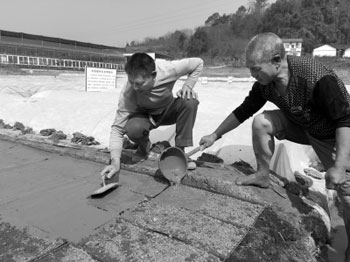
Preparation of nutrient soil for green ecological rice seedling cultivation technology.
"This is not traditional agricultural film, but non-woven fabric, which is ventilated and breathable and can also absorb water, and the residual fragments of non-woven fabric cause little pollution to the soil." Recently, the Chongqing rice seedling cultivation new technology on-site training session was held at the Huangzhuang Modern Grain and Oil Science and Technology Demonstration Park in Jiangjin District. Some district and county agricultural technicians and large grain growers who came to learn on site developed strong interest in the green ecological rice seedling cultivation technology.
According to reports, green ecological seedling cultivation includes green ecological dry seedling cultivation, dry-raised blanket seedling mechanical transplanting, dry-raised trayless throwing transplanting, dry-raised plastic tray throwing transplanting, etc. Its core is fertilizing seedling beds with biogas residue, soaking seeds with biogas slurry, and covering with non-woven fabric. About 25 days before sowing, biogas residue and superphosphate should be applied to the seedling bed, and the seedling bed soil should be fertilized by piling, covering with film, and fermenting. After the seeds are sun-dried and selected, before sowing they need to be soaked for 36 hours with mid-layer biogas slurry diluted with water at 1:1 or with the original liquid. After sowing and covering with soil, first lay a layer of ultra-thin film flat on the bed surface, then build an arched shed and cover it with non-woven fabric.
"Good seedlings mean half a year's grain." Guo Feng, a researcher at the Municipal Agricultural Technology Extension Station, introduced that non-woven fabric is ventilated and breathable and also absorbs water, which can reduce the risk of seedling burning from high temperatures. Rainwater can also seep in, so there is no need to manually uncover the fabric for water management. Adopting green ecological seedling cultivation technology can save more than 4 labor units for seedling raising; combined with advantages such as water saving, it saves more than 50 yuan per mu in seedling cultivation costs, and compared with agricultural film covering, it has a higher emergence rate, more tillering, stronger growth, and thicker stems, and can use nutrients more effectively, laying a good foundation for high yield.
"Test results in 2015 proved that after using this technology, the general yield increase per mu was 26.8-97.2 kg, with an increase of 5%-10%." Guo Feng said that compared with traditional seedling cultivation technology, this "upgraded version" of seedling cultivation technology reduces the amount of chemical fertilizer applied by using biogas fertilizer, which is beneficial for improving soil structure and texture; non-woven fabric covering is breathable, permeable, and degradable. Even if some fragments enter the soil, they will not cause negative effects like agricultural film blocking soil moisture and nutrient transmission, and are beneficial for protecting the rice field ecological environment. In short, it is both ecological and environmentally friendly.
"Today's on-site meeting taught us 'two practical techniques.' One is green ecological seedling cultivation using non-woven fabric instead of agricultural film. The other is that in greenhouse seedling cultivation, a layer of seedling hemp film should be placed at the bottom of the hard seedling tray, which both retains water and helps the seedlings root into the tray and form a root ball." Ouyang Jing, general manager of Jinqiao Agricultural Machinery Company from Dazu District, said that he would apply what he learned in this spring's seedling cultivation work and strive for a bumper harvest this year.
It is reported that over the past 3 years, this new technology has been explored on a small scale in some districts and counties of Chongqing. At present, a relatively complete set of technical specifications has been formed, and starting this year it is planned to be promoted throughout the city. (Reporter Deng Li, intern Wang Zhen, text/photo)