Smart agriculture takes center stage at Beijing Agriculture Carnival
Original title: Smart agriculture at the Agriculture Carnival
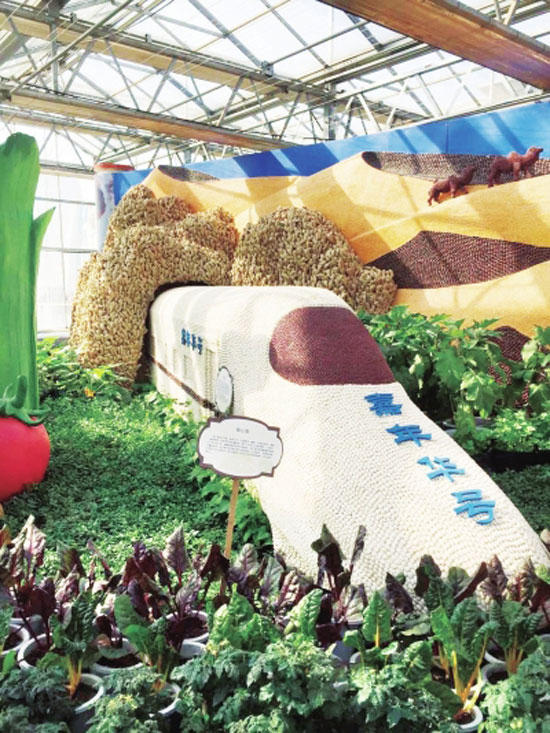
The 4th Beijing Agriculture Carnival is in full swing in Changping District, Beijing. With farming culture, creative agriculture and agricultural high-tech as its elements, the Agriculture Carnival attracts urban crowds to come and visit. It is both an opportunity for city dwellers to get close to agriculture and return to nature, and a platform to showcase the latest achievements and technologies in agriculture. Today (the 23rd), we take you to see --
By our reporter He Ye, text/photos
-- Lifestyle smart agriculture --
Growing vegetables indoors: nutritious and eco-friendly
If you are someone with especially high food-safety standards and want to grow vegetables for your own table, you can bring home a "multi-layer fine-leaf cultivation cabinet." Multi-layer fine-leaf cultivation cabinets can grow small leafy vegetables such as bok choy, garland chrysanthemum, spinach, cilantro, shepherd's purse and leaf lettuce. They generally use a two- or three-layer structure; on the planting board of each layer, a soaked non-woven fabric is laid out, sprout seeds are sown on the planting board, and then ceramsite is spread evenly over it to retain moisture and anchor the plant roots. Traditional soil cultivation is time-consuming and laborious, has poor controllability, and easily breeds pathogens and attracts mosquitoes, making it unsuitable for indoor use. Multi-layer fine-leaf cultivation cabinets overcome these shortcomings.
You can grow trees in the office
White-collar workers usually work in high-rise buildings, lacking a bit of natural greenery and longing for a bit of poetic green. Even bolder than putting a few pots of greenery in the office is moving the office into the middle of the greenery. Imagine a work environment where you smell fresh grass as you think over copy -- isn't that rather wonderful? Urban micro-farming technology applies soilless cultivation and hydroponics in buildings, letting people and plants live together. Vegetable production can be achieved in any space and corner, which both increases office humidity and creates a green landscape.
No water changes for fish, no fertilizer for vegetables
In the future, an office worker's fish tank could look like this: the tank is divided in two, with butterhead lettuce growing above the water and fish swimming in the water. A net separates the two parts. Although the lettuce roots are soaked in the water, they are kept from extending into the water as much as possible, so the fish will not eat the lettuce roots; otherwise, before the leaves even grow, the roots would already have been eaten clean by the fish. The butterhead lettuce is given no pesticides and no fertilizer; all the nutrients it needs come from the fish waste in the water, and the lettuce roots can also help purify the water in the tank.
The aquaponics farming system combines aquaculture and vegetable production -- two originally completely different farming techniques -- through ingenious ecological design to achieve scientific synergistic coexistence, thereby realizing the ecological symbiotic effect of raising fish without changing the water and without water-quality worries, and growing vegetables without fertilizer while still growing normally. Water from aquaculture is sent to the hydroponic cultivation system, where microbial bacteria break down ammonia nitrogen in the water into nitrites and nitrate salts, which are then absorbed and used by plants as nutrients. Achieving a harmonious ecological balance among animals, plants and microorganisms is a low-carbon production model of sustainable circular zero emissions for the future.
-- Factory-style smart agriculture --
Vegetables "chasing the sun"
If the page could show animated images, you would see that all the vegetable pots move slowly along a track, and each vegetable pot also rotates around its own center. This is the rotating light-chasing cultivation facility. As the track turns, every plant gets sufficient light, thereby improving vegetable quality. This equipment is fitted with sensing devices that can detect the moisture on vegetable leaf surfaces, and through parameters set by computer programs and a touch-screen controller it can achieve fixed irrigation and targeted harvesting, saving more than half the labor cost, while planting efficiency is more than three times that of other planting methods.
Tomatoes grown in sponge
The tomatoes here are especially sweet, with a sugar content 6 to 10 percentage points higher than ordinary tomatoes. This is the low-node close-planting cultivation model for high-sugar tomatoes. Sponge is used as the substrate; its advantages are being eco-friendly and capable of non-toxic degradation. During the plant growth stage, only 3 to 5 trusses of fruit are retained, so the fruit can fully absorb nutrients. Reasonable close planting means arranging crop planting reasonably within a given area, which helps make full use of light energy and improve photosynthetic efficiency. The advantage of this cultivation model is that the cultivation environment is stable, labor can be used flexibly, and four crops can be grown each year.
Vegetables floating on water
From a distance, they look like flowers blooming on the water surface, but in fact they are vegetables grown using the floating cultivation method. Seeds are planted in a seedling substrate, and foam plug trays filled with the seedling substrate float on the water surface, allowing the seedlings to fully absorb water and nutrients from the substrate and water bed and take root and grow. Floating cultivation is used in a fully controllable environment; the nutrient solution circulates within a closed system, which can save more than 90% of water, avoid the spread of soil-borne diseases, and reduce the use of insecticides.