The Lily Prince's Path from Flower Farming to Agritourism
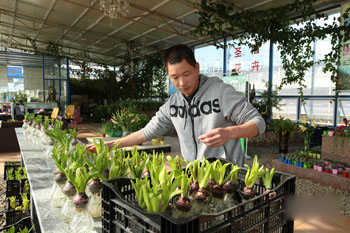
From "waiting to collect money before the seeds were even planted" to "going door to door to find flower shops to sell to" and then to "holding picking activities and developing agritourism," Cai Rongtian, head of Fujian's largest lily cultivation base, has gone through one transformation challenge after another over the past 2 years, like a roller coaster ride.
As early as April 2008, Cai Rongtian was introduced by someone and came from Nanping to Zhuyuan Village in Shaxian, where he signed a 140-mu land transfer agreement with the village. "That was the most glorious period for lilies. You could count money every day," Cai Rongtian said. Before the lilies were even planted, they had already been fully booked by customers. At the peak, more than 10,000 stems were sold in a single day. "Local flower shops that wanted to place orders were told there was no stock."
Cai Rongtian kept investing to expand the scale. By 2013, the lily output at his base had reached more than 2 million stems and achieved an output value of more than 10 million yuan, making it the largest lily cultivation base in the province, with more than 90% of the lilies sold to Shanghai, Hangzhou, Guangzhou and other places. Because of this, Cai Rongtian was once called the "Lily Prince" by local people.
"But by 2014, lily production in other parts of the country had increased, the flower market was not prosperous enough, and my lily sales in Shanghai, Guangzhou and other places shrank noticeably," Cai Rongtian said. Quite a few long-term regular customers reduced or even canceled orders, and hundreds of thousands of lily stems in the greenhouses were about to come to market but still had no buyers. "It was a loss. For a long time I could not sleep well."
Cai Rongtian said the market signal was already very clear: without transformation, it would be over. Starting in 2014, he took the initiative to promote sales to local flower shops in Sanming one by one and cooperated with these flower shops on sales to expand the local market. "In the process of working with local flower shops, I found that demand for lilies was limited, but many consumers were interested in organic vegetables." So he changed the lily fresh-cut flowers from two seasons a year to a single season, and out of the 140 mu of transferred land, freed up 30 mu to grow organic vegetables.
Walking into the base of this Shengjie Agricultural Technology Co., Ltd., neatly arranged greenhouses are filled with flowers, fruits and vegetables of various colors, and along the road one can see promotional introductions for various online malls everywhere. Unlike other vegetable bases, Cai Rongtian's vegetables do not go through sales channels such as farmers' markets or supermarkets. They mainly use a membership model, with customers placing orders online and finally having them delivered directly through express logistics. "But making it work is very difficult." Cai Rongtian admitted frankly that in the first year or so, he had accumulated only more than 200 members.
"Let customers play while learning and take part in the planting process." Starting in February 2015, Cai Rongtian tried opening the base for the first time and held picking activities for categories such as lilies, strawberries and organic vegetables. Cai Rongtian told reporters that the offline picking activities brought the whole base "to life." For several days in a row, visitors were everywhere in the base, and every space near the parking lot that could hold a car was filled with cars.
Now, through online sales plus offline picking activities, Cai Rongtian's lilies no longer need to be shipped far to Shanghai, Hangzhou, Guangzhou and other places. The market around Sanming alone already cannot meet demand. Cai Rongtian did the math and said that over the past year, annual output value had recovered to more than 10 million yuan.
From the popularity of offline picking activities, Cai Rongtian saw new opportunities. He said many customers like to bring the whole family, old and young, directly to the base to play while buying agricultural products. In the exhibition and sales room in the base's glass building, small potted plants such as hyacinths and succulents, suitable for children and families, are deeply loved by customers. "They hope to DIY different styles of potted plants themselves and take them home after finishing."
"Since customers have new needs, we should change. Relying only on the old model of growing and selling lilies could mean being forced out at any time. We should actively develop into agritourism." Cai Rongtian said this is his current effort and his dream for the future, especially after the opening of Sanming Shaxian Airport, as Shaxian now has convenient multi-dimensional transportation including airplanes, bullet trains and expressways. "More people are coming to Shaxian, which creates an opportunity to build leisure agricultural tourism centered on the lily base."
Cai Rongtian already has some plans. He said he plans to add light music along the base's pathways, plant flowers with different blooming periods in the base's greenhouses, and provide popular science information about different crops. "I want to combine tourism resources such as the Taijinshan Scenic Area in Shaxian, as well as Shaxian snack culture and historical culture, so that tourists can play and take photos in the base in all four seasons and also learn knowledge about growing flowers, making it a good destination for agricultural eco-tourism."
At present, Cai Rongtian is busy learning from eco-tourism attractions inside and outside the province that have unique designs and brisk popularity.