After the mushroom business opportunity was discovered, how did she seize it?
Liu Ai: Today, the students will work in pairs, with one basket per pair, to pick these mushrooms together. Whichever basket has the most mushrooms and they are the most beautiful, with no dirt or debris stuck to them, wins.
She is Liu Ai, and today she is going to hold a mushroom-picking competition here.
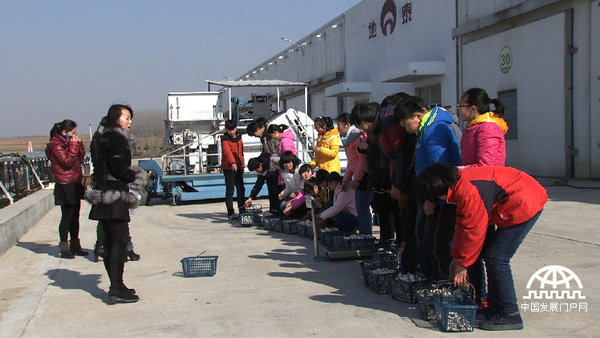
Liu Ai: The students who get the top 3 places will receive 3 mystery gifts, (each) worth 180 yuan.
Student: Wow!
Liu Ai: Now pair up first, two people to a team, two people to a team.
The competition is timed at 15 minutes, and within 15 minutes they will see who can pick the most. The top 3 will receive Liu Ai's mystery gifts. The people invited to take part in the picking competition are all students invited by Liu Ai through the local women's federation. Whether they win or lose, they can take away the mushrooms they picked.
Liu Ai: Start, open the door, 15 minutes, don't rush, pay attention to safety.
Normally, outsiders are not allowed into Liu Ai's mushroom workshop without disinfection, but because this batch of mushroom compost is about to be discarded, these students were allowed to enter directly without any disinfection measures.
Reporter: How many have you picked?
Student: Lots, lots, one basket already, this is the second basket.)
Reporter: This is the second basket?
Student: Mm.
Reporter: Have you picked mushrooms before?
Student: Never picked them.
Reporter: But I see you're picking pretty fast.
15 minutes will soon be up, and the mushrooms on the bottom layer have already been picked clean.
Reporter: Where's your teammate? Why is it just you now?
Student: Over on the other side.
Reporter: The two of you split up to pick.
Worker: Gather up, gather up, everyone stop working. Stop, time's up.
After the competition ended, Liu Ai had everyone weigh the mushrooms they had collected in groups. In the end, the 6 students in these 3 groups won.
Student: It felt like a lot of fun, and I also learned some things about how to pick mushrooms. I feel like I enriched myself a bit.
Student: It feels really good.
Student: Being able to eat mushrooms I picked with my own hands makes me very happy.
Why did Liu Ai look for these students to take part in the activity? This all has to do with the mystery gifts that were about to be given out.
Liu Ai: Open them for everyone and see what they actually are.
Student: Wow! What is this? So black, is it chocolate?
When the winning students saw the prizes, they were both surprised and disappointed.
Reporter: Are you satisfied with this (prize)?
Student: Not satisfied.
Reporter: Why are you not satisfied?
Student: What is this? We busied ourselves for so long and it's just a pot of dirt.
Student: I really don't know what this thing is. Why give this to me?
Student: It's just a pot of soil, there's really nothing good about it.
These are mushroom growing boxes from Liu Ai's factory, containing button mushroom substrate. After the students take these boxes home, button mushrooms can soon grow. Activities like this, inviting students from many schools in the city through the municipal women's federation, are held by Liu Ai 1 to 2 times every month. This has a lot to do with Liu Ai's successful entrepreneurship. It took her only 3 years to build a company with annual sales of more than 50 million yuan.
Cannery manager Wu Chuansong: She holds a leading position in the same industry (button mushrooms), in terms of mushroom cultivation.
Vice president Gao Maolin: In a very short time, she has covered a path that many companies in Europe, America, and domestically have taken decades to cover. It should be said that both the speed of development and the quality of development are quite solid.
Why did Liu Ai give these boxes to primary and secondary school students? And how did she use 3 years to build a company with annual sales of more than 50 million yuan?
Liu Ai was born in Beijing and moved to Hong Kong, China with her family at the age of 10. In 2000, she entered a financial company in Hong Kong, China to work, with an annual salary of more than 2 million yuan. In 2009, she studied for an MBA at Fudan University in Shanghai. After graduation, during a trip abroad, Liu Ai discovered the business opportunity in button mushrooms.
Liu Ai: When traveling in European and American countries, I found that this kind of mushroom was very common on dining tables. When I returned to China, I found that there were no mushrooms to eat, so I searched online and found that our country actually has the largest planting area and is also the country that exports the most.
At that time, Liu Ai further investigated and found that European and American countries all produce button mushrooms industrially, while domestically there were still very few industrial producers of button mushrooms.
This mushroom is scientifically named the button mushroom. Industrial cultivation of button mushrooms can both standardize product quality and allow production all year round. Moreover, the domestic market potential for button mushrooms is very large.
Vice president Gao Maolin: At present, in the production of button mushrooms, modern factories in China, compared with the production of other varieties, are relatively low in the number of producing enterprises and in market share, but judging from the dietary situation of button mushrooms in Europe and America over decades, ordinary people like them very much. Judging from China's dietary habits and cooking habits, I believe it will surpass the development speed of other edible fungi.
After Liu Ai discovered the business opportunity, she began investigating all over the country, and finally discovered that Linyi City, Shandong Province, was very rich in wheat straw and chicken manure resources.
Liu Ai: The main raw materials for this button mushroom are wheat straw and chicken manure. So this can both solve the environmental protection problem and fully reflect the circular economy.
In addition to abundant raw materials, Liu Ai also found that Linyi City had many food enterprises engaged in export processing. In this way, once the mushrooms were produced, they would be easy to sell. In early 2013, Liu Ai gave up her job in Hong Kong, China, and invested all her savings plus funds raised from others, totaling more than 30 million yuan, in Linyi City, Shandong Province, to build this button mushroom factory covering 283 mu.
At the beginning, Liu Ai did not understand the technology, but she was optimistic about the prospects of industrial button mushroom cultivation, so she hired 2 technical staff to specially help her manage the factory.
Liu Ai: At the time I thought hiring people would be enough to manage it, and I felt it was easy, (wasn't it) just growing vegetables?
Liu Ai originally wanted to get the company on track and then return to Hong Kong, China to live. But she did not expect that problems would arise in the very first year of the company's operation.
Worker Ma Junjie: This place is going to collapse, or what? That's just how it was, it made everyone feel panicked.
Worker Zhang Xuemei: Wages had not been paid for two months, so of course we were anxious. There are children at home going to school, and we urgently needed money.
Liu Ai: They came to ask me, hey boss, when will wages be paid? They kept asking like this. I said, don't worry, I will settle it for everyone before the end of the year. Actually, when I said that, I was very nervous inside. If there was really no other way, I would mortgage property for a loan to pay the company employees their wages.