Salmon farmed in multiple mountainous areas of Hubei leaves the mountains and its value quadruples
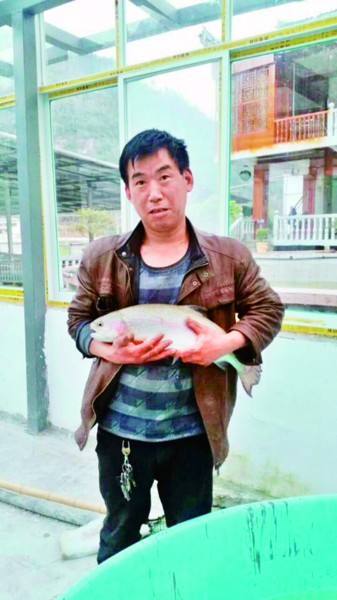
After eating salmon for so many years, for the first time I clearly saw what it looks like
Salmon in the standard sense, also known as Atlantic salmon, as the name suggests, is a fish that lives in the deep sea of the Atlantic Ocean. It has long been the main ingredient for sushi and sashimi, and is truly a high-end delicacy.
But did you know that today it has actually long since settled in the deep mountain cold pools of our province. Many of these delicacies on Wuhan dinner tables are produced in the mountainous areas of our Hubei. At present, fish farms deep in the mountains in Shiyan, Xianning, Enshi and other places in our province all have it. The day before yesterday, the reporter came to the cold-water fish breeding base in Dahongzhai Village, Huaping Town, Jianshi County, Enshi, to witness the wonder of how this traditional sea fish is farmed in remote mountains and old forests.
[Visit]
A "foreign immigrant" comes to the mountain ravine
Dahongzhai Village is at an altitude of 904 m, and the cold-water fish breeding base is located in a mountain hollow in the village surrounded by mountains on all sides. Here the mountains are dense and the people are few, and the roads are hard to travel. Before the breeding base was completed in 2011, there was no aquaculture industry here at all. The breeding base chose this site first and foremost because of a spring of clear mountain spring water.
"There is a natural spring eye here, and the spring water temperature is around 11.2°C year-round, very suitable for farming cold-water fish like salmon." Deng Guibin, manager of the breeding base, introduced that there are two basic conditions for farming salmon: first, the water temperature cannot be higher than 18°C; second, the water quality must be very clean. "Both conditions are met here." Deng Guibin said, "Before tap water was available, when the mountain villagers were thirsty, they would cup a handful of mountain spring water and drink it." There was one more reason, which Manager Deng finally pointed out proudly, "This is the first selenium-rich village in Enshi Prefecture, so the fish raised here are naturally different from elsewhere."
The reporter saw that the entire breeding base covers 45 mu, and raises salmon introduced from Norway, as well as cold-water fish such as rainbow trout and golden trout. Zhang Xuezhen, associate professor at the College of Fisheries of Huazhong Agricultural University, said that based on the good natural conditions here, 5 years ago he helped the local area introduce cold-water fish such as salmon. He introduced that the reason salmon can "immigrate" to the deep mountains is that salmon is an anadromous migratory fish, so it can grow and develop in both fresh water and seawater. At present, multiple mountainous areas in our province with cold-water resources are farming salmon.
[Farming]
Salmon feed is 4 times more expensive than ordinary fish food
Treating new immigrants like salmon is not just a matter of moving them in. Their rearing conditions and bait are all particular.
"This fish is first of all very picky about water quality. After rain, when the water quality becomes cloudy, they stop eating." Deng Guibin, manager of the breeding base, said that the base specially built a filtration pond to solve this problem.
Second, salmon require a much higher oxygen content in the water than ordinary fish. "Ordinary domestic fish can survive with 1 mg of oxygen per liter, but salmon require 8 mg."
In addition, Deng Guibin also said that salmon have very high requirements for bait. The feed eaten by salmon fry costs 28,000 yuan per ton, and adult fish feed also costs 12,000 yuan per ton. "The price of ordinary domestic fish feed does not exceed 3,000 yuan per ton. By comparison, salmon feed is 4 times more expensive than ordinary fish feed."
Why is it expensive? Deng Guibin said that salmon feed has a higher protein content and also has vitamin C added. "Salmon grow in cold water and consume more energy, so the feed protein content requirement is higher compared with the same amount." Deng Guibin took out salmon juvenile fish feed and ordinary fish feed for the Chutian Metropolis Daily reporter to smell. The salmon feed was clearly fishier. "This kind of salmon feed is called 'opening feed,' which means only feed of this quality can make the fry start eating."
During the farming process, caring for these salmon also requires even more attention to detail. "During the farming process, it is necessary to prevent salmon from getting scratched, getting sick and dying." Zhang Xuezhen, associate professor at the College of Fisheries of Huazhong Agricultural University, said.
According to the introduction, salmon generally need three years from fry to maturity and market, and usually grow to three to five jin, while ordinary freshwater fish can generally be marketed in two years.
[Value]
Leaving the mountains, its value quadruples
Compared with imported salmon, how do the salmon farmed in the mountainous areas of our province compare in taste, nutrition and price?
Associate Professor Zhang Xuezhen, who has long been engaged in salmon research, gave his answer: taking Jianshi County as an example, the quality of the salmon produced here is not inferior to imported salmon, and its nutritional value is even higher. "According to my test results, in terms of protein content, the protein content of the salmon here is about the same as imported fish, and it is selenium-rich, so its quality is higher."
In terms of taste, Zhang Xuezhen, who has eaten salmon in many countries and places, also has a say. "The salmon farmed here tastes crisper and smoother." Zhang Xuezhen explained that a lot of foreign salmon is also farmed in net cages, and the farming conditions are not much better than those in China's mountainous areas. In particular, salmon imported into China, because of freezing treatment, is not as fresh and delicious in taste as the live salmon from the mountainous areas of our province.
In terms of price, Deng Guibin, manager of the cold-water fish breeding base in Dahongzhai Village, revealed that the ex-factory price of the salmon here is 60 yuan/jin, and when sold to big cities such as Wuhan, the retail price immediately rises 4 times, with almost no difference from the price of imported salmon.
The reporter recently saw at a large supermarket near South-Central Minzu University that the price of salmon here is 236 yuan/jin. At another large supermarket in Wuchang, the price of salmon is 230 yuan/jin. However, much of the salmon sold in these supermarkets does not indicate the place of origin.
[Current situation]
Domestic salmon accounts for 1/3 of the market
"Of the salmon consumed nationwide each year now, 1/3 is domestic." The data given by Associate Professor Zhang Xuezhen shows that the pace of salmon localization is getting faster and faster. "Thirty years ago, Chinese people were still only satisfied with filling their stomachs, so high-end foods like salmon did not have much of a market." Zhang Xuezhen said that with the gradual improvement of people's living standards, over the past 20 years, domestic freshwater salmon farming has become more and more common.
The reporter learned from some restaurants in Jianshi that in recent years salmon has begun to appear on local dinner tables. "Now every year before the New Year, many local people come to our base to buy fish." Manager Deng Guibin introduced that besides eating sashimi in line with international trends, local people also like to make it into salted fish. Ms. Peng, a Wuhan resident who lives in Wujiashan, loves eating salmon. She said that every year she orders salmon from the base by phone. "Generally I buy 10 at a time. They pack them in cold bags, and the fish I receive are alive." Ms. Peng said that the reason she values salmon produced in her own province is simply that it is lively and jumping.
[Reminder]
Salmon can be farmed in both seawater and freshwater
Zhang Xuezhen, associate professor at the College of Fisheries of Huazhong Agricultural University, introduced that the reason salmon can "immigrate" to the deep mountains is that salmon is an anadromous migratory fish and can grow and develop in both fresh water and seawater.
Salmon in the standard sense specifically refers to Atlantic salmon, but if you take a walk around the market, you will find that many fish with different appearances, textures and tastes are all claimed to be "salmon." If you ask the sellers further, you will find that these "salmon" have various "prefixes": such as Norwegian salmon, king salmon, red salmon, Alaska salmon and so on. In fact, they are in the same family as Atlantic salmon, but not the same genus, and there are also differences in taste.