How does tea cultivation help people get rich? A man from Naxi, Sichuan gives the answer
On February 12, Sichuan Meiling Extra-Early Tea Group Co., Ltd. was established in Meiling Village, Huguo Town, Naxi District, the hometown of China's extra-early tea; on February 27, at the "Hometown of China's Extra-Early Tea - Sichuan Fourth Tea Harvest Activity Week," the only extra-early tea in Sichuan formed a "sister tea" partnership with Hangzhou West Lake Longjing, and output and output value increased substantially.
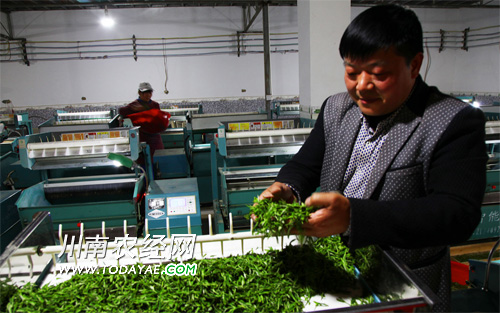
Yan Honggui inspecting newly produced tea
Who would have thought that this group company, with nine branch factories under it and capable of producing more than a dozen kinds of tea, was just a small family workshop more than ten years ago. Recently, Chuannong Agricultural Economics Network conducted an exclusive interview with company general manager Yan Honggui. When it came to growing and making tea, Yan Honggui immediately opened up.
Returning Home to Start a Business, Persisting Through Adversity
In the late 1990s, the construction industry gradually rose in our country, and many young people joined the ranks of construction workers, starting their own path to wealth through migrant work. Yan Honggui, in the prime of life and full of energy, also devoted himself to the construction industry, using his labor to create wealth, and became a locally somewhat famous contractor. "I worked on construction sites for a few years and earned some money, but I still wanted to build a career in my hometown." Talking about his original intention for starting a business, Yan Honggui was very excited.
In 2000, Yan Honggui, who had been smooth sailing in the construction industry, resolutely changed careers, came to Fujin Village in Huguo Town, contracted 360 mu of land, and opened up barren hills to build a tea garden. Fujin Village is very remote, but its geography and environment are very suitable for tea tree growth. In the first two years, Yan Honggui led his family to stay in the tea garden all day long, and the one thing they busied themselves with from morning to night every day was hoeing weeds in the tea garden. They worked from National Day all the way to Spring Festival and still had not finished hoeing.
In the first two years, many people busied themselves in the tea garden all day but saw no returns at all, and quite a few people beat a retreat and chose to give up. Yan Honggui, however, still persisted. In the spring of 2003, the newly planted tea trees sprouted tender buds, giving Yan Honggui's family hope: "Although picking tea every day made my back ache, my legs hurt, and my hands go numb, every day I could sell the freshly picked leaves and get cash, and I felt that no matter how tired I was, it was worth it."
From Planting to Production, Growing Stronger Through Development
After several years of development, Yan Honggui discovered that selling fresh leaves alone could not reflect the greatest value of Naxi extra-early tea, because once tea in the Jiangsu-Zhejiang area began to be picked, the price of local fresh leaves plummeted, and there could even be unsalable tea. Although Naxi tea was early, it still could not seize much market advantage. Therefore, Yan Honggui decided to make tea himself.
In 2004, Yan Honggui used all his savings of more than 30,000 yuan to purchase equipment and opened Hongyan Tea Factory. Calling it a tea factory was really no different from a family workshop: a few machines were placed in several old tiled rooms, and he was both boss and worker. Fortunately, through the recommendation of experts from the Naxi District Agriculture Bureau, several tea manufacturers in Beijing and the Jiangsu-Zhejiang area were very interested in Naxi extra-early tea and sent technical personnel to guide him on how to make tea. Yan Honggui began staying in the production workshop day and night, not neglecting any detail in fixing, rolling, and drying. He quickly mastered the essentials of green tea production, and the tea he made was snapped up by these manufacturers. In one year, he made more than 100,000 yuan in income, which kept him excited for quite a long time.
Having tasted success, Yan Honggui did not stop there. He used his profits to buy new equipment and hired his relatives to help in the factory. In this way, there was more and more equipment, and the factory grew larger and larger. In 2007, Yan Honggui's tea processing factory had nearly 30 pieces of equipment and could produce more than 100 jin of tea per day. To expand the influence of Naxi extra-early tea, he renamed his factory Meiling Tea Factory.
Father and Son Working Together, Cooperating to Create a Brand
Because the family had always grown and made tea, his son Yan Wei would also come to help in his spare time, and through long-term exposure he formed an indissoluble bond with tea. In 2011, when filling out his college entrance examination preferences, Yan Wei did not hesitate to apply for the tea science major in the Department of Horticulture at Sichuan Agricultural University. At school, Yan Wei learned that black tea is fermented, does not irritate the stomach and intestines, and also has the effect of warming the stomach and calming the nerves, making it suitable for more people to drink. Therefore, Yan Wei shifted the focus of his studies to the research and development and production of black tea varieties.
For Yan Honggui, 2011 was an extraordinary year, and also an unforgettable year for him. Yan Honggui is a national tea evaluator, with rich experience in growing tea and skilled tea-making and tea-evaluation techniques. Combined with his son Yan Wei's hard study and research, after ten years of struggling in the tea industry, Meiling Tea Factory finally had its own brand - Yanfeng. The father and son combined their respective strengths and jointly launched specialty varieties such as Yanfeng Xueya, Yanfeng Maofeng, Yanfeng Mingcha, and Yanfeng Black Tea, which were favored by many tea lovers.
Joining Forces for Development, the Tea Industry Moves onto the Path of Intensification
Meiling Tea Factory has always adhered to the concept of "selling organic tea products, doing the cause of health." To ensure the quality of tea, in 2011 Yan Honggui brought in 14 major tea-growing households from several nearby villages and established Yan Wei Tea Professional Cooperative. To improve the quality of tea, he personally guided management, fertilization, and other techniques, and the cooperative's ecological organic tea garden reached 4,000 mu.
Although his own products had no worries about sales, Yan Honggui felt that Luzhou's tea industry was not developed enough and its market competitiveness was still not strong enough. In order to make Luzhou's tea industry bigger and stronger and drive Luzhou's ordinary people to become rich, Yan Honggui joined with 9 other tea manufacturers in Luzhou to establish Meiling Extra-Early Tea Group Co., Ltd. The collective company has a professional sales team and management team below it, and the production technology and product sales of each branch factory are managed uniformly by the company.
In the month since its establishment, the group company has operated well. The company has reached more than 150 employees, the cooperative membership has increased to 586 households, and the tea garden area has reached 20,000 mu. It is expected that the group company's total output this year will be around 600,000 jin, and total output value will exceed 100 million yuan.
As for the future, Yan Honggui has his own thoughts: "I hope that through our efforts, more and more people will understand Naxi extra-early tea, and that our extra-early tea can go abroad and go global. I also hope that more ordinary people can join the ranks of growing and making tea and realize getting rich while staying at home."