New rapeseed variety shows outstanding resistance, clubroot nearly eradicated
Original title: Resistant new varieties bring rapeseed clubroot close to "eradication"
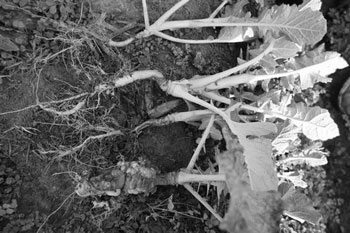
Disease incidence in the field for resistant lines and the control Photo courtesy of Zhang Chunyu
In China, for rapeseed - an important oilseed crop and a cruciferous Brassica crop - clubroot has shown a trend of accelerating spread in recent years.
The rapeseed research team at Huazhong Agricultural University, led by Fu Tingdong, "father of Chinese hybrid rapeseed" and academician of the Chinese Academy of Engineering, has come up with a new solution to this problem - using new clubroot-resistant varieties as a "sharp weapon" for control.
Recently, an on-site observation meeting on the breeding and application of new clubroot-resistant rapeseed varieties and an integrated control exchange meeting were held in Zhijiang City, Hubei Province. At the demonstration site, participating experts observed the growth of the resistant new lines bred by the research team in the epidemic area and conducted identification on randomly sampled plants. The expert group's identification results showed that the resistant new line ZHE-226 had a disease resistance rate of 100%, placing it at the domestic leading level in terms of clubroot resistance.
"Breeding resistant varieties is the most effective and most economical solution to clubroot," commented Wang Jijun, director of the Oil Crops Division of the National Agricultural Machinery Extension Center.
Clubroot: a stubborn disease in the world of Brassica crops
Clubroot is a highly contagious global soilborne disease that specifically parasitizes Brassica crops. Traditional agricultural control has long been difficult to make effective; in other words, clubroot "can be prevented but not cured."
Since clubroot was first discovered in Russia in 1873, it has spread to Brassica crop production areas around the world, including most European countries, Australia, Canada, Japan, South Korea and China.
After Brassica crops are infected, symptoms usually include death of seedlings, or slow growth and stunting of plants at the adult stage; outer leaves often wilt at noon, and in later stages the outer leaves turn yellow and withered, sometimes with the whole plant dying.
According to statistics, in Victoria, Australia, 70% of the cabbage cultivation area is harmed by this disease; statistics from 2011 showed that all major Chinese cabbage production areas in South Korea were harmed by clubroot, with annual affected area reaching 38% of the total planting area and economic losses reaching 125.5 billion won.
Why has clubroot become a chronic disease of Brassica crops?
"The pathogen survives for a long time, with a survival life in soil of more than 10 years," Zhang Chunyu, a professor at the College of Plant Science and Technology of Huazhong Agricultural University, explained to a China Science Daily reporter. "The pathogen mainly spreads through flowing water, transport of diseased seedlings and agricultural operations, so the spread speed is fast."
This means that clubroot pathogens can spread over short or long distances by adhering to the surfaces of farm machinery and transport vehicles. With the increasing level of agricultural mechanization, the spread of clubroot pathogens has become even faster.
In recent years, clubroot has begun to seriously threaten normal production in China's main Brassica crop production areas. According to incomplete statistics, the national affected area is at least more than 35 million mu (including 30 million mu of rapeseed), with average yield losses reaching 20%-30%, and yield losses in severely affected fields reaching more than 60%.
Sichuan Province is China's largest clubroot epidemic area for rapeseed, with an affected area of more than 3 million mu. With the continuous improvement of mechanization, the disease is rapidly radiating outward, resulting in varying degrees of distribution in Hubei (Yichang, Jingmen, Jingzhou), Yunnan, Guizhou, Shaanxi, Hunan, Anhui and other places.
A fundamental and economical solution
How can the spread of clubroot be curbed? How can this infectious disease of Brassica plants be fundamentally cured? Fu Tingdong proposed that the disease should be eliminated at the source.
It is understood that after rapeseed is industrializedly raised as disease-free seedlings and then mechanically transplanted, the inhibition rate against clubroot can reach 95%, but the cost increases by nearly 70 yuan per mu on average; when transplanting or direct seeding is combined with the application of calcium cyanamide, the soil pH value can be significantly increased, and once the pH value reaches 7.2, the harm of the pathogen can basically be inhibited, but the cycle is relatively long, increasing the cost by nearly 60 yuan per mu each year. If chemical agents are used for control, first, the cost is more than 200 yuan per mu; second, the effect is limited, and it pollutes water sources and soil, causing environmental deterioration.
By comparison, planting clubroot-resistant varieties is one of the most fundamental and most economical ways to control clubroot.
However, China still lags relatively behind in the innovation and utilization of clubroot-resistant resources, especially in the breeding of new resistant varieties. Several years ago, Fu Tingdong pointed out preventively that production lacked effective control measures, especially rapeseed resistant varieties, and that clubroot had a tendency toward a major outbreak in China's main rapeseed production areas; if effective measures were not taken as early as possible, it would inevitably cause major harm to China's rapeseed industry.
It was also from that time that Fu Tingdong began guiding the research team in breeding new resistant rapeseed varieties.
"Some international research institutions obtained some valuable disease-resistant resources after extensive screening of resources such as Chinese cabbage, cabbage and rapeseed. Among them, turnip contains the most resistance loci and is also the most widely used in resistance breeding," Zhang Chunyu said.
Zhang Chunyu collaborated with Park Jongyun, a professor at Shenyang Agricultural University, and found clubroot-resistant material in turnip. Through multiple crosses, backcrosses and self-crosses with "Huashuang No. 5," they bred the normal resistant new line ZHE-226, with oil content reaching 40.27%, glucosinolate content of 20.78 μmol/g, and erucic acid content of 1.39%.
Experiments showed that the new clubroot-resistant rapeseed line ZHE-226 exhibited dominant resistance controlled by a single gene against physiological races in clubroot areas such as Huangshan in Anhui and Zhijiang and Enshi Badong in Hubei.
At the demonstration site in Zhijiang City, the expert group randomly sampled and identified the new resistant varieties: the resistant new line ZHE-226 had a total of 311 plants, with 311 resistant plants and a resistance rate of 100%; the control variety Huahang 901 had a total of 407 plants, with 406 diseased plants and an incidence rate of 99.75%. The expert group believed that this new line showed immune resistance to clubroot and was at the domestic leading level in clubroot resistance. Its innovation and breeding provided effective resources for clubroot resistance breeding in Chinese rapeseed, had demonstration and promotion value in clubroot-affected areas, and was of great significance for resisting the development and spread of clubroot.
Looking forward to more resistant varieties
Brassica crops are one of the most important crop types among China's crops, with an annual planting area of 375 million mu - among which Brassica vegetables (including Chinese cabbage, cabbage, etc.) account for 273 million mu, with planting area accounting for 40% of the total vegetable area; rapeseed accounts for 102 million mu, providing 40% of China's self-supplied edible oil.
Although clubroot currently already threatens the development of China's rapeseed industry, Zhang Chunyu said that as long as research on clubroot resistance genetics and resistance molecular mechanisms is continuously strengthened, and breeding work for clubroot-resistant rapeseed varieties is systematically carried out, the threat brought by clubroot to the healthy development of the rapeseed industry can be fundamentally eliminated.
The successful breeding of the new rapeseed variety ZHE-226 is only the beginning, and the rapeseed team at Huazhong Agricultural University has already set its next goal.
"Because physiological races of clubroot pathogens are diverse, and single-gene resistant materials have strong race specificity, long-term planting of single-gene resistant varieties will lead to loss of resistance," Zhang Chunyu said. Only by carrying out pyramiding breeding of multiple resistance loci and breeding excellent rapeseed varieties with simultaneous resistance to multiple physiological races of clubroot can the continuous harm of clubroot to rapeseed production be fundamentally solved.
"Because turnip (ECD04) contains multiple different resistance loci, according to our inoculation results, it shows strong disease resistance against multiple different physiological races of clubroot pathogens," Zhang Chunyu said. "In our previous research, we also obtained rapeseed near-isogenic lines containing other different resistance loci, which will lay a solid foundation for our future pyramiding breeding of resistance loci."