New Fujian Gracilaria variety favored by EU customers
Original title: A new member of the Gracilaria family
- The story of the birth of the new Gracilaria variety "Lulong No. 1"
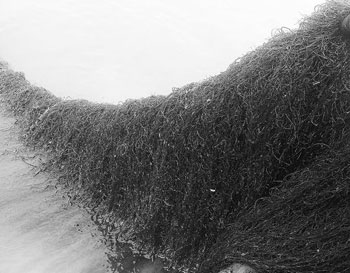
"Lulong" new Gracilaria variety
China is a major seaweed cultivation country. In addition to the widely known kelp and nori, the Gracilaria seaweed of the genus Gracilaria has become the third-largest cultivated seaweed species favored by coastal fishermen because it can both be used to extract the industrial raw material agar and serve as feed for abalone. For this darling of the seaweed cultivation world, while people pay more attention to its economic value and environmental benefits, in a laboratory at Ocean University of China, a group of people is working quietly and diligently on variety improvement of Gracilaria. From "981" to "2007" and then to "Lulong No. 1," these constantly emerging new varieties not only demonstrate this university's advantageous position in the field of Gracilaria genetic breeding, but also record a series of little-known scientific research stories.
In April 2015, the new variety "Lulong No. 1" announced by the Ministry of Agriculture was another new member added to the Gracilaria family by the team of Professor Sui Zhenghong from the Key Laboratory of Marine Genetics and Breeding of the Ministry of Education at Ocean University of China, together with the Putian City Aquatic Product Extension Station of Fujian Province, after 6 years.
Inheritance and innovation: six years to breed a good variety
China's Gracilaria cultivation began in the 1970s. At that time, it mainly relied on manual collection of wild varieties growing naturally in the ocean for cultivation. Not only was the yield low and growth slow, but the agar content was also not high. Therefore, conducting genetic research on Gracilaria and breeding improved varieties became a new challenge for the marine life science community. "In the 1990s, my advisor Professor Zhang Xuecheng and researcher Fei Xingeng of the Institute of Oceanology, Chinese Academy of Sciences, first began research in this area, and in 2007 bred the first new variety '981,' and in 2014 bred '2007.'" When talking about the course of Gracilaria improved variety selection and breeding, Sui Zhenghong spoke with great familiarity.
To solve problems emerging in the development of the Gracilaria cultivation industry, such as a single variety structure and trait degeneration of the original varieties, Sui Zhenghong, as Professor Zhang Xuecheng's first doctoral student, continued along the path of Gracilaria genetic breeding opened up by her advisor. Since 2009, taking the three major trait characteristics of "fast growth, increased yield, and high quality" as breakthrough points for improvement, she began the arduous and tortuous work of selecting and breeding new Gracilaria varieties.
Breeding new Gracilaria varieties requires not only conducting experiments in the laboratory, but also going to cultivation sea areas for field observation. Putian City in Fujian Province is one of the largest Gracilaria cultivation bases in the country. Every year, Sui Zhenghong goes there two or three times to understand the demands of farmers, inspect the growth status of Gracilaria, and observe changes in climate and seawater, among other things. "To work in this field, you must calm down, go deep into the front line, understand what farmers need, and also overcome risks such as wind, waves, and seasickness. New varieties cannot be bred in the laboratory alone," said Sui Zhenghong.
On the journey to breeding "Lulong No. 1," Sui Zhenghong and her team not only had to overcome difficulties from nature and their own bodies, such as wind, waves, cold, and seasickness, but also had to bravely accept technical challenges, continuously innovate and break through, and lead the forefront of the industry.
In the eyes of ordinary people, all Gracilaria looks exactly the same, like strands of red thread. In breeding work, however, it is often necessary to identify their differences. The most common task is male and female identification. This is not very difficult once Gracilaria has grown and reached sexual maturity, but if identification is carried out at the very small seedling stage, it is more difficult. To accelerate the breeding process and save time, Sui Zhenghong led the team to invent a unique "molecular marker technique for Gracilaria sex identification," shortening the breeding process by more than half a year. In accelerating the Gracilaria life history cycle and rapidly advancing the breeding process, they also optimized the technical scheme for making Gracilaria release spores, thus solving the previous awkward situation of only being able to wait for Gracilaria to release spores naturally. In addition, in response to the difficulty faced during breeding of screening specific individuals from a huge population, they invented the patented technology of "spore collection for seedling cultivation," greatly improving the accuracy of screening. To standardize Gracilaria selection and breeding, Sui Zhenghong led graduate students over one and a half years to construct trait descriptions and quantitative trait regression models used to quantify the characteristics of different Gracilaria individuals, laying a solid foundation for the efficient and precise advancement of breeding work.
Over 6 years, after population selection, single-plant crossbreeding with ultraviolet mutagenesis and high-temperature stress, single-plant selection, and cultivation of superior lines through 4 consecutive generations, they finally bred the new Gracilaria variety "Lulong No. 1." In July 2014, Sui Zhenghong reported this achievement, which took 6 years and embodied the painstaking efforts of the research team, to the Ministry of Agriculture. After review and approval at the second meeting of the Fifth National Aquatic Original Species and Improved Variety Approval Committee, in mid-April 2015, Ministry of Agriculture Announcement No. 2242 made this variety public.
Talking about the name of this new variety, Sui Zhenghong said it was first named "Haidachanglong," which both reflected that it was an achievement of Ocean University of China and matched the habits and characteristics of this new variety, but the approving party said 4 characters were too long, so it was later changed to "Lulong No. 1." "Lu" refers to Shandong, "Long" refers to Gracilaria, and "No. 1" indicates that this is only the first variety in the series, and new varieties such as No. 2 and No. 3 will continue to be introduced later. Breeding new varieties is an undertaking without an endpoint.
Improved variety selection and breeding: an undertaking without an endpoint
Putian, located in the central coastal area of Fujian, has long enjoyed the reputation of "a coastal Zou-Lu" and "a land famous for literature." Because of its unique geographical location and climatic conditions, it has become a nationally renowned Gracilaria cultivation base. Whether in cultivation area or output, Putian accounts for nearly half of China's Gracilaria cultivation industry.
In mid-August 2015, in Putian City, Fujian Province, which has a history of more than 20 years of Gracilaria cultivation, something happened that made local people both feel it was novel and worth celebrating. The locally cultivated "Lulong No. 1" Gracilaria was ordered in a single purchase of 50 tons by customers from the EU. Exporting Gracilaria to the EU was not only the first time in Putian, but also the first case in the country.
The reason "Lulong No. 1" could win the favor of EU customers first comes from its outstanding performance in external intuitive indicators such as appearance, growth traits, and economic traits, for example: its appearance is bright red and vivid, with dense branches, slender algae bodies, and uniform thickness from top to bottom; its growth rate is high and length increases quickly. In a suitable growing season, after 1 month of cultivation the average length of the algae body reaches more than 1 m, and after 2 months of cultivation the average single plant grows to 2 m; the average yield per mu is about 6 tons of fresh seaweed and 0.75 tons of dry product, with output 15%-30% higher than traditional cultivated varieties. Second, in terms of internal algal quality, "Lulong No. 1" also improved qualitatively: agar content is 20% higher than the wild type, gel strength is 30% higher than the wild type, protein content is 12% higher than traditional varieties, and phycoerythrin content is 11% higher than traditional varieties.
For a time, "Lulong No. 1" became famous and became a cultivated variety deeply welcomed by farmers, and was widely cultivated in Qingdao and Weihai in Shandong Province, and Fuzhou and Putian in Fujian Province, among other places. "We often receive calls asking to buy the new variety 'Lulong No. 1,' and I tell them that we are only a research and development unit, and that they need to go elsewhere to buy improved varieties," said Sui Zhenghong. In 2015, the promoted cultivation of "Lulong No. 1" reached more than 7,000 mu. Calculated at an output value of 12,000 yuan per mu, the direct economic benefit it created reached more than 80 million yuan.
At present, Sui Zhenghong is leading her research team in stepping up efforts to breed new Gracilaria varieties. "Generally, the emergence of a new variety takes at least 6-7 years. The new variety currently being bred has already had two years of work done, and we still have a long way to go," said Sui Zhenghong. Gracilaria is a Gracilaria species unique to China, and only China carries out large-scale cultivation of it. China is even at the world's leading level in genetic breeding research on it. "In this field, we must both hold our ground and carry on the tradition, and also continuously open up and innovate, creating more scientific research achievements to serve society and benefit the vast number of farmers." (Our reporter Liao Yang, correspondent Feng Wenbo)