Soil remediation crosses the Darwinian Dead Sea, Guangxi's practice stands out
Original title: CAS researchers overcome difficulties, finally making crops grow on polluted land where not even grass could survive
Crossing the "Darwinian Dead Sea" of soil remediation
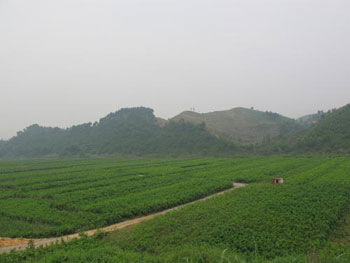
After treatment, a lush mulberry orchard has formed (online illustration)
In Huanjiang County, Guangxi, the polluted land was once so barren that not even grass would grow, and it lay abandoned for nearly ten years. After several years of remediation by the Environmental Remediation Center of the Institute of Geographic Sciences and Natural Resources Research, Chinese Academy of Sciences (CAS), this land finally produced crops and yielded qualified agricultural products.
At a heavy metal polluted remediation site in Guixi, Jiangxi, what was once barren land is now lush and green. What gratifies Zhou Jing, a researcher at the CAS Nanjing Institute of Soil Science, even more is that the surrounding landscape and water quality have changed, with cadmium and copper levels in the streams dropping by 70 to 80 percent.
In a certain place in Hunan, the team led by Huang Daoyou of the CAS Institute of Subtropical Agriculture is using multiple remediation models and technologies, including constructed wetlands to purify irrigation water sources, so that a mining site 5 kilometers upstream no longer poses a threat to the safety of rice in farmland.
"Organizing the relevant forces of CAS into a team battle makes it easier to learn from each other and improve, and is more effective than working alone." Chen Tongbin, host of the project cluster and director of the Environmental Remediation Center of the CAS Institute of Geographic Sciences and Natural Resources Research, recently told a reporter from China Science Daily at the progress exchange meeting of the CAS STS Program project cluster "Risk Zoning and Remediation Technology for Heavy Metal Pollution in Southern Soils" held in Changsha.
The pain of transformation
Now, without having to visit the site in person, Lei Mei, deputy director of the Environmental Remediation Center of the CAS Institute of Geographic Sciences and Natural Resources Research, can observe in real time online from her Beijing office, through the soil remediation supervision platform, the growth of Pteris vittata at heavy metal polluted soil remediation sites in Shimen, Hunan, and Huanjiang, Guangxi, and can obtain parameters such as temperature, humidity, wind speed and rainfall.
Such results have not come easily.
At the just-concluded Two Sessions, a fresh term emerged: "Darwinian Dead Sea." Xu Xudong, deputy director of the CAS Institute of Hydrobiology, used it to describe the difficult zone in the process of technology transformation.
Lei Mei has personal experience of this: generally, in areas with heavy metal polluted soil, the facilities, industrial chains and other supporting technologies necessary for transformation do not yet exist, making the work especially hard to carry out, because it is not only necessary to research pollution remediation technologies, but also to drive forward both the preceding and subsequent supporting technologies in order to form an industrial chain.
"If we do not do this transformation, who else would be willing to do it?" Lei Mei asked herself.
Many polluted areas are not economically developed regions, and transforming technological achievements faces many difficulties. This leads to relatively high technological risk, and many enterprises are unwilling to step into the field of farmland pollution remediation, while local governments cannot possibly allocate too much funding to support it.
"That being the case, we must tailor forms of achievement transformation suited to local development, based on the agricultural characteristics of the polluted areas and the level of acceptance among farmers." Lei Mei stated.
Coping with the technology "death trap"
"The last mile from technology to application is often the hardest. The junctions between different fields and different stages are the weakest." Chen Tongbin sighed.
The difficulties are further amplified as technological achievements are applied. Chen Tongbin stated that although the original innovation component of the technology relatively declines, there are more and more interfering and constraining factors, the problems become more and more complex, and the time and funding investment required grows larger and larger. At the same time, the control capacity and importance of scientific and technological personnel relatively decline, and the risk of failure rapidly increases.
In his view, the technology "death trap" and the "Darwinian Dead Sea" are universal laws. The difficulty of transforming scientific and technological achievements is basically a common problem faced globally; it is just that the disconnection between science-technology-product (engineering)-industry in China is more serious.
The STS Program, namely the CAS Science and Technology Service Network Initiative, was born precisely to address the difficulties of technology transformation. It is one of the important measures of CAS to deepen the reform of the science and technology system, aiming to further enhance CAS's capacity for the transfer and transformation of scientific and technological achievements and to serve national and local economic and social development.
One of the characteristics of the STS Program is that, driven by national, social and market demand, it mobilizes and organizes the scientific and technological forces of the entire CAS, integrates and assembles innovation elements, adjusts and optimizes business models, and carries out systematic, networked and holistic work.
"Now, once many laboratory research results are introduced into practical engineering applications, they become completely different. The STS Program is meant to address problems in this regard, oriented toward user needs." said a management personage who declined to be named.
In the view of Luo Yongming, director of the CAS Yantai Institute of Coastal Zone Research, this work can distill and integrate many innovations drawn from practice, and is not merely simple technological connection. "This is precisely the characteristic of CAS's work."
Providing support for decision-making, the market and society
CAS has long-term accumulated experience in the remediation of heavy metal polluted soil, and has built an advantageous team, developing multiple soil pollution remediation and resource utilization technologies, including phytoremediation and combined physicochemical remediation. Industry experts believe that in the remediation of heavy metal pollution in farmland soil, CAS's work is leading.
The current situation, however, is that demonstration must go hand in hand with exploring more economical and simpler technologies. "CAS only provides technical support and should not replace the engineering implementation role that enterprises should bear in soil remediation projects. If we did all the engineering ourselves, we would no longer be scientists." the experts stated, adding that at the same time, technologies must be both simple and advanced and easy to use.
It is understood that CAS will further promote the construction of a national comprehensive demonstration zone for the remediation of heavy metal polluted soil, carry out "zoning, classification and grading" remediation according to different typical polluted areas, different pollution types and pollution degrees, and, with the support of relevant national departments, initially establish a nationwide network demonstration platform. (Staff reporter Wang Hui)