Gaogang builds a thousand-mu camellia oleifera base, guiding villagers to gradually withdraw eucalyptus from the market
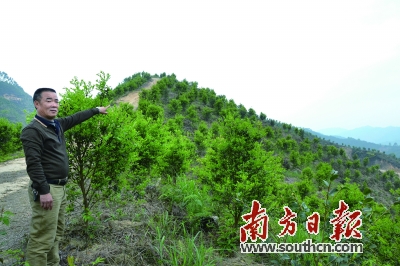
He Gaoshan introduces the growth of camellia oleifera in this year's Luxia camellia oil orchard to reporters.
The brothers He Gaoshan and He Gaowu are well-known wealthy households in Gaogang Town. Recently, "Shan Ge" He Gaoshan cut down some of the existing eucalyptus near Xianzibei in Sanlian Village Committee and planted several hundred mu of camellia oleifera trees, which left local villagers quite puzzled. Could camellia oleifera really be more economically profitable than eucalyptus? With this question in mind, the reporter went together with staff from the Gaogang Town Government to the two camellia oleifera planting bases in Gaogang Xinlian and Luxia to learn about the current status of the thousand-mu camellia oleifera base from the brothers He Gaoshan and He Gaowu.
This year, the He Gaoshan brothers invested more than 3 million yuan to plant more than 1,200 mu of camellia oleifera trees in contiguous plots in Xianzibei of Sanlian Village Committee and Gaogang Luxia Village. They are currently the farmers planting the most of this variety in Fogang County. They hope to plant camellia oleifera with better economic returns, guide local villagers to gradually withdraw eucalyptus from the market, and lead villagers to common prosperity.
"Shan Ge's" third venture
In Gaogang Xinlian Village, anyone who meets He Gaoshan affectionately calls him "Shan Ge." The He Gaoshan brothers made their first pot of gold through agriculture, so local people hold them in great respect. "Shan Ge," the person in charge of the camellia oleifera base, introduced that as early as 2000, the two brothers took out a loan of 50,000 yuan to plant 100 mu of sugar oranges, becoming the earliest large-scale sugar orange growers in the Gaogang area and earning their first pot of gold in life. Later, before huanglongbing spread on a large scale, they decisively switched to planting more than 2,000 mu of eucalyptus and opened a wood processing factory, becoming well-known wealthy households.
"Camellia oleifera planting is the third venture in my life. I succeeded in the first two ventures, and I am currently very optimistic about the development prospects of this camellia oleifera industry," Shan Ge said.
Shan Ge introduced that in recent years the government has realized that eucalyptus forests have many adverse effects on the ecology and intends to guide villagers to gradually withdraw from eucalyptus planting. Now he is trying to transition to camellia oleifera planting, hoping that by establishing a complete industrial chain he can lead local farmers onto a new path to prosperity.
Building a thousand-mu camellia oleifera base
Shan Ge introduced that Gaogang has a history of planting camellia oleifera for several years. The camellia oil orchard in Luxia Village began in 2008 when a person from Guangzhou contracted the land to plant camellia oleifera, but in the past two years it was neglected in management, the camellia oleifera trees were covered by weeds, and the trees turned yellow.
In Shan Ge's view, as people's living standards improve, everyone pays more and more attention to the use of healthy, green food. As the "king of oils," camellia oil is rich in monounsaturated fatty acids essential to the human body, is a very healthy green food today, and has broad market prospects. In Fogang, camellia oil is also often used among the people to dispel wind, sterilize and reduce inflammation, care for hair, and protect skin and retain moisture, and it also has a certain reputation locally.
In August 2015, the He Gaowu brothers took over the operation of the camellia oil orchard in Luxia Village, hired people to weed and fertilize, and replanted more than 10,000 new seedlings.
He Gaowu introduced that camellia oleifera trees have strong adaptability and are easy to manage. They only need base fertilizer twice a year, weeding twice, and one spraying of pesticide for aphids when the flowers fade. At present, the camellia oil orchard in Luxia Village has nearly 10 excellent varieties including Changlin Series No. 3, No. 4, No. 27, No. 40, and No. 55, Ganshi 84-8, Ganyong No. 6, and Ganfu No. 20. Through mixed planting of tea trees, the yield of camellia oil is increased.
As for the yield issue that villagers care about, Shan Ge did some calculations: one mu of land can generally plant 100-120 camellia oleifera trees. Input for seedlings, fertilizer, and labor requires 1,500-2,000 yuan. per mu, and after 3-4 years the fruit can be harvested. Camellia oleifera generally reaches full production after about 8 years of planting. At that time, one jin of camellia seeds can press two and a half liang of oil, and the yield of camellia seed oil per mu is more than 100 market jin. At the current market price of 80 yuan per market jin, the annual return per mu is more than 5,000 yuan, and the economic benefit is very considerable.
Shan Ge introduced that after a period of careful management, in October last year they harvested a batch of camellia fruit, obtaining nearly 3,000 jin of camellia seed oil.
Registering a trademark and building an oil pressing processing factory
In order to make the camellia oleifera industry bigger and stronger and extend the industrial chain, the He Gaowu brothers decided to introduce shelling machines, dryers, oil presses and other equipment and establish an oil pressing factory with two fully automatic oil pressing production lines. At present, the site for the oil pressing factory has been selected, and the land is currently being leveled.
In February this year, the He Gaowu brothers registered the trademark "Guanyinshan High Mountain Camellia Seed Oil." The next step will be to package the camellia seed oil, supply it to supermarkets and sell it online, and build it into a specialty souvenir of Gaogang and Fogang.
Shan Ge introduced that this year they also established a 15-mu seedling nursery, have already provided nearly 50,000 camellia oleifera seedlings to nearby villagers, and provided technical guidance. When the full production period arrives, they will consider purchasing fresh camellia fruit from farmers at market prices to solve the sales problem of camellia oleifera.
Shan Ge said that the scenery when camellia oleifera trees bloom is very magnificent. He also plans to build a farmhouse restaurant in the Sanlian camellia oil orchard, raise chickens and sheep, use the water storage pond to raise fish, attract tourists for fishing and sightseeing, and develop sightseeing ecological agriculture.
"I hope the government can increase publicity for the camellia oleifera industry so that farmers understand the prospects of this industry. At the same time, in guiding the switch to new crops, it can give certain subsidies and policy support to camellia oleifera planting," Shan Ge said.