Wang Anhua sows the seeds of agricultural technology across the African land
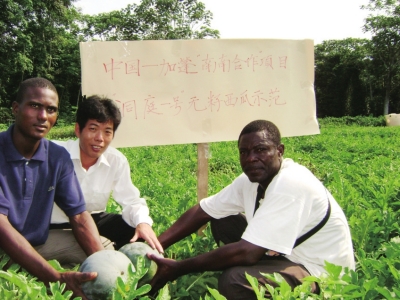
Wang Anhua and growers pose for a group photo in a seedless watermelon demonstration field
On the African land thousands of miles away, there is a group of popular Chinese people: with sincere hearts, they bring advanced agricultural technology and equipment, and with sheer drive, they create conditions for trials and demonstrations without waiting or relying on others, helping local farmers live prosperous lives.
Wang Anhua, a senior agronomist from Hunan, is one of them. He has been to Africa twice, participating in the "South-South Cooperation" agricultural aid projects under the framework of the United Nations Food and Agriculture Organization. In his words, his greatest achievement is "sowing the seeds of agricultural technology, so that more African farmers can see the hope of the land."
From 2007 to 2009, Wang Anhua participated as a vegetable expert in the "China-Gabon South-South Cooperation" project, assigned to the project site in Lambarene, Gabon. After extensive research, Wang Anhua found that high-quality watermelons had a broad market in Gabon, and Gabon's soil and climate were highly suitable for producing seedless watermelons. He resolved to use seedless watermelons as the breakthrough point for technical assistance.
Wang Anhua quickly wrote the project report "High-Yield Cultivation and Industrial Development of Seedless Watermelons in Gabon," which won high recognition and approval from Gabon's Ministry of Agriculture and the FAO. Just as he was full of confidence and preparing to implement the project, a technical expert from Gabon's Ministry of Agriculture kindly reminded him: "In Gabon, even growing ordinary watermelons is very difficult; the watermelons simply don't grow big. Despite the high prices, farmers generally don't grow watermelons, and seedless watermelons are unheard of."
Why, when the climate and soil were so suitable, could high-quality large watermelons not be grown? Wang Anhua didn't believe it at first. He conducted seedless watermelon cultivation trials, and the result was exactly as the Gabonese agricultural experts had said: the watermelons stopped growing once they reached the size of a fist.
The problem troubled this "veteran agronomist" with 25 years of experience in watermelon cultivation technology extension. He set to work himself, clearing a 400 sq m trial plot in the courtyard of his residence. From sowing onward, he monitored it almost 24 hours a day, making observations, records, and analyses, not letting any detail slip. During the two months of the experiment, he contracted malaria twice from mosquito bites, yet he did not give up.
Hard work pays off, and the root of the problem was finally discovered - the African Mediterranean fruit fly. The Mediterranean fruit fly is a pest unique to Africa; during the young fruit stage of the watermelon, it lays eggs inside the tender melon. As the young melon grows, the eggs begin to hatch into larvae, and the larvae desperately gnaw at the flesh, so the melon stops growing. This entire process is very difficult to detect from the outside.
Having identified the problem, Wang Anhua immediately took technical measures and managed to grow large, sweet seedless watermelons, thus ending the history of Gabon not producing seedless watermelons. Over two years, Wang Anhua trained 15 large-scale seedless watermelon producers and 5 technicians in Gabon. The promoted seedless watermelon planting area reached 20 hectares, with an average output value of about 20,000 USD per hectare. Seedless watermelons became a sweet undertaking for Gabonese farmers to increase income and get rich, and were subsequently listed by the Gabonese government as a priority project for revitalizing the agricultural economy. In Gabon, farmers also affectionately called Wang Anhua the "King of Seedless Watermelons."
From 2012 to 2014, Wang Anhua accepted the even tougher aid task of the "China-Liberia South-South Cooperation." Liberia is a poor country that endured 14 years of war, with a strained economy and a devastated livelihood.
As the head of the agricultural aid expert group, Wang Anhua led a 7-person team in Bong County, Liberia, overcoming harsh conditions such as no electricity, no water, and prevalent disease. They established their own demonstration garden and used it as a platform to carry out the display, promotion, and skills training of new technologies.
Under the conditions at that time, creating a demonstration garden was no easy task. Many friends who came to visit Wang Anhua didn't understand: "Your situation is already hard enough, why go looking for more hardship?"
But Wang Anhua stubbornly mobilized all the experts and trainees. With crude tools, they moved nearly 500 cubic meters of earth and stone, dug 300 m of drainage ditches, and made 30 cubic meters of organic compost. During that period, everyone's hands developed calluses and blood blisters. Soon, 8,000 sq m of abandoned land overgrown with weeds and strewn with bricks and stones took on a completely new look. Plots of demonstration fields were neatly arranged, and various crops were full of vitality.
The demonstration garden was not only a platform for displaying new varieties and practical technologies, but also became a base for professional practical training. Over two years, the demonstration garden held 46 training sessions on practical techniques and operational skills for trainees and local farmers, completed trial demonstrations of 21 crop varieties including grains and vegetables, successfully implemented 11 micro-projects in six professional fields - vegetables, rice, corn, watermelon, and livestock breeding - and displayed and promoted 15 practical agricultural technologies suitable for Liberia. Through trial demonstrations, seedless watermelon cultivation achieved a zero breakthrough in Liberia; the promotion of the dry-raised, tray-free seedling-throwing technique for rice greatly improved the production efficiency of rice cultivation and fundamentally transformed Liberia's rice cultivation methods.
Advanced planting techniques also brought improvements to local farmers' lives. The farmer MOSES, a family of six, had long tended nearly 2 hectares of land, but due to extensive techniques, a whole year of busy work only allowed them to maintain basic subsistence. With Wang Anhua's help and by participating in training at the demonstration garden, the 2,000 sq m of new-variety peppers and seedless watermelons he planted earned him a net income of 3,100 USD in just half a year, causing a great sensation locally. MOSES excitedly told the reporters who came to interview him that this was the first time in his life he had earned so much money, and that he could not express in words his gratitude to the Chinese experts.