Lazy Fish Helps a Post-90s Young Man Turn His Life Around
In 2012, at the age of 24, after graduating from university, he worked in Ningbo. With a monthly income of 2,000 yuan, he became a member of the boomerang generation. He returned to his hometown to start a business, setting his sights on an interesting type of fish. When he encountered difficulties, he was so lost that he didn't know what to do; when he got his first taste of success, he was full of pride. See how Lu Zehui, a post-90s young man, used wisdom and hard work to become a local industry leader in just 3 years.
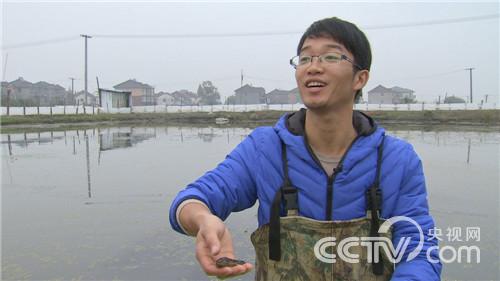
Lu Zehui: If it's not too loud, the crabs still won't really run away.
Reporter: There are so many!
This young man named Lu Zehui catches crabs differently from others. He doesn't catch them during the day; he insists on catching them at night.
Lu Zehui: During the day, as soon as you walk over, the crab basically runs away. But now it's nighttime, just like people, it feels like after climbing up it's resting, so it's easier to catch. That's why you shouldn't stimulate it with strong light. Once strong light stimulates the crab, it's equivalent to waking it up, and then it's harder to catch.
Lu Zehui told us that according to the crabs' habits, before the end of September and after December each year, the crabs stay in the water the whole time. But during October and November, at night, the crabs come ashore.
Reporter: I see some crabs raise their claws at the slightest thing.
Lu Zehui: Just like a cobra, after you scare it, its head rises up. This crab has the same trait. After you scare it, its two claws point up to the sky. That means it's ready - if you touch it again, it will attack you. If you grab it, you'll definitely get pinched, right? It will definitely, look, it will definitely go for you, so this crab is quite aggressive. See, if you slowly look away from it, it will lower them and put its claws down.
Today Lu Zehui's customer wants large-sized crabs: male crabs of 4 liang and female crabs of 2.8 liang.
Reporter: Will this one do?
Lu Zehui: This one won't do, it's still too small. This one is only about 3 liang at most, I estimate.
Reporter: It's about the same.
Lu Zehui: The one on your right is a bit bigger. This one might be 3.5 liang.
Reporter: Feels about the same.
Don't be fooled by the difference of just half a liang - for crab prices, the difference is huge. A male crab of 3.5 liang sells for 70 yuan per jin, while a male crab of 4 liang sells for 120 yuan per jin.
Lu Zehui: This should be ten or twenty jin. Don't underestimate these ten or twenty jin - these ten or twenty jin can sell for 300020 yuan per jin. They're in high demand, and the price keeps rising. Now it's basically a different price every day, going up five yuan a day, five yuan a day. This crab is pretty big. This crab is 4 liang, the kind that can be sold on the market. Right now it's because large crabs are scarce on the market.
In early 2012, as Lu Zehui walked through the village, even he didn't expect that a few months later he would return here. The reason was that after Lu Zehui graduated from Ningbo City College of Vocational Technology with a major in Computer Applications, he stayed in Ningbo to work. With a monthly salary of just over 2,000 yuan, Lu Zehui couldn't cover his expenses at all and still had to rely on his parents. Not long after, Lu Zehui spotted a business opportunity and decided to return to his hometown to start a business. In just three short years, he became a leader in the local crab farming industry. He was the first to experiment with a new polyculture method, raising the income per mu of crab pond from the initial four to five thousand yuan to over ten thousand yuan.
Chen Chao, Mayor of Hongqiao Town People's Government, Changxing County, Zhejiang Province: He chose to return to his hometown to start a business. For our entire river crab industry, this has injected new vitality. Last year he trial-farmed about 50 mu, and the local people saw his profits, so this year their enthusiasm for farming has also increased, expanding to 3,000 mu.
The son rows the oars, the father fishes - this scene has been repeated for many years. However, starting in 2012, Lu Zehui stopped letting his father farm, because he thought his father's farming methods were too traditional.
Father Lu Xinquan: When you put in silver carp fry, the fish do grow, but they're not worth much. As for the crabs, by the end of the year, it depends on the weather. Some years are okay, but some years you even lose money.
Lu Zehui stopped letting his father farm, but he himself quit his job and came back to continue crab farming. In March 2012, Lu Zehui persuaded his parents to support him and helped him raise 600,000 yuan to build over 100 mu of crab ponds. His parents couldn't talk him out of it, so they had to let Lu Zehui give it a try. His father had farmed for over ten years without making much money - could a college student who had just stepped into society and was still somewhat inexperienced really succeed?
Crabs, freshwater shrimp and mandarin fish - these three are usually farmed separately, but Lu Zehui discovered that polyculture of the three was very popular locally, so he did the same. At that time, Lu Zehui was full of pride, feeling that he had a foundation and could endure hardship, so making money would be no problem.
Lu Zehui: When I first came back, I was thinking a bit too highly of myself. I felt that if I entered this industry, I would definitely be more dedicated than them, notice things they wouldn't notice, so I thought I could definitely do better than them in many ways.
After intensive farming in the crab ponds, the crab survival rate suddenly increased by 30% compared to before, and Lu Zehui's confidence soared. But not long after, in September 2013, Lu Zehui noticed a phenomenon: on the field ridges outside the farm, there were some crabs wandering around. Where did they come from? Lu Zehui quickly became alert - they were his own crabs. Lu Zehui was puzzled. Although burrowing is a crab's nature, other people's crabs were fine, so why were his own crabs burrowing so many holes and escaping?
Lu Zehui: A mud ridge 3 to 5 m wide can easily be burrowed through by crabs. Once a hole like this is made, the crabs line up in a queue, and within a few days a huge number will escape.
Reporter: Can't you just plug it up? Is there enough time?
Lu Zehui: Plugging it up only treats the symptoms, not the root cause. If you plug it, it might be fine for a while, but in another week or two, they may burrow somewhere else.
After inspecting, Lu Zehui found that the crabs in two crab ponds had basically all escaped, with a loss of sixty or seventy thousand yuan. Over the course of a year, after all his efforts, Lu Zehui still ended up losing money. Using his parents' hard-earned money to start a business, yet ending up in this situation, Lu Zehui felt an indescribable pain in his heart.
Lu Zehui: I felt like I was ruining the family, and I was very sorry to them. I hadn't done well what I had originally planned to do, and I felt very ashamed.
At that time, Lu Zehui was under a lot of pressure. He often observed at the crab ponds, wanting to find the reason why the crabs were burrowing and escaping. And that reason was actually a complex chain reaction - the root problem was related to the mandarin fish. This is the underwater world of polyculture of crabs, freshwater shrimp and mandarin fish. Although the mandarin fish do not harm the crabs, they indirectly affect the aquatic plants that the crabs depend on for survival.
Lu Zehui: At the beginning, we specifically put in small fish, wild miscellaneous fish for the mandarin fish to eat. Once the mandarin fish are not polycultured well, those wild miscellaneous fish will survive in large numbers and reproduce very, very quickly. In the later stage, they will cause massive damage, biting off all the roots of the aquatic plants.
After the aquatic plants died, the crabs followed their nature and frantically burrowed holes everywhere.