Couple in Yangji, Fangcheng County Turn Barren Hills into a Gold Mine Through Greening
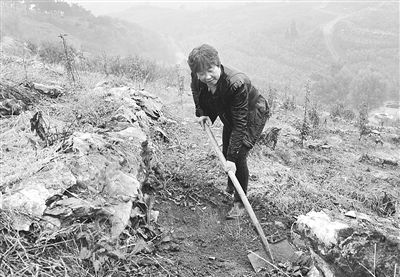
Sun Jianhua repairs a mountain road after rain
On March 25, light rain was falling. After breakfast, Sun Jianhua and her husband, who live in Yinzhuang Village, Yangji Township, Fangcheng County, picked up their shovels and headed straight for "Danyang Temple" Mountain behind their house. The road was slippery, so the couple could only walk carefully along the path, supporting each other.
"Rainy days give the best soil moisture retention, but the road is just no good, and I slip and fall often," Sun Jianhua told this reporter.
Sun Jianhua and her husband have kept up this life for 6 years. Today, the 5,000 mu of rocky barren hills they contracted are covered in green shade. Not only that, Sun Jianhua and her husband also led 74 farming households to establish a forest fruit planting cooperative, growing soft-seeded pomegranates, thin-shelled walnuts and other high-value forest fruits, finding a path to prosperity for the villagers.
"This is 'Danyang Temple' Mountain, and it is now basically covered with mature and young trees," Sun Jianhua told this reporter. Ever since she contracted this barren hill, the mountain has become her home.
As one of the county's earliest batches of farmers to go out to work, Sun Jianhua in her early years did odd jobs, sold eggs, and even contracted cantaloupe fields with her husband in **. With their hardworking hands, the couple slowly saved up some money. In early 2010, she and her husband decided to return home and contract barren hills for greening.
"Seeing the ** Gobi Desert turned into orchards, I firmly believed the barren hills back home could also turn green." Speaking of that decision, Sun Jianhua was very calm.
At that time, "Danyang Temple" Mountain had many ugly nicknames - "Water-Short Ridge," "Bald Mountain." In those years, urban greening was already difficult, let alone barren hills, but Sun Jianhua resolutely took out years of savings and signed contracting agreements with the Yinzhuang Village Committee one after another to reclaim 5,000 mu of barren hill afforestation land.
Easier said than done, however, and difficulties piled up. Drought was the problem in greening barren hills. With no water, Sun Jianhua hired vehicles to haul water from several kilometers away to the foot of the mountain. One bucket of water could only irrigate one sapling, and every day she had to carry a 30-plus jin water bucket up the mountain and down the gullies. With no road, she drew a sketch of a winding mountain road herself and then led an excavator operator to open the way, building an 8-kilometer dirt road along the rugged mountain ridge. To conserve water, she and her husband used hoes to break ground and their hands to build up terraces, carving layer upon layer of terraced fields out of the barren hill. Wherever the trees went, the terraces went too...
Over 6 years, Sun Jianhua and her husband advanced funds and raised money, investing more than 10 million yuan in total to lay dirt roads, build terraces and dig water cellars on the slopes of the 5,000 mu they contracted. From the first few hundred trees that survived to more than 100,000 mature trees now, the couple poured in untold effort.
With the barren hills turned green, Sun Jianhua began looking for suitable economic tree species.
In March 2011, after consulting experts and making a field visit all the way to Xingyang, she introduced 5,000 soft-seeded pomegranate saplings from the Henan Academy of Agricultural Sciences at 12 yuan each for trial planting. The next year, the soft-seeded pomegranate planting scale reached more than 1,000 mu.
In September 2015, the first batch of soft-seeded pomegranates Sun Jianhua planted began to bear fruit. The largest weighed 1.8 jin, and with juicy, sweet flesh, they sold for a good price of more than 10 yuan per jin.
Sun Jianhua naturally would not miss such a unique advantage. In July 2015, she and her husband introduced more than 100 mu of Yudanshen seedlings for trial planting, with very good results, and this winter they plan to expand the planting area to 2,000 mu. At the same time, they also planted Chinese angelica, peony, angelica sinensis, Hangzhou white chrysanthemum and other medicinal herbs, and raised pheasants and wild ducks free-range under the trees, energizing the "under-forest economy."
Not only that, the "Forest Fruit Planting Cooperative," jointly initiated by Sun Jianhua and her husband with 74 farmers participating, was also officially established. More than 80% of the cooperative's members are left-behind women. Through cooperative operations, members can not only learn planting techniques, but also earn more than 10,000 yuan in extra income per person each year through pruning, flower picking and fruit thinning.
In September 2015, as soft-seeded pomegranates sold well, some self-driving tourists began going up the mountain to pick them in person, and Sun Jianhua's fame in nearby towns and villages grew. Right now, she is leading members in infrastructure construction, building a "one-stop" economic model of "leisure + tourism + under-forest picking."