Large-scale lotus root grower Xie Qingmian achieves double harvest of fish farming and lotus root growing through "one water, two uses"
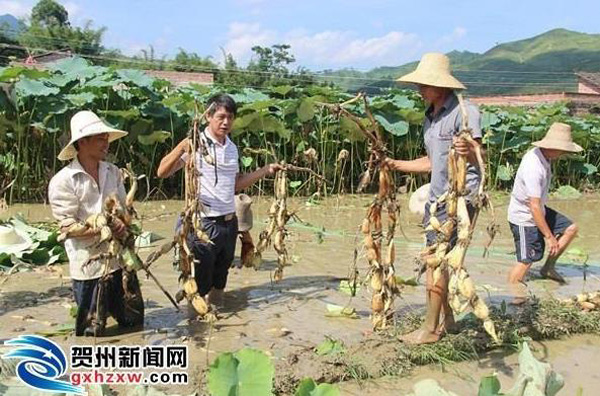
Xie Qingmian (second from left) is digging lotus roots.
In today's rural areas, many people choose to go out to work to earn money and support their families. However, quite a few people, after venturing out into the world, see the good development prospects of their hometown and choose to return to develop farming and breeding businesses. In Xinxin Village, Gonghui Town, Pinggui Management District, there is such a farmer who returned home to grow lotus roots and established a farmers' cooperative. His name is Xie Qingmian. Recently, the reporter walked into Xinxin Village, Gonghui Town, Pinggui Management District, met this lotus root growing expert, and listened to him tell the story of returning home to grow lotus roots.
A bond with lotus roots: act on the idea
"A person who had never farmed actually came home to grow lotus roots." In early 2010, the news that Xie Qingmian had returned home to grow lotus roots spread through the village, and at first no one could believe it. Like many farmers, Xie Qingmian had experience working away from home. He had worked in Guangdong, Fujian and other places, and had been involved in wholesale and sales of vegetables and local specialties. In 2009, by chance, after visiting the 600-mu lotus root planting base of a large-scale lotus root grower in Quanzhou, Fujian, Xie Qingmian's horizons were greatly broadened. "At that time, looking at the endless stretches of connected lotus root fields, more than 100 lotus root diggers each holding a high-pressure water spray pipe inserted into the mud, pulling up thick lotus roots one by one in less than a minute, that scene really shocked me. And I heard that this Fujian merchant earned several million yuan net in just one year from growing lotus roots." Seeing how prosperously the lotus root industry had developed in Hubei, Fujian and other places, with lotus roots not only high in yield and good in price but also selling well in domestic and international markets, and then comparing it with his own hometown, where due to backward planting techniques and other reasons, lotus root yield and quality had always remained low and market response was poor, Xie Qingmian, who had always wanted to return home to start a business, suddenly had an idea - he should also introduce varieties and techniques from elsewhere, return home to start a business developing lotus root cultivation, and lead his fellow villagers to prosperity.
Acting on the idea at once, in the second half of 2009, Xie Qingmian had an in-depth discussion about the idea of developing large-scale lotus root cultivation with his cousin Xie Qingrang, who served as village Party secretary in their hometown, and the two hit it off immediately. Afterwards, Xie Qingmian traveled to Jinan in Shandong, Wuhan in Hubei and other places to conduct market research, "learn from masters" among local large-scale lotus root growers, learn their techniques and experience in large-scale lotus root cultivation, and made a special trip to the Hubei Aquatic Vegetable Research Center to study and consult with experts researching aquatic vegetables, carrying out all-round study and understanding of key techniques such as lotus root seedling cultivation, fertilization, management and harvesting.
Just after the 2010 Spring Festival, based on his hometown's climate, soil and other conditions, Xie Qingmian selected a new lotus root variety that can be planted for two seasons a year from the Hubei Aquatic Vegetable Research Center, and rented 30 mu of paddy fields in the village for trial planting. Hard work pays off. For Xie Qingmian's new variety lotus roots, the first season's harvest reached more than 5,000 jin per mu. In addition to the per-mu yield being one-third higher than traditional lotus roots, the appearance, taste and starchiness of the lotus roots were all better than traditional lotus roots. When introduced to the market, they sold for 5 yuan per kilogram, 5 to 8 mao higher than traditional lotus roots. After deducting costs, each mu of lotus roots earned a net income of more than 20,000 yuan per year.
"The key to growing lotus roots is the variety and the harvesting. With traditional lotus root harvesting methods, one person can dig at most 100 jin a day, and large-scale cultivation is simply impossible." Xie Qingmian said that this year he expanded his lotus root planting area to 200 mu, and by using lotus root harvesting techniques learned from elsewhere, one person can dig more than 500 jin a day, greatly improving lotus root harvesting efficiency.
Growing lotus roots enriches a region: driving villagers to prosperity
No pains, no gains. Compared with lotus roots grown traditionally in Hezhou, the lotus roots grown by Xie Qingmian are not only high-yielding but also sell at a higher price than local traditional lotus roots, which let Xie Qingmian taste the sweetness of growing lotus roots in his hometown. The new variety lotus roots quickly made a name for themselves in the Hezhou vegetable wholesale market, were well received by vegetable dealers and supermarkets from various places, and became a hot commodity in the market, selling out as soon as they were listed.
As the benefits of lotus root cultivation became apparent and he became prosperous, Xie Qingmian, as a member of the Communist Party of China, did not think only of himself, but led villagers to take up lotus root cultivation. Farmers in Shatian Town and Shilong Town in Zhongshan County around Gonghui Town, as well as in Shita Village, Liansheng Village, Tianfu Village, Yanghui Village, Xinnong Village, Limu Village and other places around Xinxin Village, also came one after another attracted by his reputation to learn his lotus root cultivation techniques. He also enthusiastically taught villagers experience in every link from seedling cultivation and management to harvesting, provided follow-up technical guidance, and used his previous connections in the vegetable business to help lotus root farmers sell lotus roots to Wuzhou, Yulin, Nanning within Guangxi and the Guangdong-Hong Kong-Macao region. It is reported that from returning home to grow lotus roots in 2010 to now, Xie Qingmian has driven farmers in surrounding townships to grow more than 3,000 mu of lotus roots.
In order to better introduce and promote excellent lotus root varieties, provide unified technical service guidance for lotus root farmers, package and sell lotus roots, and establish a large-scale operating channel covering planting, production and sales to make the lotus root planting industry bigger. In 2011, Xie Qingmian also established a farmers' cooperative - Runtu Planting Professional Cooperative, with nearly 200 members. Today, Xie Qingmian and the members have rented more than 500 mu of paddy fields in the land leveling area of Shita Village in Gonghui, preparing to introduce high-yield wild rice stem, early-producing arrowhead, water chestnut and other aquatic crops for planting, continuously enriching product varieties and forming a new, advantageous modern characteristic interplanting and co-culture of lotus roots and aquatic products.
Not satisfied with the status quo: "One water, two uses" brings double harvest of fish farming and lotus root growing
In order to improve efficiency, Xie Qingmian had a sudden inspiration: he used his lotus root growing advantage to raise fish in lotus root fields. To increase feasibility, Xie Qingmian went to Shandong, Jiangxi and other places to learn from experience. "This 'growing lotus roots and raising fish' model means stocking loach, crucian carp and other aquatic products that coexist mutually beneficially with lotus roots in paddy fields. The decaying matter produced by lotus roots serves as fish feed, while the fish also provide fertilizer for the growth of lotus roots, giving relatively good economic benefits."
Although Xie Qingmian learned that so far no one in Hezhou had adopted the "growing lotus roots and raising fish" model, he acted as soon as he said it. At the beginning of this year, Xie Qingmian invested more than 1.2 million yuan and rented 48 mu of land, beginning his attempt at "growing lotus roots and raising fish." It is reported that under "growing lotus roots and raising fish," the output value of double-season lotus roots per mu can reach more than 20,000 yuan, and with the co-cultured fish, each mu can increase added output value by about 5,000 yuan.