Mulberry Branches Grow Mushrooms, Turning Waste into Treasure: Waste Material Can Also Generate Income
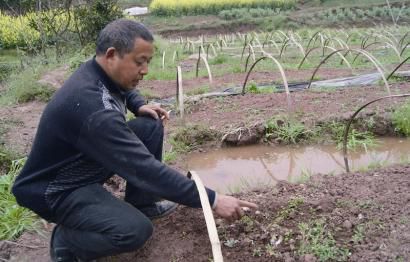
Wang Yueneng inspects the growth of the mushrooms in the field.
Everyone knows that mulberry leaves can feed silkworms and mulberries can be sold fresh, but what can mulberry branches be used for? Villagers of Yuhe Village, Sanlie Township, Dongxing District, Neijiang City began planting mulberry trees in 1999 and started raising silkworms in 2000. Today, the village's mulberry plantation area has reached 67 hectares. Focusing on adding value to mulberry branches, Wang Yueneng, the village Party secretary of Yuhe Village, began his entrepreneurial journey.
The First Person in the Village to Grow Mushrooms from Mulberry Branches
Recently, Wang Yueneng's home has welcomed batch after batch of guests every day. What attracts these guests is the edible mushrooms Wang Yueneng has cultivated using mulberry branches. "Mulberry branch edible mushrooms can be stir-fried with meat or cooked in soup. They are crisp and fragrant, with a very good texture." Luo Fuzhang, a villager from Group 2 of Yuhe Village, is a regular visitor to Wang Yueneng's home. On March 20, he went to Wang Yueneng's home again and bought two kilograms of mulberry branch edible mushrooms.
In 2014, Wang Yueneng went to Zizhong and Nanchong to learn mulberry branch edible mushroom technology. After completing his training and returning, he planted one mu of mulberry branch edible mushrooms in the village and also bought a mulberry branch crusher. "First crush the mulberry branches, then ferment them for a few days, mix them with rice husks, lime and other raw materials, and spread everything together in the field to cultivate mushrooms," Wang Yueneng said.
Wang Yueneng told this writer that he was the first person in the village to try growing mushrooms from mulberry branches. "In the past, the mulberry branches cut by villagers at home were either burned or thrown away in the fields unused. Now I collect them all to grow mushrooms. This not only puts discarded mulberry branches to use, but also allows me to earn more than 10,000 yuan in sales revenue each year from mulberry branch edible mushrooms."
Annual Sales Revenue of 30,000 Yuan
In the first year of trial planting, Wang Yueneng's mulberry branch edible mushrooms had a bumper harvest, with sales revenue that year reaching more than 30,000 yuan. However, because mulberry branch edible mushrooms were still something new in Neijiang, many people could not yet accept them, so sales naturally became a problem. Wang Yueneng remembers that the first time he went to the vegetable market to sell mulberry branch edible mushrooms, he ran into obstacles. At that time, many people looked but few bought. After analyzing the reasons, he found that at 30 yuan per kilogram, mulberry branch edible mushrooms did seem a bit expensive compared with other edible mushrooms, and at the same time this type of mushroom was somewhat black in color and did not look very appealing.
But this did not discourage Wang Yueneng. If once did not work, then try twice. In order to open up sales, Wang Yueneng went many times to Sanlie Township market town, Neijiang urban area and other places to set up stalls and sell. Gradually, more and more people recognized good quality, and many people who had tasted the edible mushrooms also became repeat customers. Some customers even made the long trip specially to his home to buy them, and the reputation of mulberry branch edible mushrooms gradually spread far and wide.
Afterward, Wang Yueneng decided in 2015 to expand the scale and increase the planting area to more than 5 mu. "The mulberry branches from my own mulberry plantation were not even enough, so I had to collect some mulberry branches from other villagers' homes to use as material," Wang Yueneng said.
"There is great potential in mulberry branch mushrooms." Wang Yueneng counted on his fingers and did the accounts. "Each mu of mulberry branch mushrooms requires 4,000 kilograms of mulberry branches and 500 kilograms of rice husks as raw materials. In addition, about 2,000 yuan is needed for mushroom spawn. The investment per mu is about 5,000 yuan. At current market prices, each mu can produce more than 1,000 kilograms of mulberry branch mushrooms, creating an output value of more than 30,000 yuan. After deducting labor costs and expenses, the net income per mu is more than 10,000 yuan."
Joining E-commerce, Products Sell Far Away. "Even the fragrance of mushrooms fears a deep alley." Wang Yueneng deeply understands this principle. Yuhe Village is located in a remote area. Leaving the village to sell mulberry branch edible mushrooms takes both time and effort and is very inconvenient, while the customers who come into the village to buy are also very limited. How could he further expand sales and make the name of mulberry branch edible mushrooms known? He thought of e-commerce, which Party committees and governments at all levels had been actively promoting in recent years.
With the help of the village's "first secretary," Wang Yueneng came into contact with an e-commerce platform for the first time. What he did not expect was that e-commerce sales performed very well. Since the beginning of this year, the e-commerce platform alone has generated several thousand yuan in sales revenue.
For Wang Yueneng, growing mulberry branch edible mushrooms brings both joy and worry. In January this year, a rare heavy snow fell on Neijiang, causing some impact on the mulberry branch edible mushrooms. Fortunately, after the weather turned warmer in March, on average several dozen jin could basically be harvested every day.
"Now the planting technology and sales channels for mulberry branch edible mushrooms are in place, and the e-commerce platform has also been set up. Next, I plan to lead more villagers in developing mulberry branch edible mushrooms and help everyone increase their income," Wang Yueneng said.